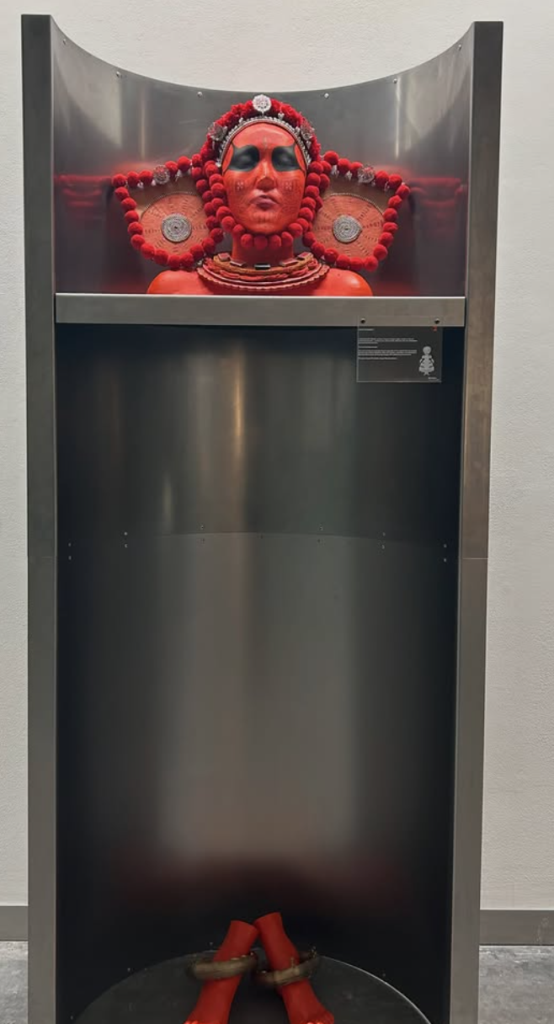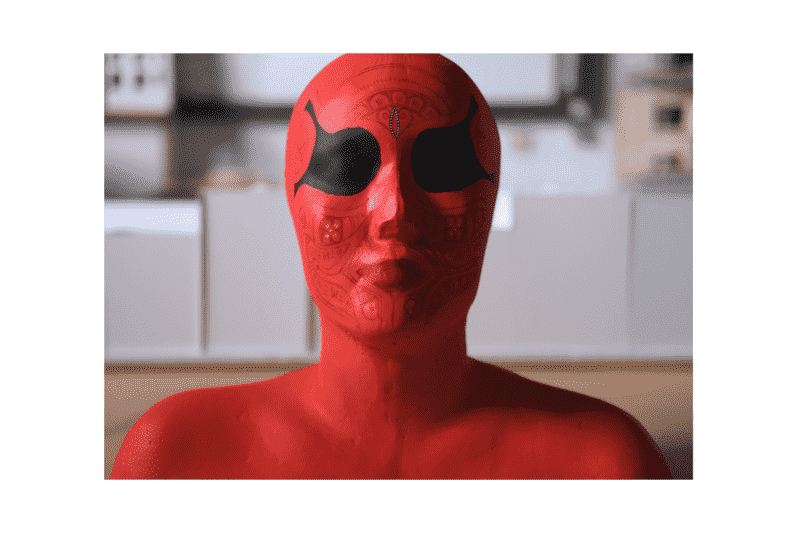
Anisomorphic Space
Anisomorphic Space began with Theyyam, a ritual practice from northern Kerala, but the project gradually became a way for me to question how Interior Design identifies, observes and represents space in the first place.
I began from a decolonial position, questioning what happens when a culturally situated practice such as Theyyam is studied through the frameworks of a Western academic discipline. Drawing from Linda Tuhiwai Smith, I became conscious that mapping and representation are not neutral acts. I therefore wanted to avoid reducing Theyyam to its most recognisable visual elements — costume, colour, symbolism and spectacle — and translating these into another design language. Instead, I asked whether the ritual could be approached as something that already contains spatial knowledge.
This also required questioning my own assumptions about what constitutes an interior. Lois Weinthal’s expanded understanding of interiority allowed me to move away from the architectural shell, while Doreen Massey’s relational understanding of space challenged the idea of space as a stable container. Through Massey, I began to understand the ritual ground as something continually negotiated through simultaneous relationships between performers, spectators, movement, sound and time.
However, describing space as relational was not enough. I wanted to understand how those relationships actually change during an event.
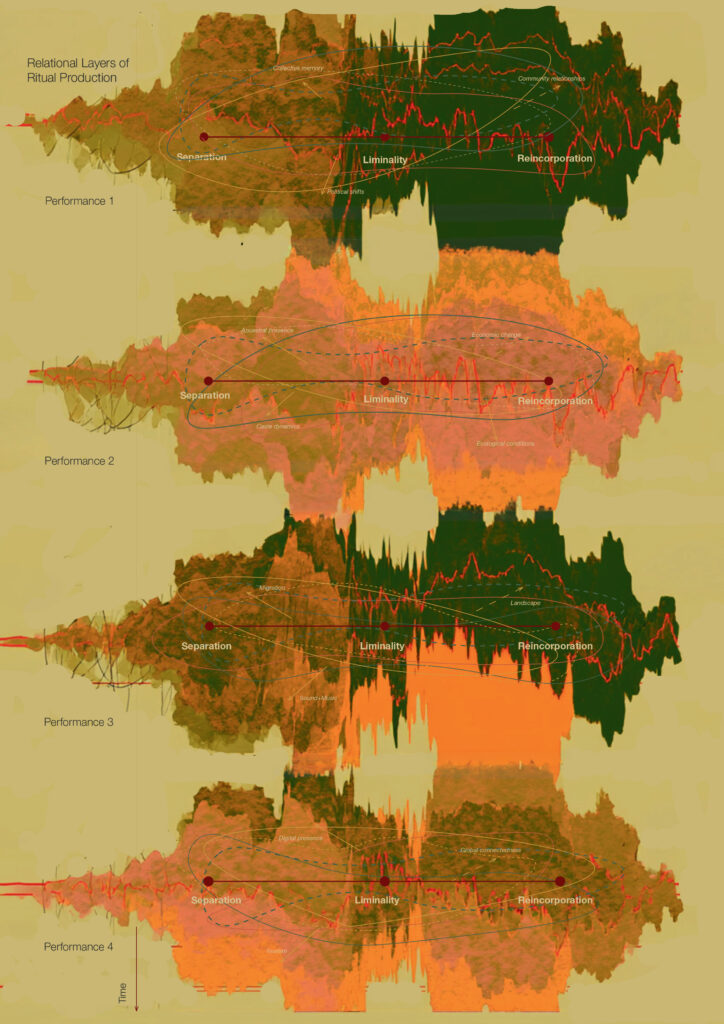
I therefore narrowed the research to two observable conditions: movement and sound. Laban Movement Analysis provided a way of examining bodily movement, while Brandon LaBelle’s acoustic territories helped me consider sound as something capable of producing spatial conditions beyond visible or architectural boundaries. Time-geography, dynamic cartography and critical mapping then became ways of testing how these conditions could be followed through time.
The mapping process also exposed a problem within representation itself. A map can easily make something unstable appear fixed, objective and measurable. Rather than treating my drawings as definitive representations of Theyyam, I began to use mapping as a critical and interpretive design practice. Gaps, overlaps, temporal differences and moments of uncertainty became as significant as the information that could be clearly recorded.
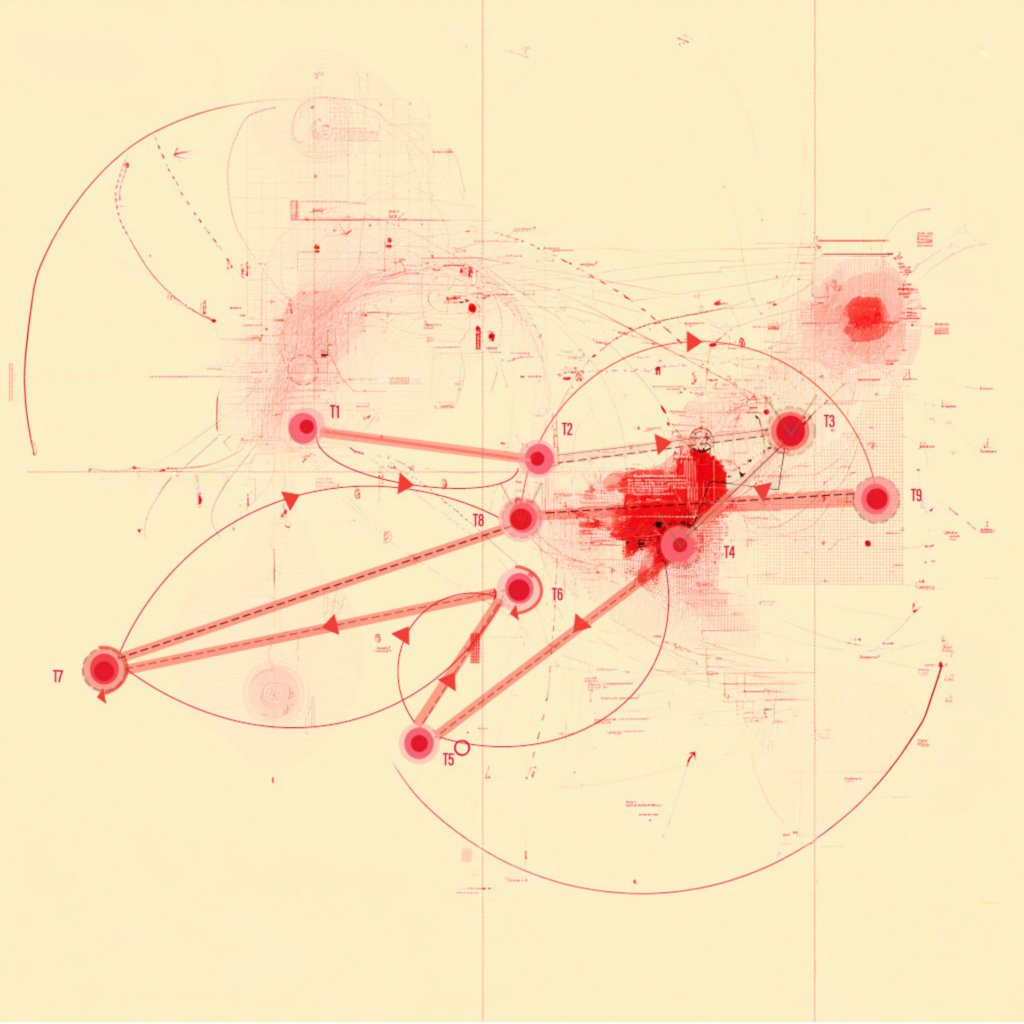
When movement and sound were compared, they did not produce the same spatial condition. At some moments their trajectories aligned; at others they separated, overlapped or changed at different times. This led to Anisomorphic Space — my proposition for describing a spatial condition produced by multiple trajectories that are relational but not necessarily equivalent in form or behaviour.
The project does not propose Anisomorphic Space as a universal model, nor does it attempt to translate Theyyam into a transferable design vocabulary. Instead, it asks what becomes visible when Interior Design temporarily suspends its dependence on enclosure and treats movement, sound, time and uncertainty as spatial evidence.
In this sense, the project is less about designing for Theyyam and more about questioning the tools through which design claims to understand it.
Anisomorphic space
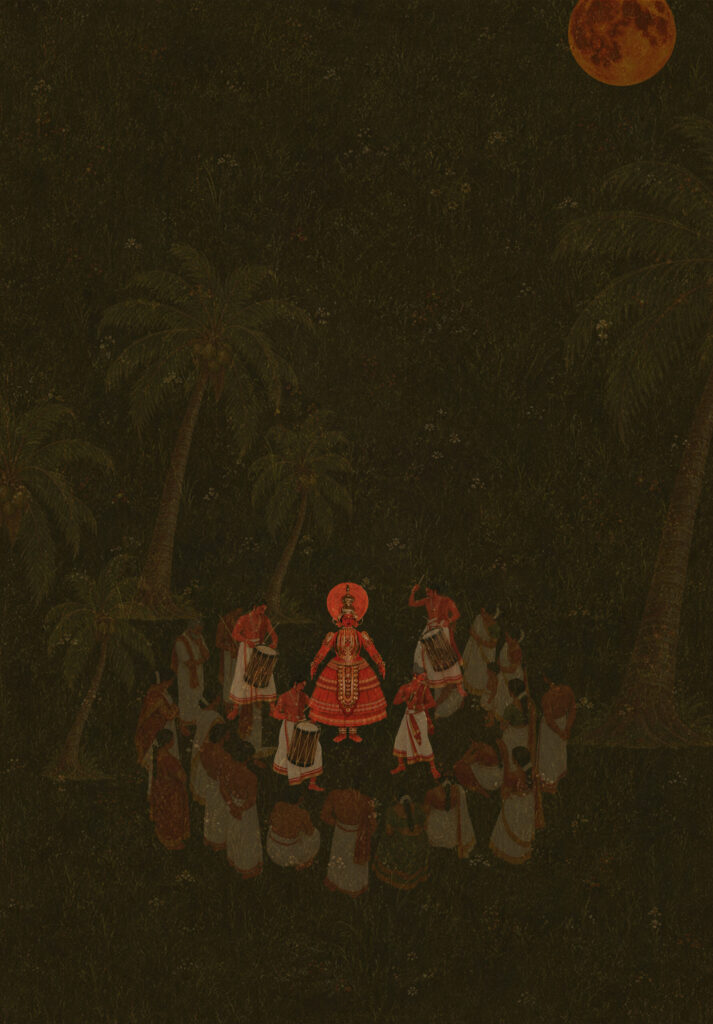
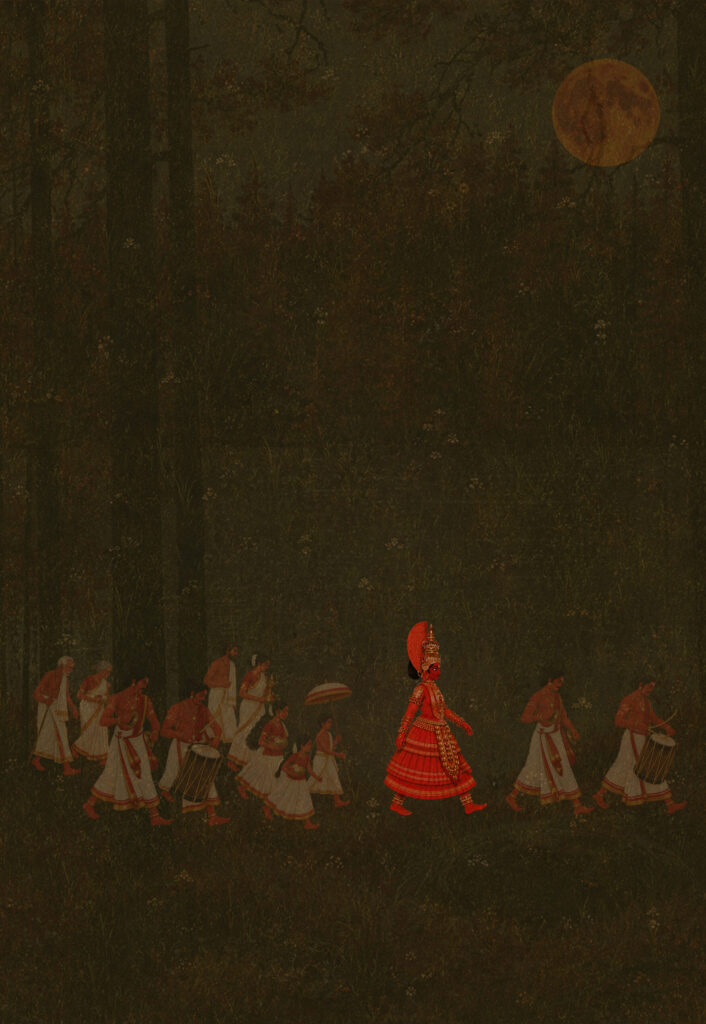
The spatial condition of Theyyam does not emerge suddenly at the moment of performance. It is formed through a much longer process of practice, preparation, worship, belief and embodied knowledge accumulated over time. The film moves through a series of speculative visual scenes — from a performer withdrawing from everyday life in the days preceding the ritual, through preparation and make-up, to the performance itself. These scenes are not intended as a reconstruction of an individual performer’s experience, nor as an attempt to translate Theyyam into spectacle or entertainment. Rather, they acknowledge that what becomes visible during the ritual is preceded by conditions that cannot be fully understood through observation of the performance alone. From a decolonial position, the film therefore resists presenting Theyyam as an isolated visual event available for consumption. It recognises the limits of representation and does not claim access to the spiritual or embodied knowledge held by its practitioners and communities. The film asks us to encounter the performance not as a beginning, but as one visible moment within a much longer continuum of practice, belief and lived experience.
This short film explores Anisomorphic Space, a spatial proposition developed through my research into Theyyam, a ritual practice from northern Kerala. The film begins with the familiar idea of the interior as something defined by architectural enclosure. It gradually moves beyond this fixed boundary to consider space as something continually produced through movement, sound, time and changing relationships. Movement and sound are followed as separate trajectories. At certain moments they come into proximity; at others they diverge, overlap, persist or change at different times. Rather than resolving these conditions into a single spatial boundary, the film focuses on the changing relationships between them. Anisomorphic Space describes this condition: a space produced through relationships between trajectories that coexist but do not necessarily correspond. The film translates the mapping process of the thesis into movement, allowing the spatial argument to unfold through time rather than through a single static representation.