波 (The Wave)
Nami — Writing, Memory and the Contemporary Interior
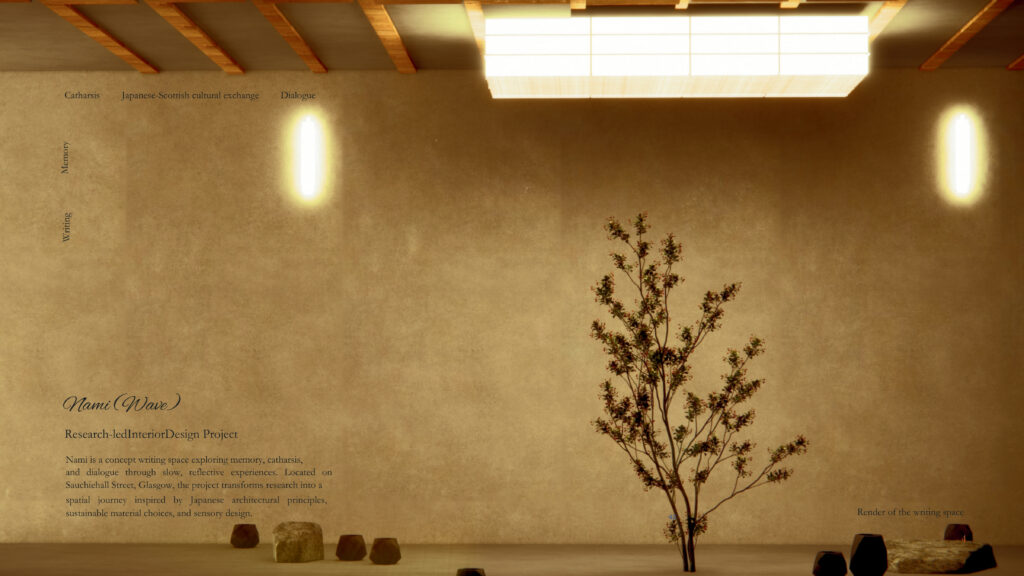
Nami explores writing as a spatial and material practice through which memory is produced, retained and revisited. At a moment when communication is increasingly mediated through digital devices, the project asks what might be recovered when the physical rituals of writing—the movement of the hand, the selection of paper and ink, and the keeping and sending of written traces—are given spatial significance.
Situated on Sauchiehall Street, the project began by examining Glasgow’s historical relationship with Japan, particularly through the influence of Japanese art and spatial thinking on figures such as Charles Rennie Mackintosh and Margaret Macdonald Mackintosh. Rather than using this connection to reproduce a Japanese aesthetic, Nami uses it as a point of departure for reconsidering how ideas can move between cultures, places and periods.
A central reference is The Missing Post Office in Japan, an art project that receives letters addressed to people, places, objects and memories that can no longer be reached. Here, writing exists without the expectation of a conventional reply. The letter becomes a physical trace of memory, absence and an individual’s desire to communicate.
This shifted Nami away from understanding writing simply as the production of text. Writing instead becomes an act of externalising memory: something can be written, held, stored, exchanged or released. The post office therefore becomes less a model to reproduce and more a conceptual provocation for thinking about what happens to words after they leave the writer.
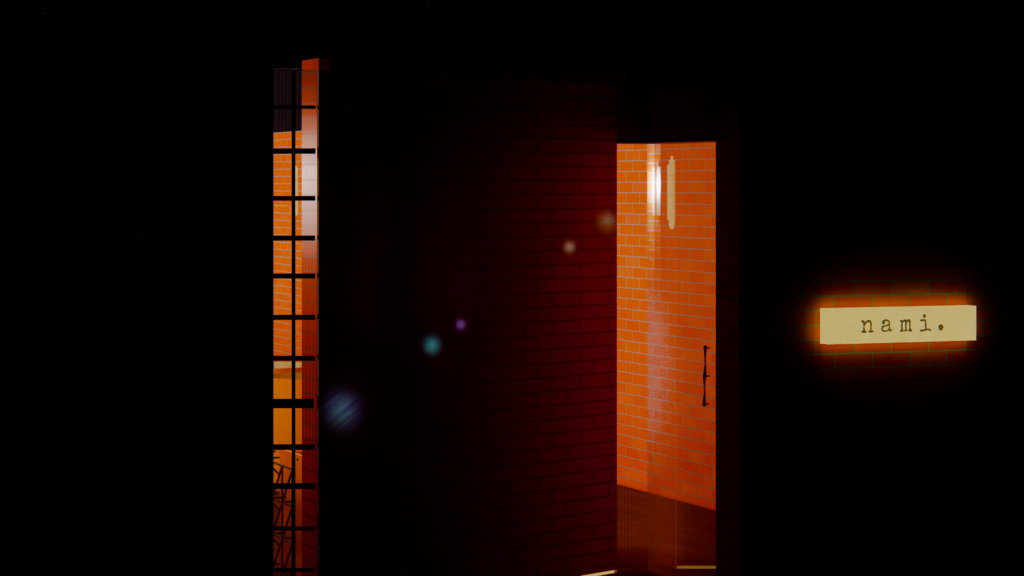
Nami translates this thinking into a contemporary interior on Sauchiehall Street. Rather than functioning simply as a stationery shop, the programme is organised around a sequence of arrival, browsing, writing, tea, reflection and exchange. Paper, ink and writing instruments remain objects of purchase, but consumption becomes only one part of a slower spatial experience centred on the act of writing.
Japanese spatial concepts further inform this experience. Miegakure—the partial concealment and gradual revelation of space—and Jun’ichirō Tanizaki’s writing on shadow informed an interior that is not immediately revealed from a single viewpoint. Space unfolds through thresholds, movement, material encounters and moments of pause.
Drawing on Pierre Nora’s concept of lieux de mémoire, the project considers how ordinary objects and repeated practices can become carriers of personal memory. The physical letter becomes particularly significant: its value lies not only in what it says, but in having been touched, written, carried, kept or left behind.
Nami ultimately asks whether a commercial interior can operate beyond transaction and become a space for memory, slowness and human exchange—reintroducing the physical act of writing into a street increasingly shaped by speed, visibility and consumption.
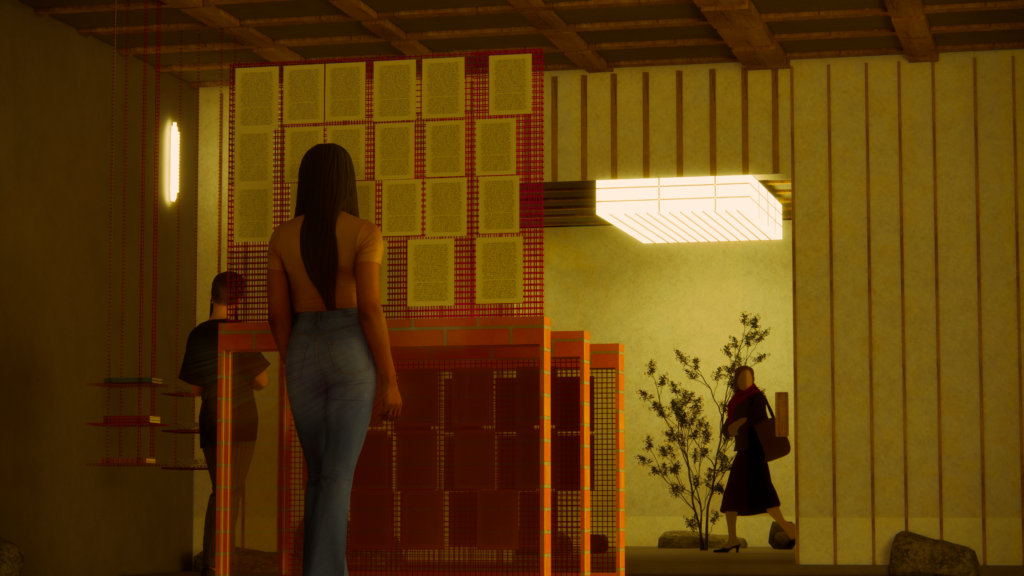
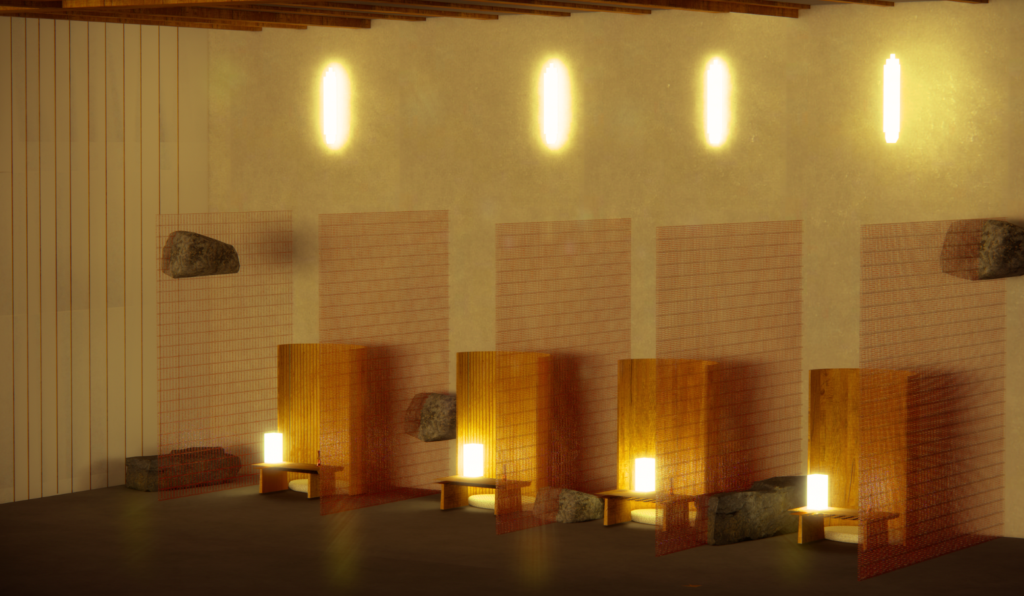
Render of Nami