

Yuyao He
(She)
MSc Product Design Engineering, I believe design is a positive discipline — it begins with noticing what could be better. As a designer, I aim to identify problems with sensitivity and turn them into opportunities for improvement. Design thinking and engineering knowledge help me carry this process from an idea to a practical solution. Thank you for viewing my work.
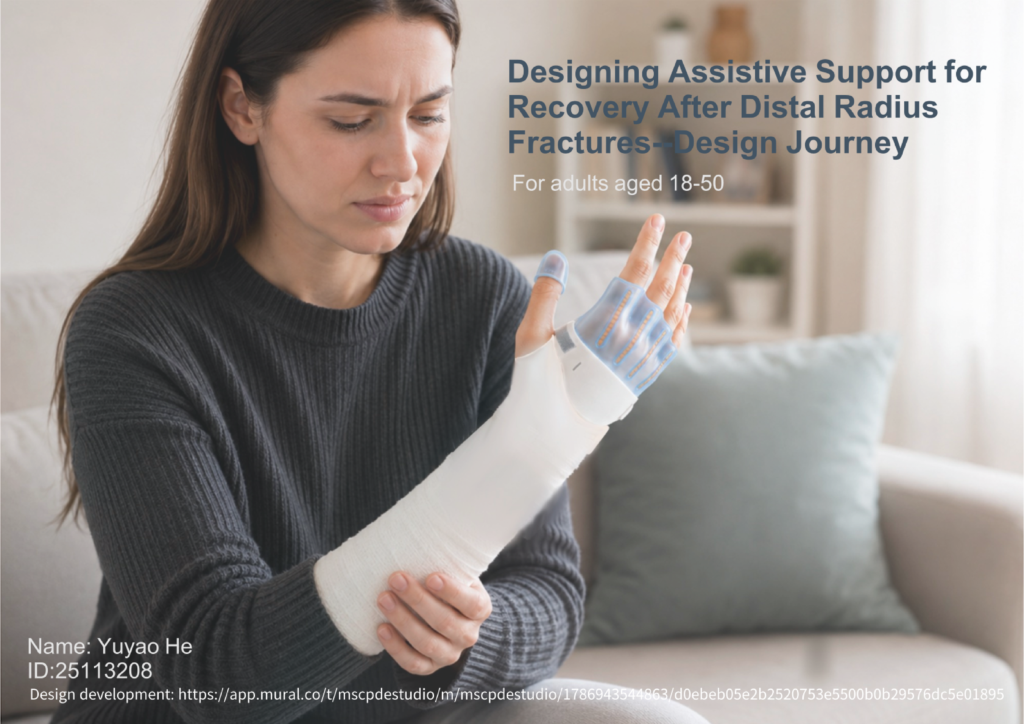
Designing Assistive Support for Recovery After Distal Radius Fractures
Distal Radius Fracture (DRF) is one of the most common fractures, accounting for 26–46% of all fractures.
The wrist is fixed in a cast for 0–6 weeks. During this period, the wrist must stay still — but the fingers are expected to stay active from day one.
When early finger movement is skipped, swelling lingers, joints stiffen, and long-term range of motion is lost.
DRF is not only a fracture pathway. It becomes a daily self-management problem once the patient leaves the clinic.
This project is designed for adults aged 18–50 with a distal radius fracture who are being treated without surgery and have their wrist immobilised in a cast. These patients usually have one injured hand. Their wrist needs to remain protected, while their fingers are still free and need to keep moving during the early stage of recovery. For adults who still need to manage everyday life, work or study independently, much of this recovery happens at home. Although hospitals provide exercise and care advice, patients may still be unsure: Am I doing the movement correctly? Am I doing enough? Am I using too much force? Have I completed my exercises today?
The final design is therefore a lightweight wearable hand-rehabilitation aid used together with a mobile app. It is worn around the hand without encouraging movement of the injured wrist. Sensing areas on the back and palm of the hand help recognise whether the fingers bend, touch the palm and release again, as well as whether the thumb completes its touch movements. The app provides simple visual guidance, reminders, repetition records and progress feedback so that the user can understand what to do and follow their recovery more easily.
The design developed through several stages, from handheld soft exercise objects to a wearable solution. The wearable direction was selected because it can focus more directly on individual finger movement rather than simply encouraging the user to squeeze harder. It was then simplified through clinical guidance, supervisor feedback, adult hand-size data and physical prototype testing. The final form is easier to wear across different hand sizes, keeps the rigid electronics mainly on the back of the hand, leaves the palm less restricted, and gives the thumb more freedom to move.
The product is not intended to replace the cast, doctor or therapist or to judge whether the fracture has healed. Instead, it acts as a simple home-recovery companion that turns the general instruction to “keep your fingers moving” into clearer guidance, feedback and progress tracking, helping users complete early hand exercises with greater confidence while their wrist remains protected.
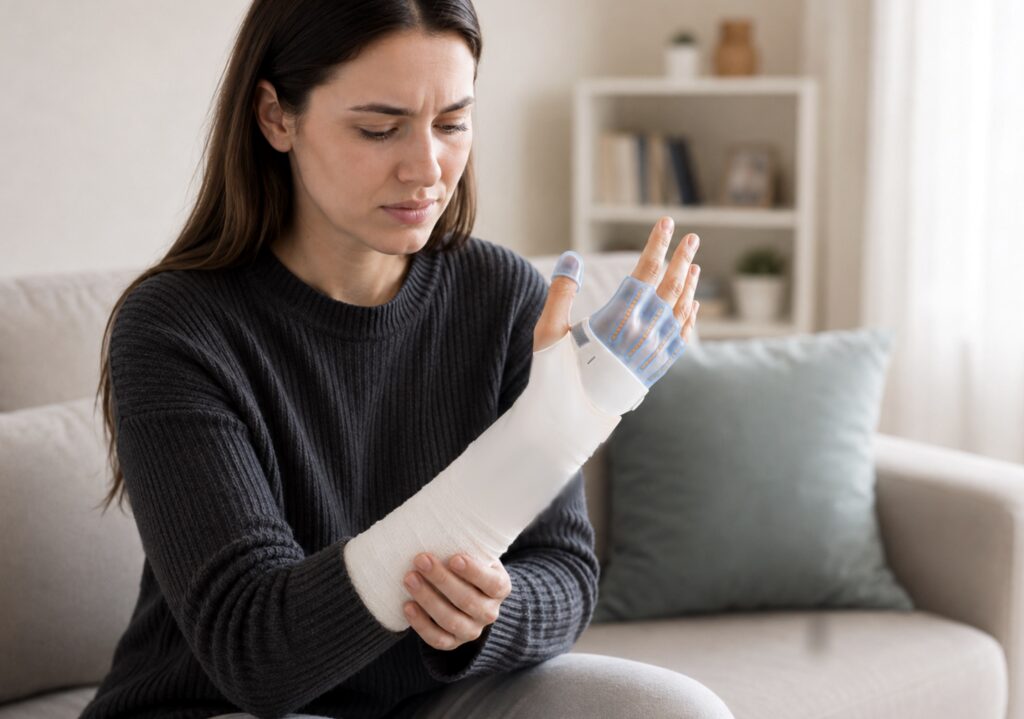
PhotoShop
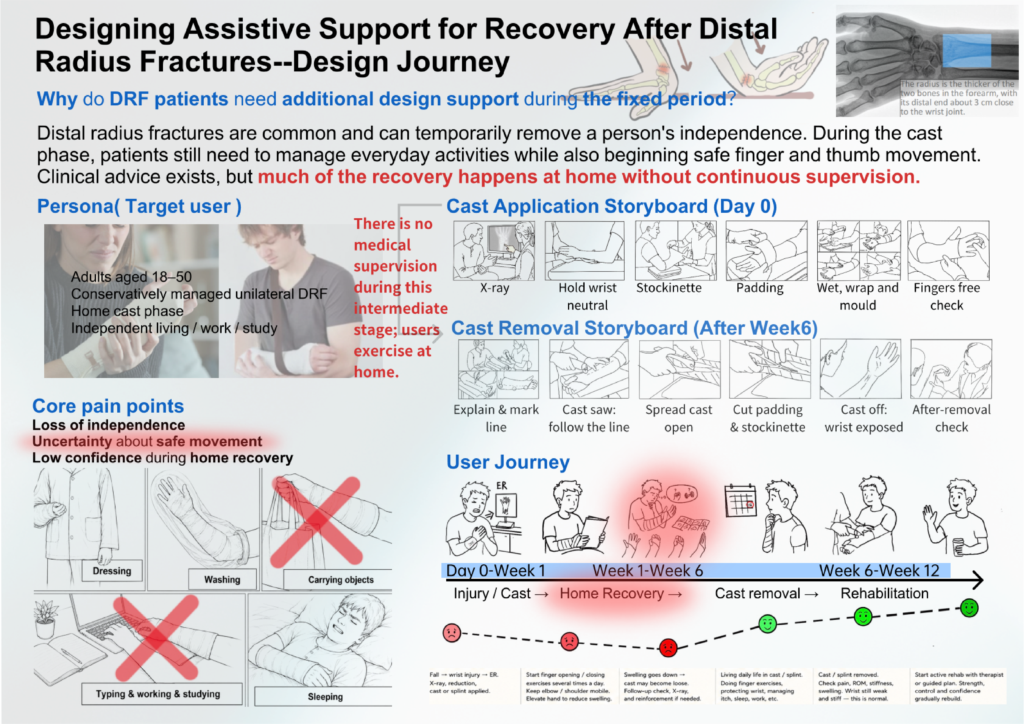
Mapping the full recovery journey revealed a key gap during the home cast phase, when patients must manage daily life and early finger movement with limited supervision.
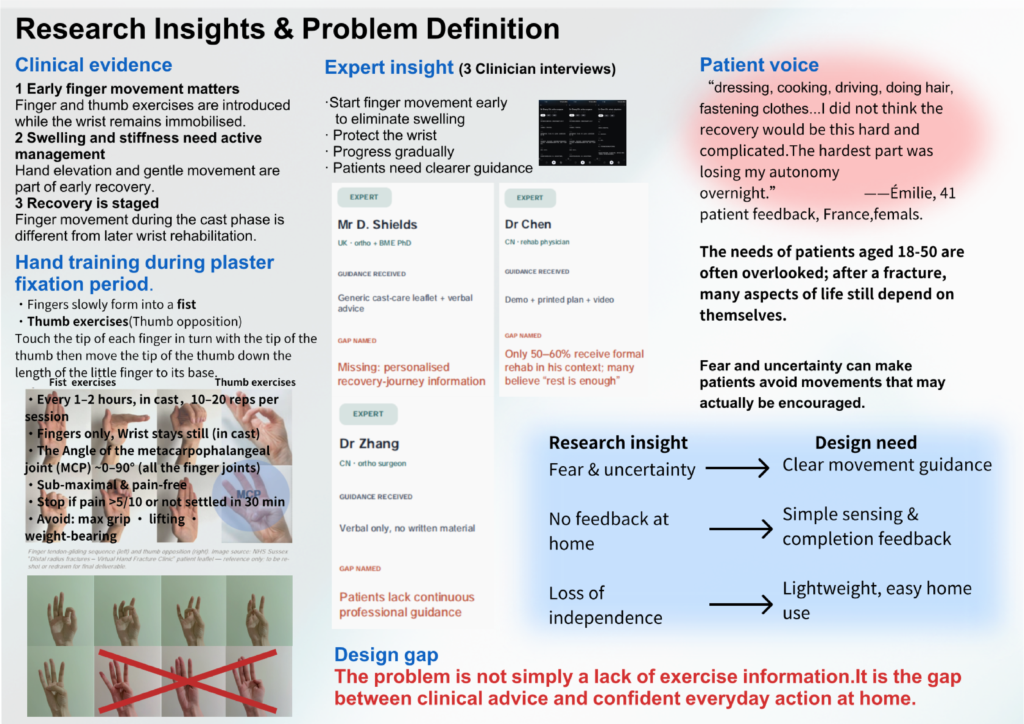
Clinical evidence, expert interviews and patient feedback showed that the main gap is not a lack of information, but difficulty turning clinical advice into confident everyday action.
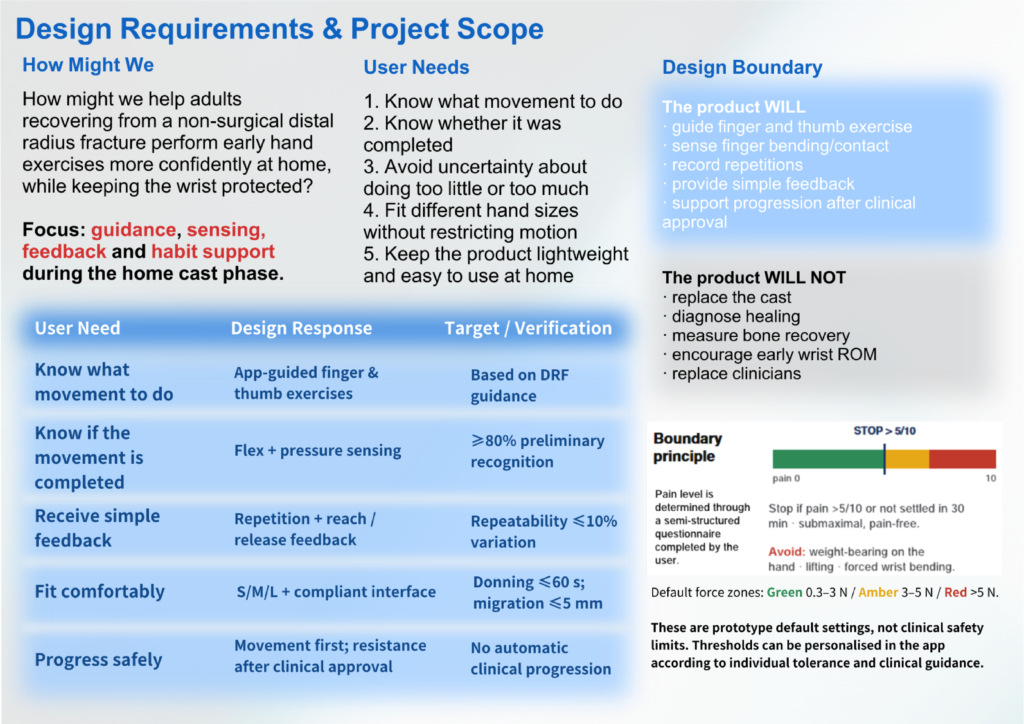
The research was translated into design requirements for movement guidance, sensing, simple feedback and comfortable home use, while keeping clear clinical boundaries.
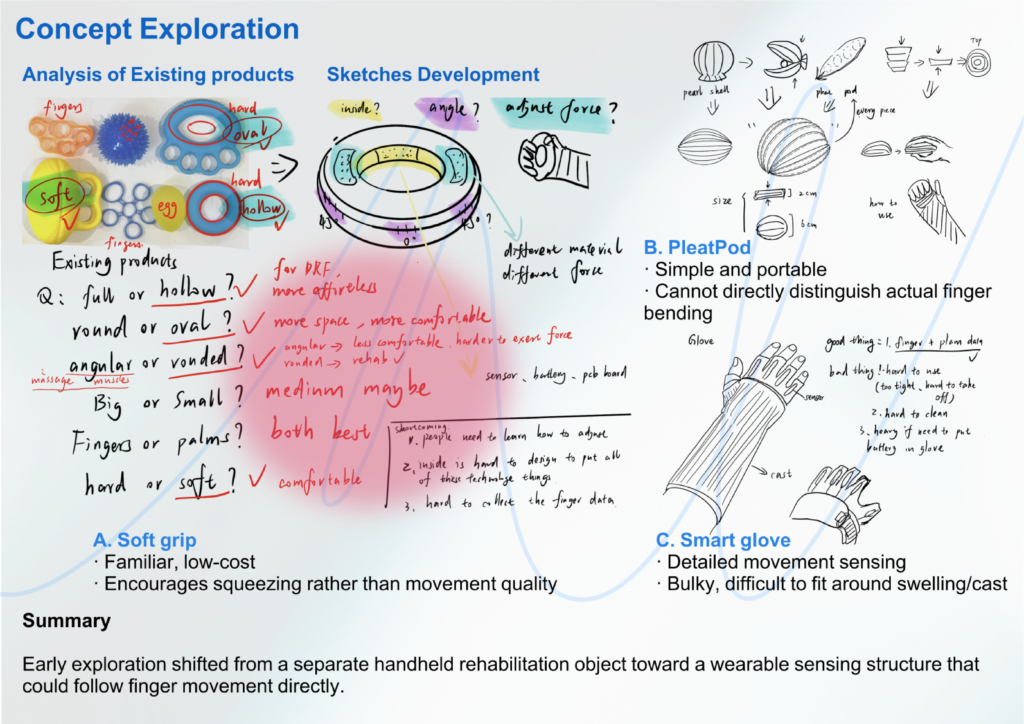
Early concepts moved from handheld rehabilitation objects towards a wearable sensing approach that could follow finger movement more directly.
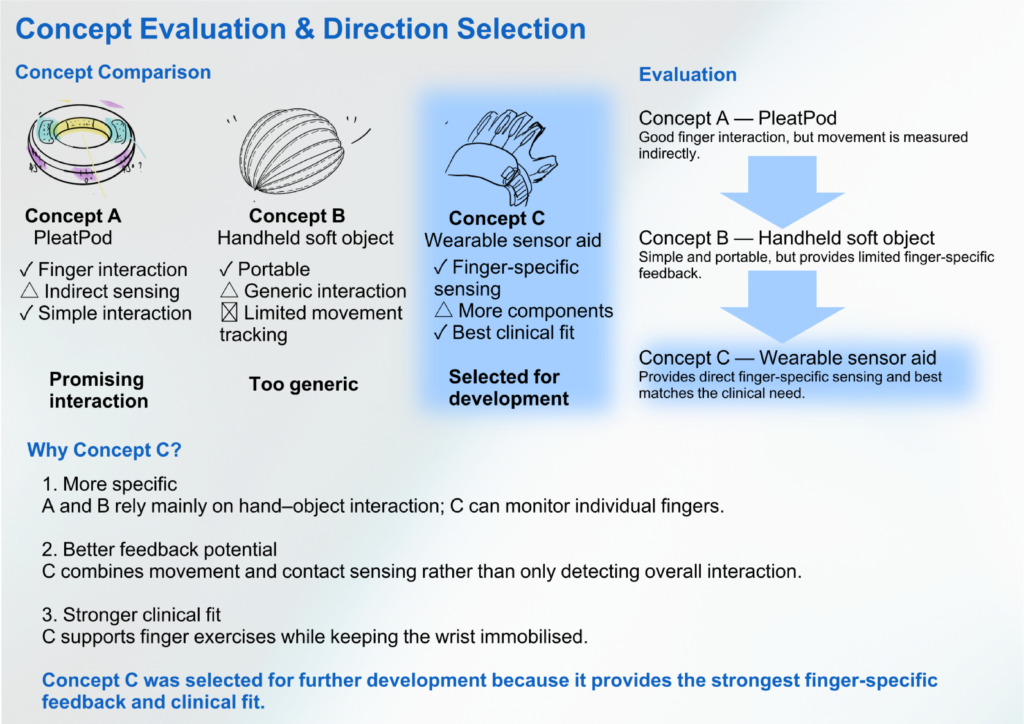
The wearable concept was selected because, despite greater complexity, it offered the strongest finger-specific feedback and the closest fit with the clinical need.
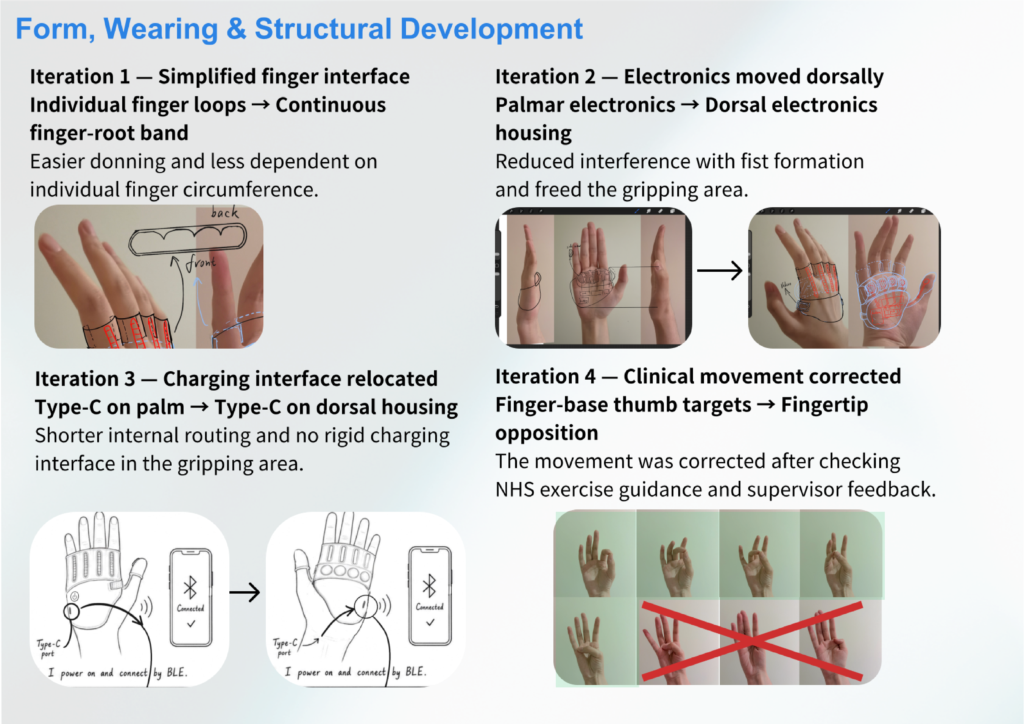
The design was refined through several iterations to simplify wearing, move electronics and charging dorsally, and correct the thumb interaction using clinical guidance and supervisor feedback.
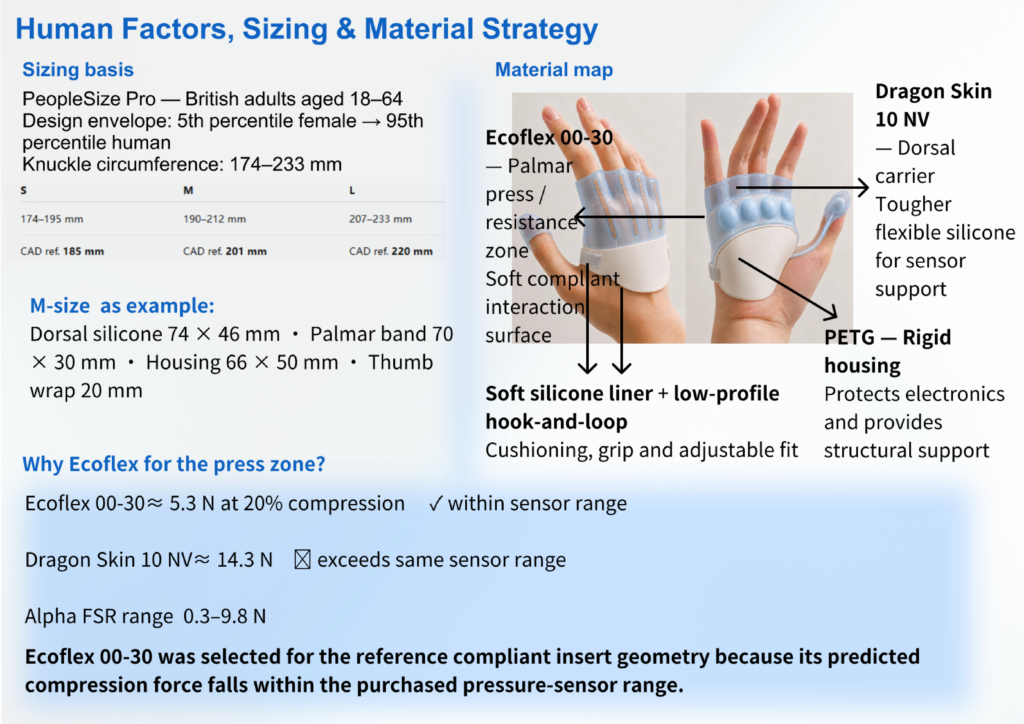
Anthropometric data informed the S/M/L sizing strategy, while material selection was matched to each functional region and supported by analytical screening of the compliant press zone.
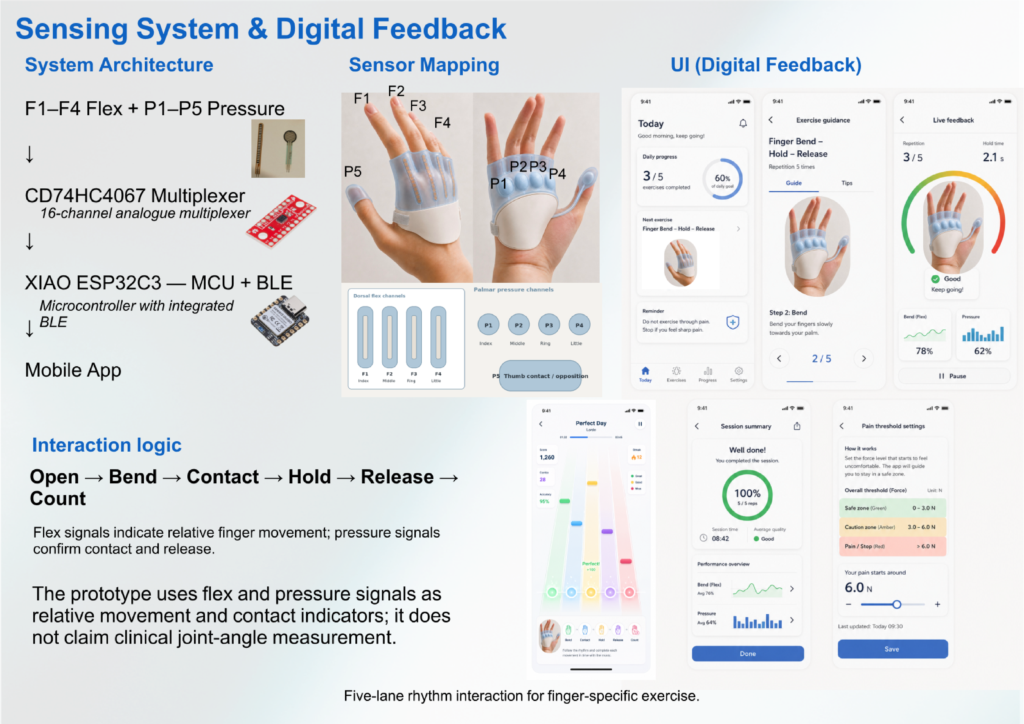
Four flex and five pressure channels provide relative movement and contact information, with BLE-based app feedback for guidance and progress rather than clinical joint-angle measurement.
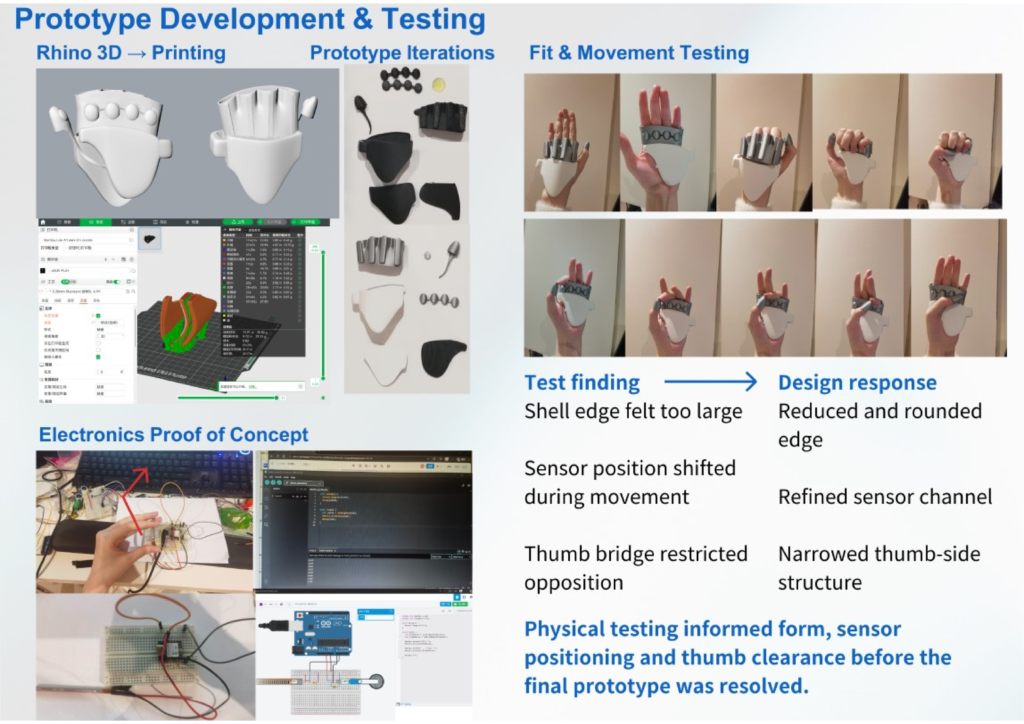
CAD, 3D printing, electronics proof-of-concept and fit testing identified issues with shell size, sensor movement and thumb clearance, directly informing the next design iteration.
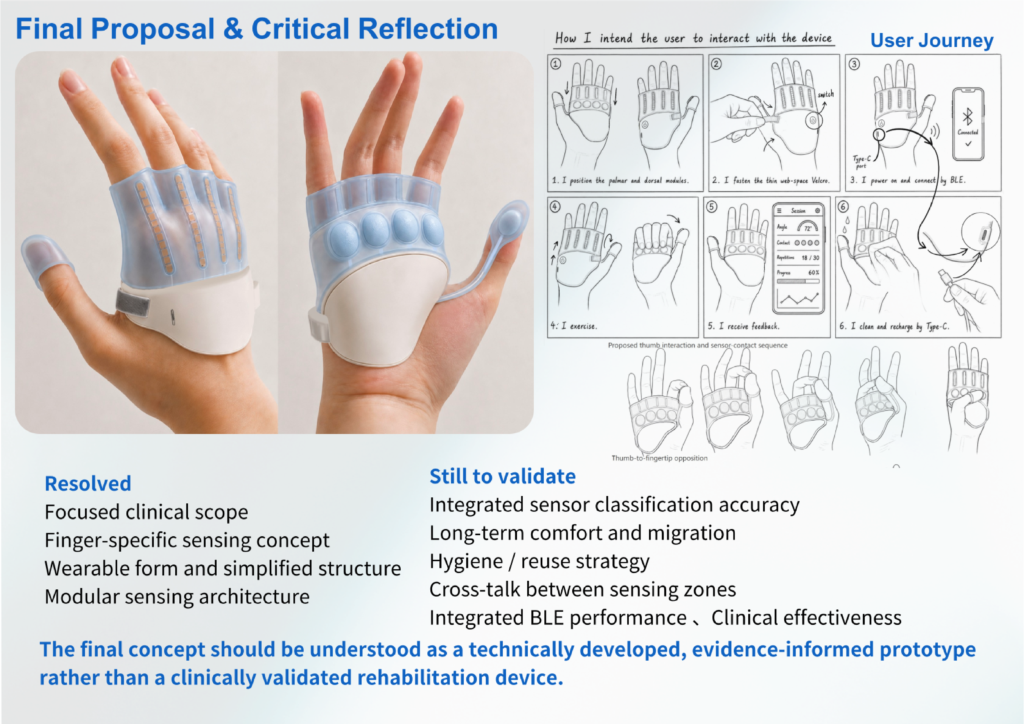
The final proposal is a lightweight, modular wearable prototype with finger-specific sensing and a complete use journey.
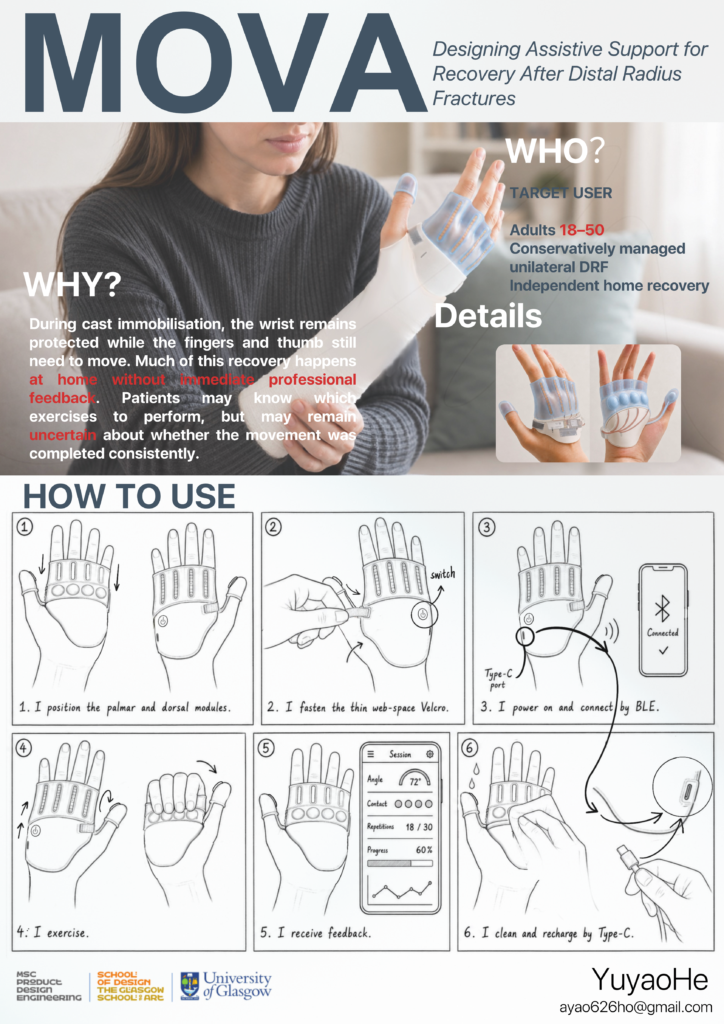
This A0 poster presents the full design proposal, covering the DRF recovery problem and target users, how the wearable and app work together, and the product’s materials, construction and sizing basis.