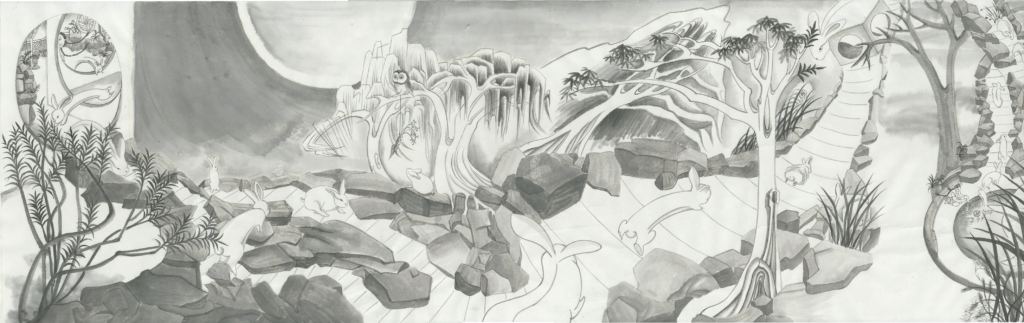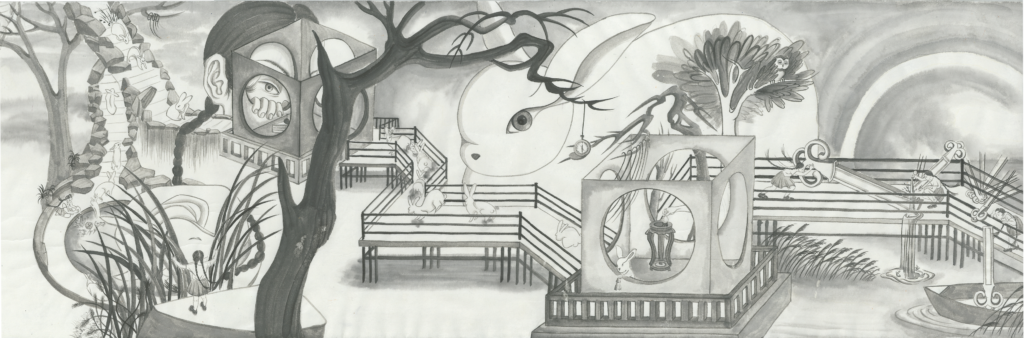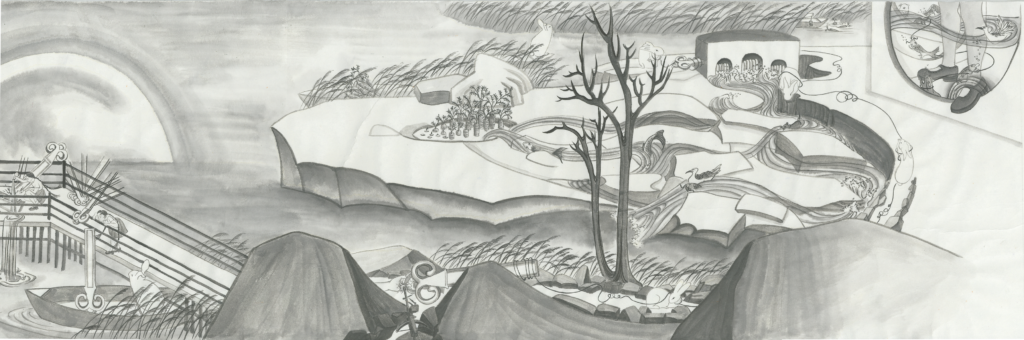
Yiling Yuan
I grew up immersed in Chinese landscape painting and classical garden aesthetics, and later entered the system of Western modern art. This path looked like my own choice, but family expectations, cultural inheritance and aesthetic training had already laid it out long before I chose it. This dual background let me see the difference between two frameworks, and taught me what it means to be a guided viewer. My work is therefore concerned with how space shapes the way we look. How a space is designed often determines that the person moving through it believes they are choosing freely, when in fact every turn has already been arranged. I am interested in this illusion of choice, and in the role of viewer it produces, someone who believes they are exploring while in fact being guided. I borrow the spatial logic of the Chinese garden to reinterpret Alice’s Adventures in Wonderland, hoping viewers will recognise that looking is never neutral, that it is shaped by cultural frameworks, visual conventions and spatial logic. My visual language is concerned with the immediacy of the ink mark itself. A stroke cannot be revised or rehearsed, and its trace shapes the pace, fast or slow, of the path through the image.
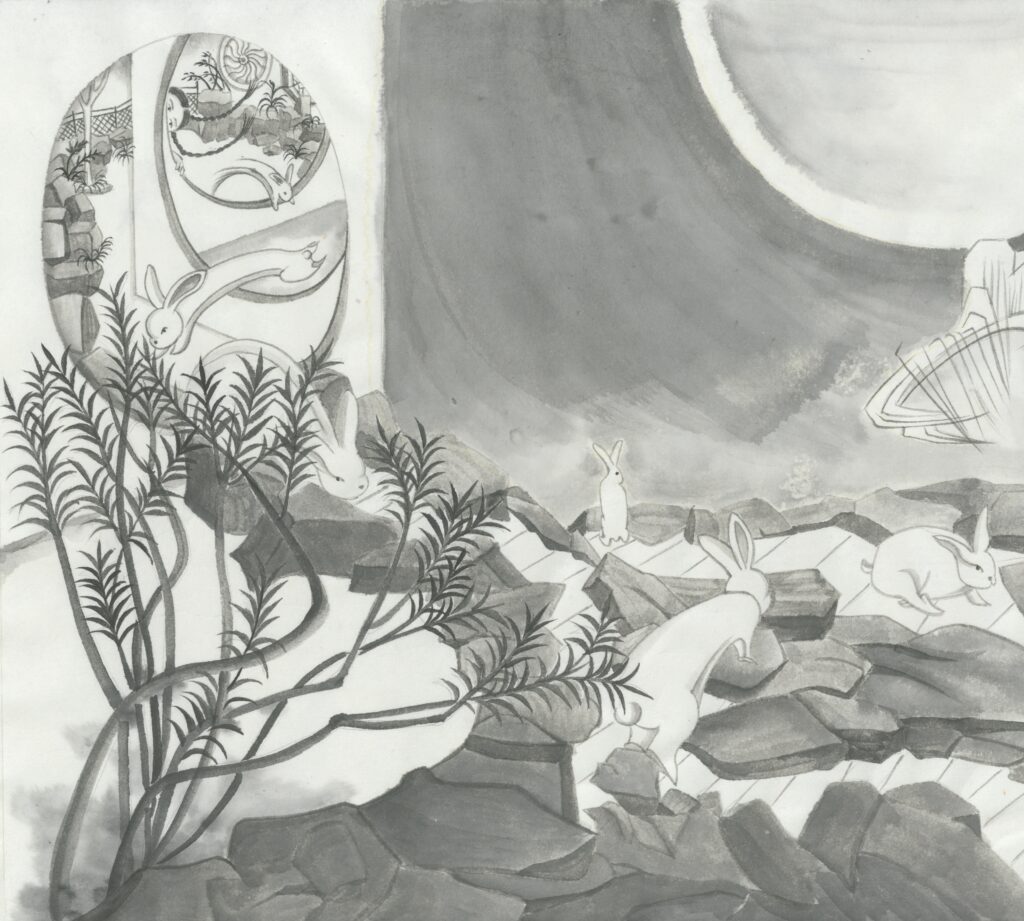
Alice Through the Moon Gates
The similarity between Chinese gardens and Wonderland lies in their carefully designed spatial structures, which create an illusion of choice for the viewer. This is why I proposed that Alice is a guided viewer. The spatial structure of Wonderland was designed before she fell into it, and the designer had already anticipated her every decision. I want my audience to realise that ways of seeing are never neutral by reinterpreting Alice in Wonderland through the lens of Chinese garden philosophy. They are shaped by cultural frameworks, visual conventions, and spatial logic. In the classical Chinese garden, one never looks at a scene directly but always through an intermediary such as a moon gate, a lattice window, or a veil of obscuring plants. The philosophy of the classical Chinese garden emphasises implication over declaration. The garden buries significant scenes in depth, viewing concealment as a precondition for revelation. The winding path is preferred over the straight one, because what arrives indirectly carries more weight. The audience is an active participant in the wonderland I constructed. I hope they become aware that they are being guided and experiencing a different mode of looking.