Yifei Liu
Hello, my name is Yifei Liu, and I am currently studying Interaction Design at the Glasgow School of Art. My creative practice focuses on exploring the relationships between humans, machines, and more-than-human entities. Through interaction design, I am interested in investigating how different entities can perceive, communicate, and form new connections with one another.
In my practice, I particularly enjoy working with sensors, physical computing, and interactive installations to communicate my ideas. I often explore ways of translating signals and information from the body, the environment, and non-human entities into tangible and perceptible interactions. For me, technology is not only a functional tool, but also a medium through which we can understand the world, build relationships, and raise questions.
I am also deeply interested in art, and I hope to continue exploring the boundaries between art, technology, and interaction design, creating interactive experiences that are experimental, sensory, and thought-provoking.
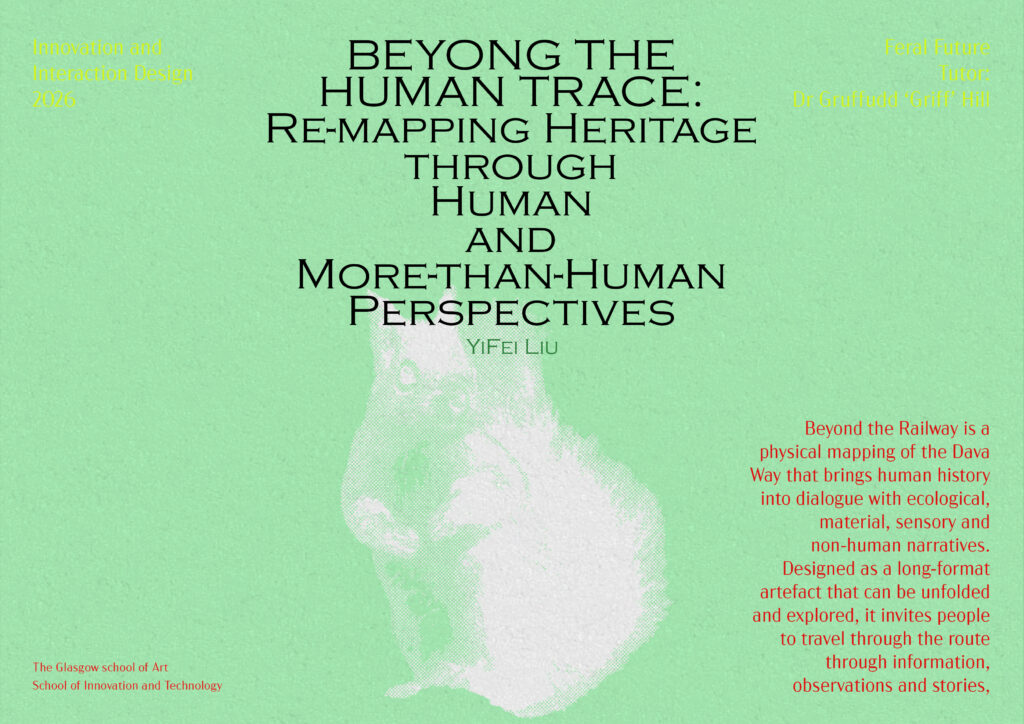
Beyond the Human Trace: Re-Mapping Heritage Through Human and More-Than-Human Perspectives
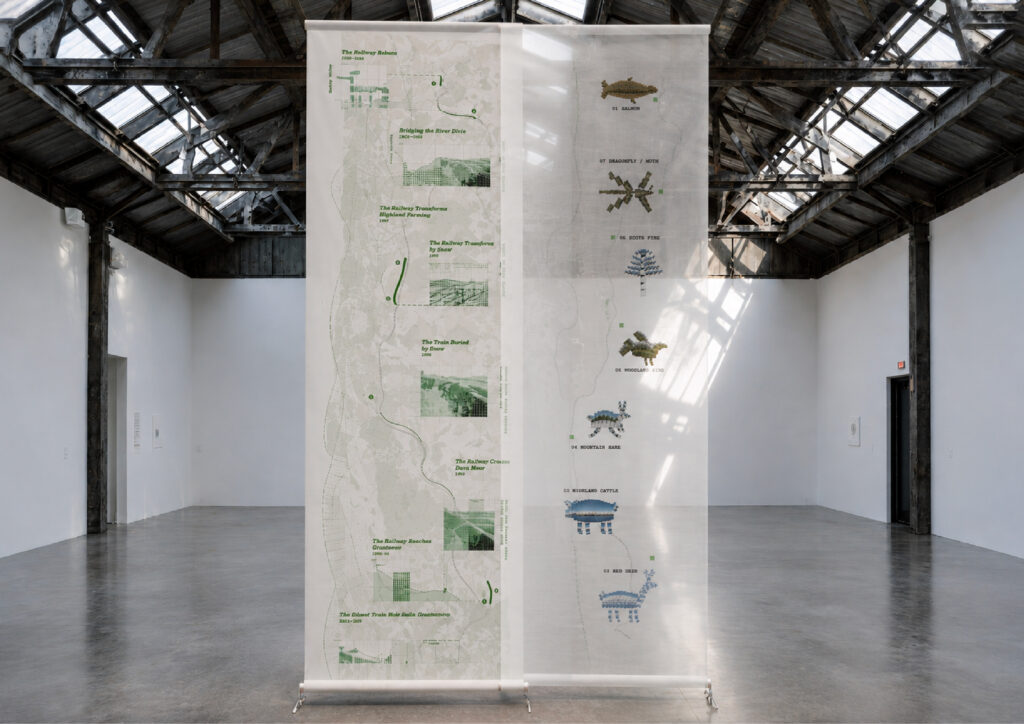
This project reframes heritage as a living and evolving network of relationships, rather than a fixed record of the human past.
Through two parallel mappings of the same landscape along the Dava Way, the project presents two ways of reading place: one traces its more-than-human participants and ecological relationships, while the other uses detailed sensory mapping and stylised drawings to reveal layers of human history, memory and experience embedded within the same landscape.
The maps also extend beyond their physical surface. By scanning elements within the mapping, visitors can activate a series of stylised moving-image works that reveal the more-than-human participants inhabiting and shaping the landscape. The act of scanning becomes a way of moving between visible and less-visible layers of the site—allowing presences that are often overlooked within conventional heritage narratives to emerge through another visual language.
By placing human histories and more-than-human lives within the same field of observation, the project questions what is selected, represented and recognised as heritage—and what remains unseen. It proposes heritage not simply as the preservation of the past, but as an ongoing relationship between human histories, non-human lives, material processes and the landscape itself.