
Artworks
obuyile (2021 – ongoing) by Thulani Rachia:
Unfolding over seven days, obuyile (“the one who returns”, isiZulu) invites audiences to explore methods of healing through sound, rest, and counter architectures, through motions of return each day.
An installation piece weaving together composition, moving image, and textile, the work emerged from an ancestral dream received by Thulani.
The cello composition, initially performed by four cellists in St Giles Cathedral and commissioned by Edinburgh Art Festival, has its foundations in melodies and harmonies recorded by Thulani as he walked the streets of cities marked by colonial violence across Scotland and Europe. An intuitive process of walking, retracing, and remapping to ground himself in new environments, that led to the melodies of memories we hear today. The seven-day duration is an acknowledgement of Frederick Douglass, who whilst in Edinburgh, taught himself a hymn from home on a fiddle over the course of a week – an act he described as a form of healing.
Thulani’s translation of isiZulu into textile, inscribe and encode his mother tongue into the material. The construction of these garments by Asia Przytarska, erects an architecture of sanctuary – enlivening Thulani’s coordinates to navigate built environments stained by colonialism. The architectures that have absorbed and generated; buried and propagated our personal and collective memories. Architectures of erasure.
Through garments which provide an architecture of sanctuary and a composition enlivened by breath and rest, Rachia’s installation enacts and provides a counter-cartography to navigate the architectures that archive colonial violence.
This counter-cartography invites audiences to retrace the coordinates that made them so.
/’meitria:k/ (2026) by Hayden Ryan:
/’meitria:k/. is an experimental sound work centring ancestry, the transmission of kindred structures and matriarchal leadership through the use of archival sound recordings and images.
The piece was inspired by the legacy of Hayden’s great-great grandmother, Muriel Pearl Stewart OA, who was the first Aboriginal woman to become a Justice of the Peace in New South Wales. For 45 years, Muriel volunteered at La Perouse School and was responsible for the construction of the local kindergarten. She was a founding member of the Foundation of Aboriginal Affairs, the Aboriginal Medical Service, the National Aboriginal Advisory Council and the Woman Justices Association.
In 1983, she received an Order of Australia for service to Aboriginal welfare.
Tracing the voices of six successive mothers and daughters /’meitria:k/. accentuates how the voices of Aboriginal women are more than semantic artifacts, which carry cultural and political identities, phonetic textures and contours, and intergenerational knowledge. Audience members experience the work through a telephone handset while immersed in an ambient soundscape. Within this sonic environment, the partially obscured voices of six women emerge – voices that may be unfamiliar to most listeners, yet immediately recognisable to their relatives and close friends.
Through the handset, listeners are invited to (re)connect with these women as they speak about their identities and lived experiences. The telephone operates as both a practical and symbolic device: a conduit for intimacy, memory, and presence. For the descendants of Muriel and May in particular, /’meitria:k/. evokes a sense of nostalgia and kinship, reanimating voices not heard through a telephone since their passing and reinforcing our lineage as Yuin people.
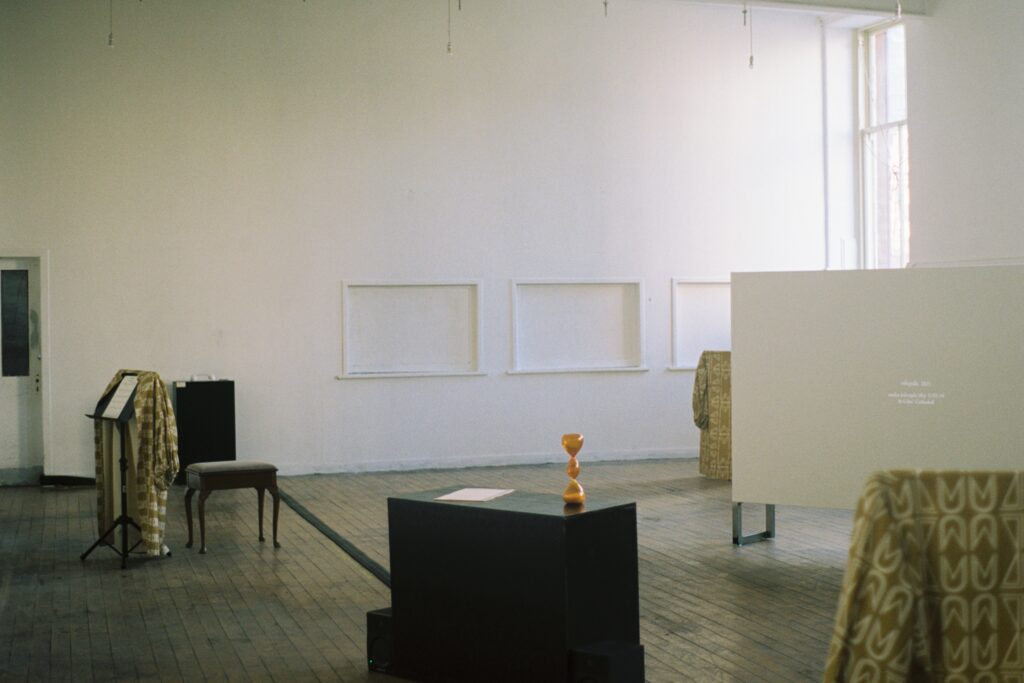
'/ˈmeɪtriɑːk/' by Hayden Ryan (2026), and 'obuyile' by Thulani Rachia (2021 - ongoing) in "mum sends me a note, with some cuttings, and other things she's remembered" (July 2026). Image Credit: Miriam Ali