
Wenxue Zhao
(she/her)
Wenxue Zhao is an interdisciplinary artist currently studying Contemporary Art Practice at The Glasgow School of Art. Her practice spans painting, moving image, installation, sound and mixed media, and is rooted in a longstanding exploration of consciousness, life and the nature of existence. From a non-dual perspective, she examines the relationships between the individual and the world, human and non-human life, material reality and inner experience, while considering how love, the divine and oneness can be perceived and given form through lived experience.
From her early black-and-white works on paper and abstract moving-image works to her research into love and interspecies perception, Zhao continues to translate experiences of consciousness that are difficult to articulate into forms that can be seen, entered and felt.
Her current project, Still Playing, is specifically rooted in her experience of living in Glasgow. Bringing together traces of the city with playgrounds and childhood memories, the spatial installation focuses on non-linear time and states of coexistence: past and present, loss and warmth, absence and presence are not mutually exclusive, but continue to unfold within the same moment. For Zhao, art is both a mode of expression and a practice through which she understands the world, examines inner experience and re-establishes connection.
STILL PLAYING
Still Playing is an immersive installation rooted in Zhao’s experience of living in Glasgow—a city where weathered, untamed surfaces coexist with the warmth and inclusiveness embedded in everyday life.
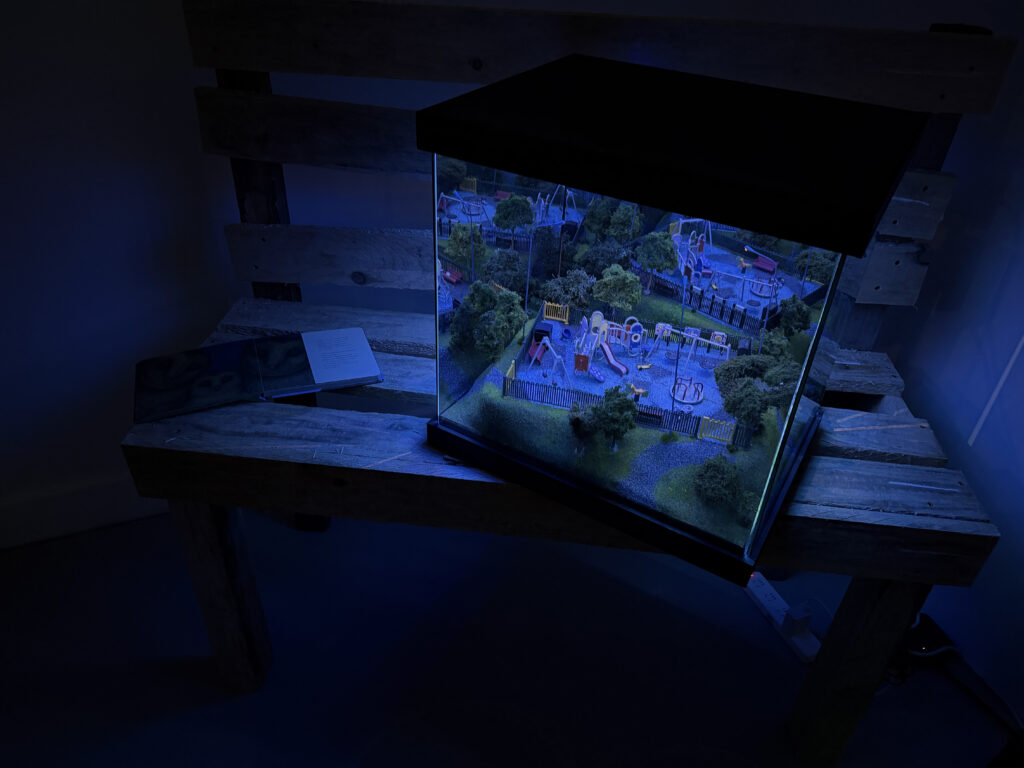
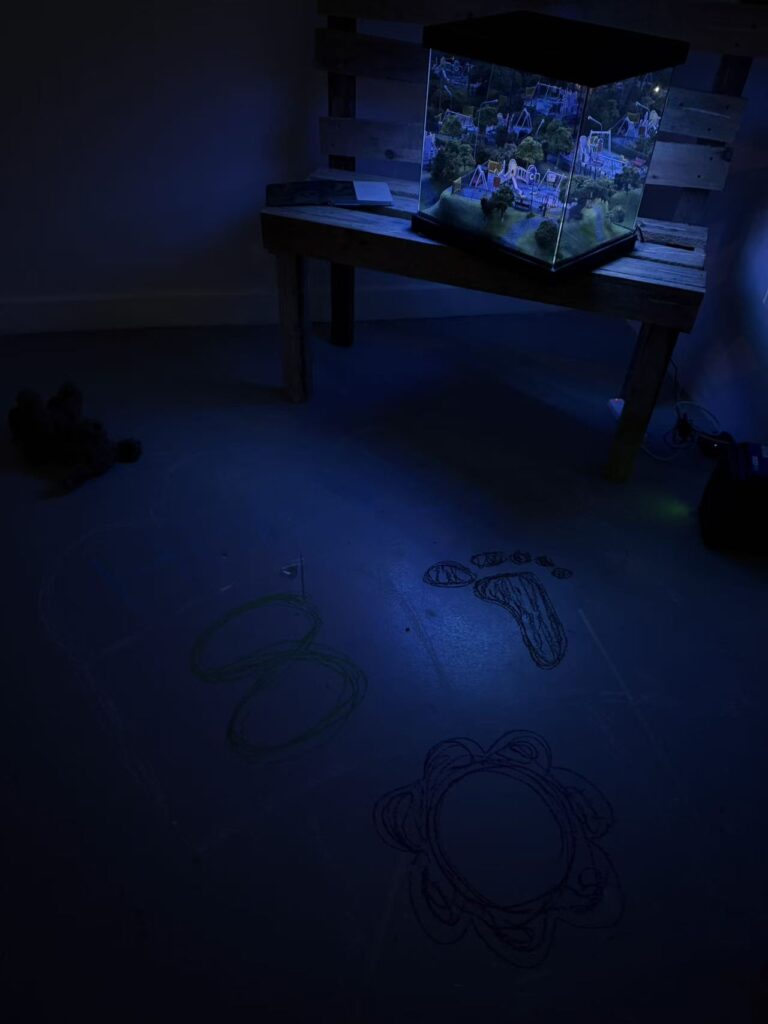
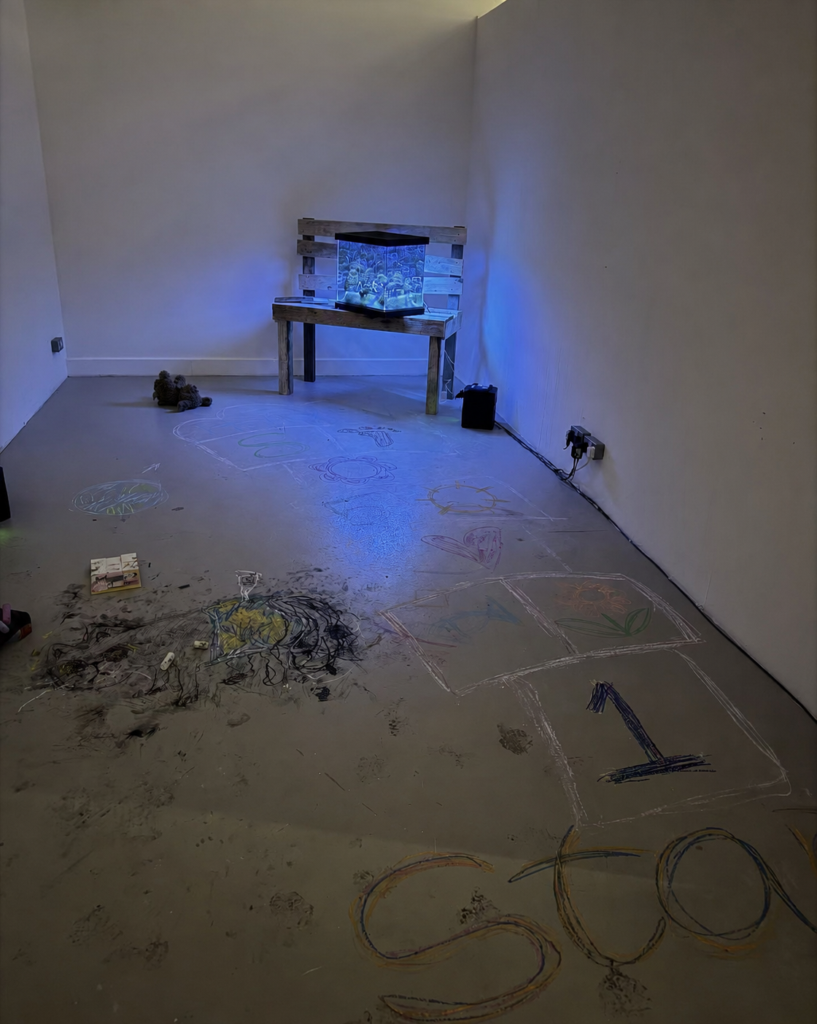
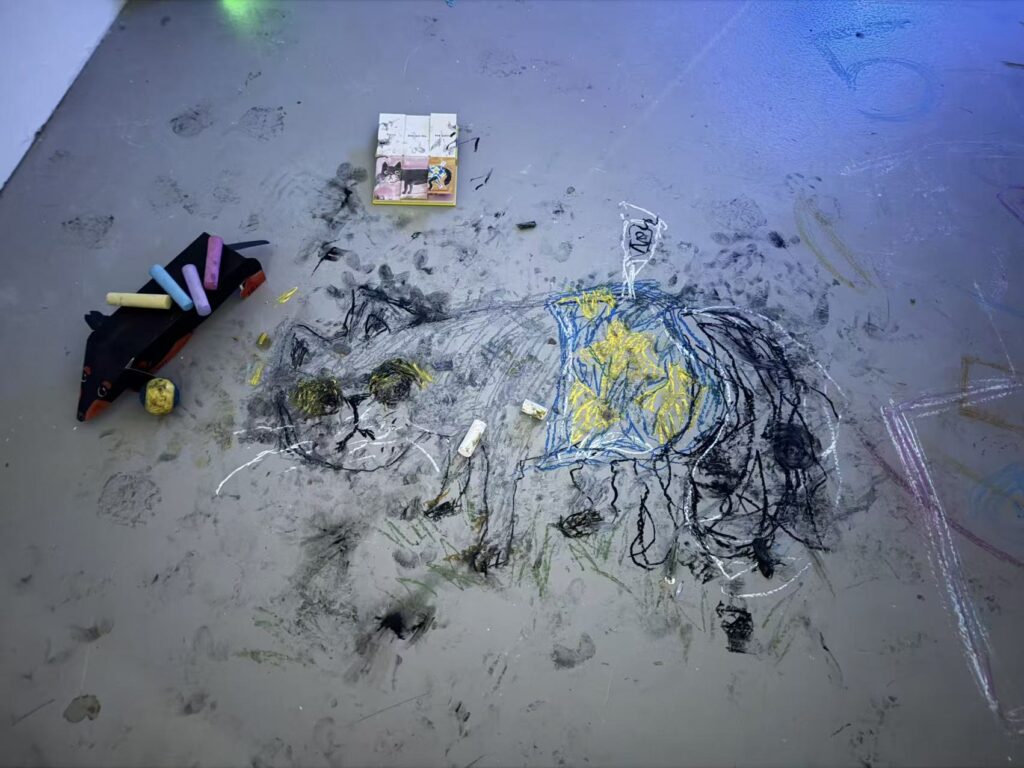
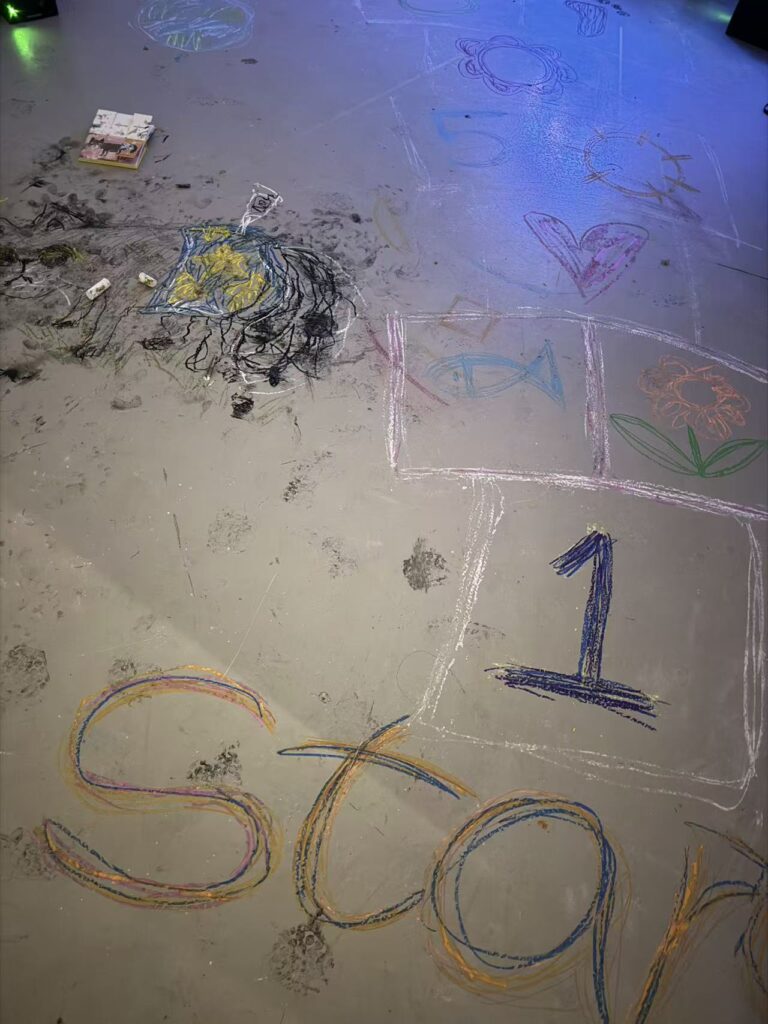
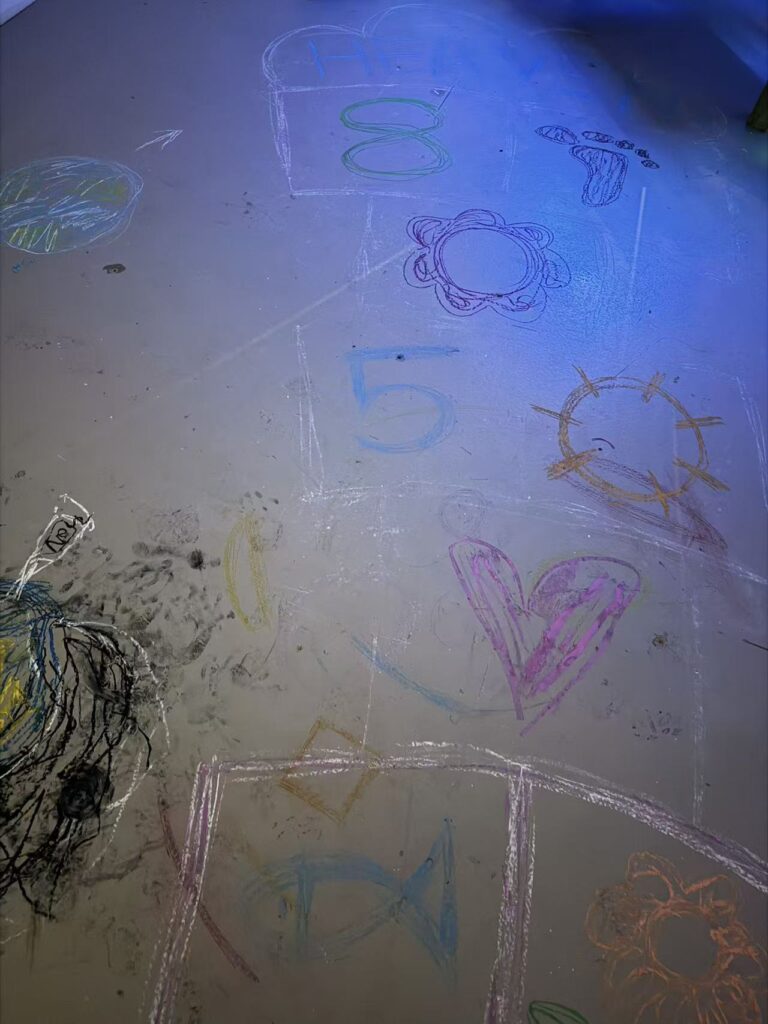
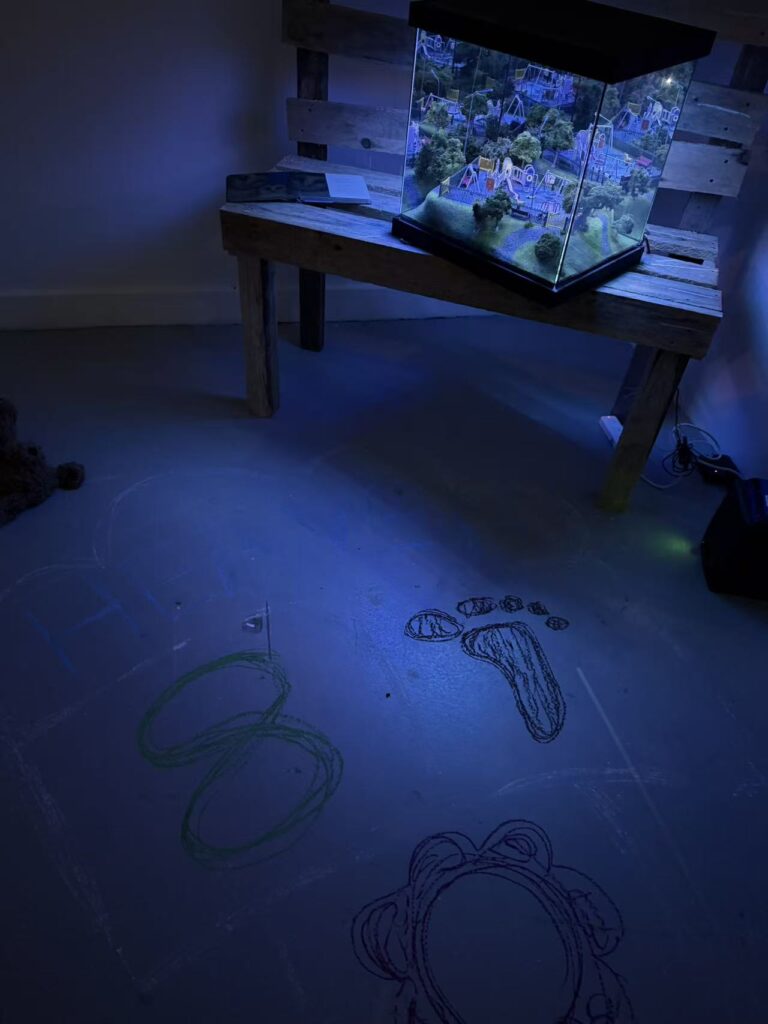
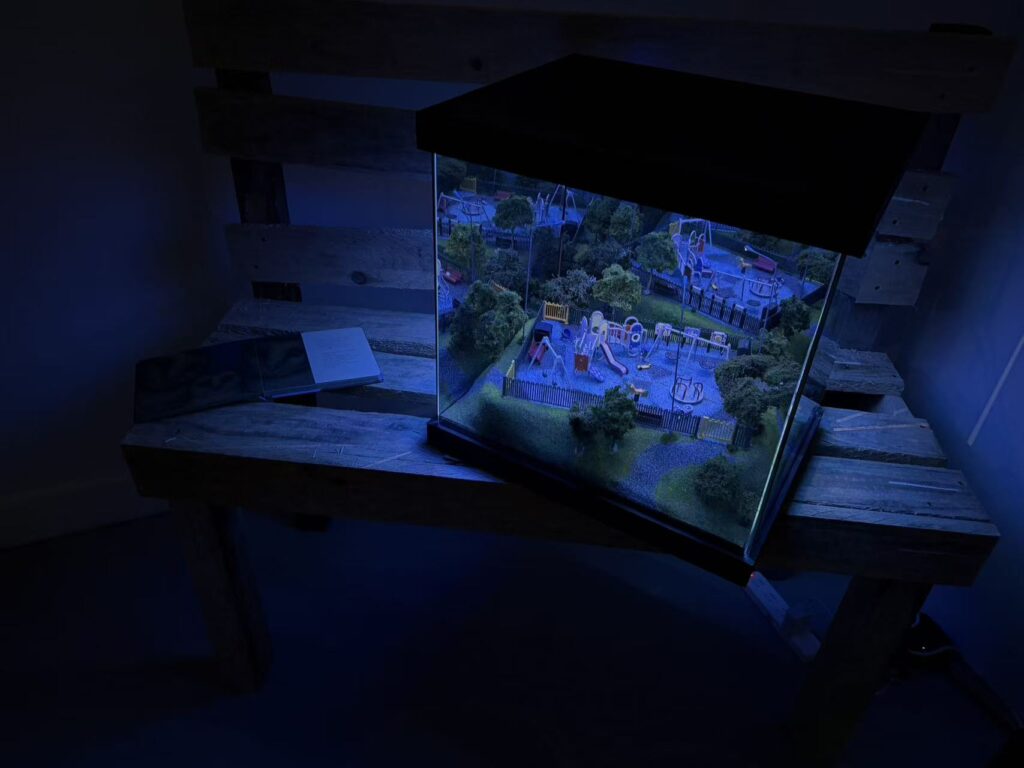
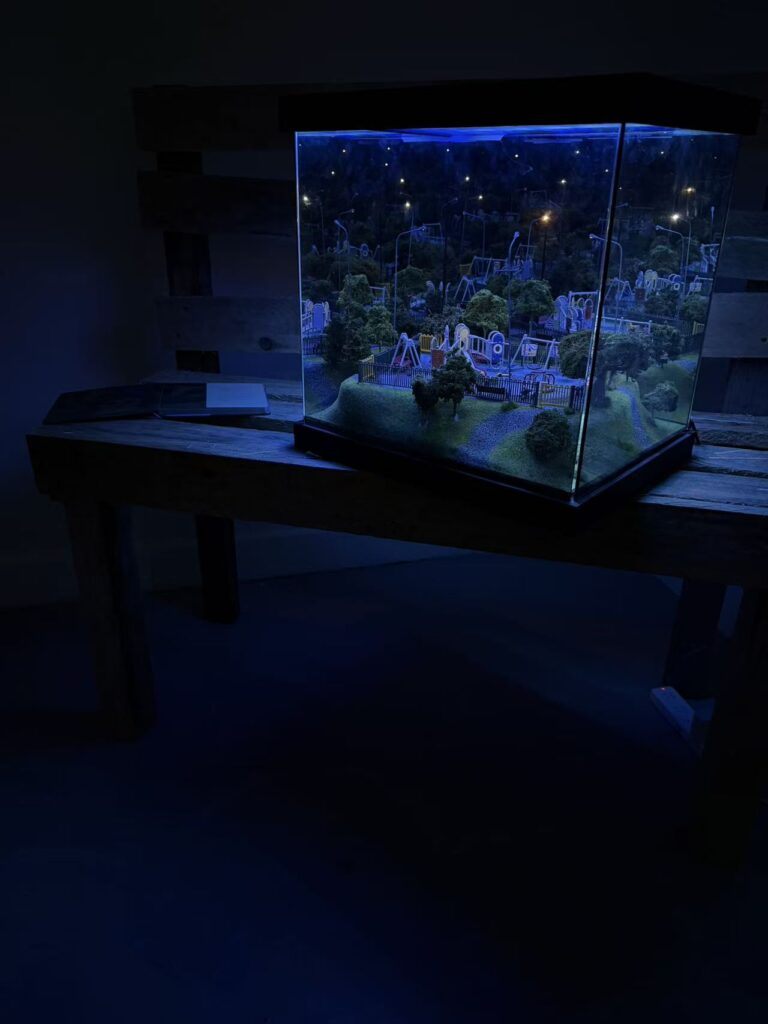
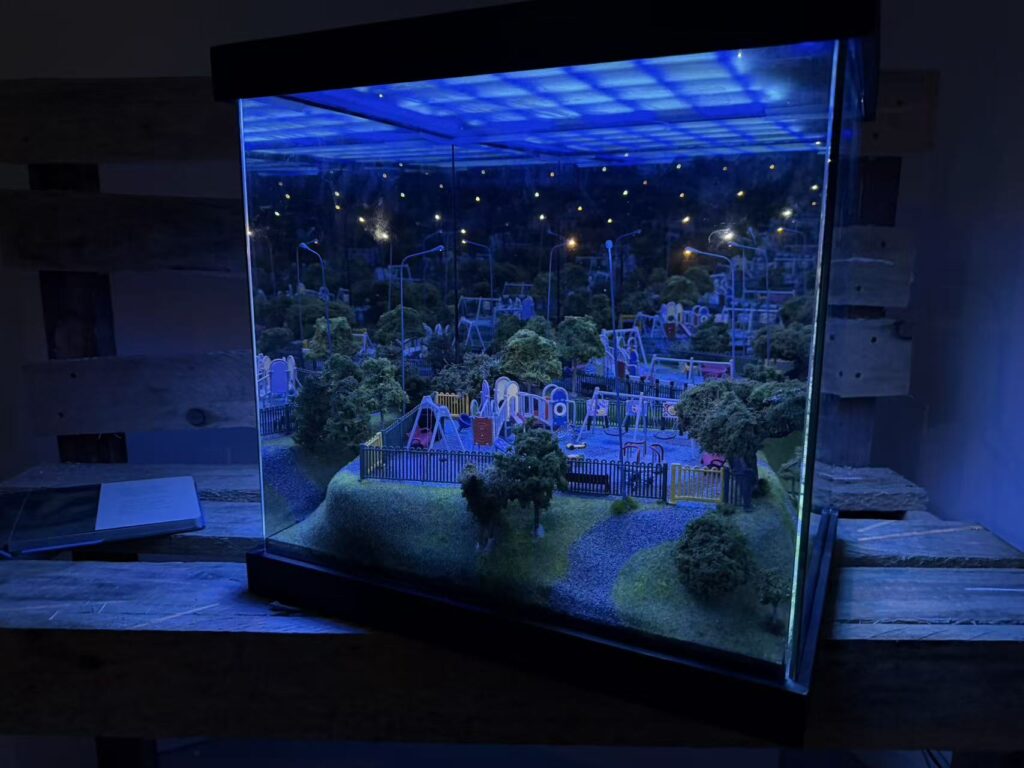
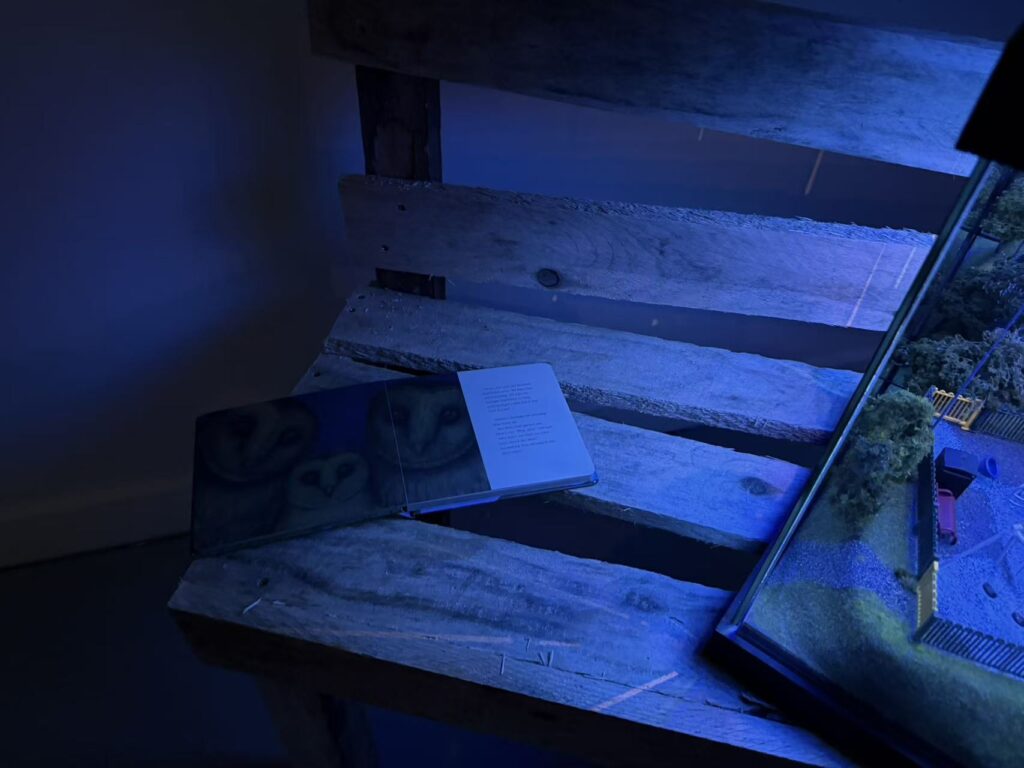
Visitors enter a space marked by childlike chalk drawings, scattered pieces of chalk, a picture book and a hopscotch path beginning with the word “Start”. A faint recording of children playing drifts through the otherwise empty room, leading them towards a blue-lit miniature playground placed on a worn wooden bench. From an adult’s standing height, the model appears finite and distant. A small instruction invites the viewer to crouch down and “borrow a child’s height”. At this lowered viewpoint, mirrored surfaces multiply the playground into an apparently endless landscape, its details come into focus, and a quiet music-box melody becomes audible. This embodied shift in perspective is central to the work: the viewer does not simply observe childhood, but temporarily returns to its scale.
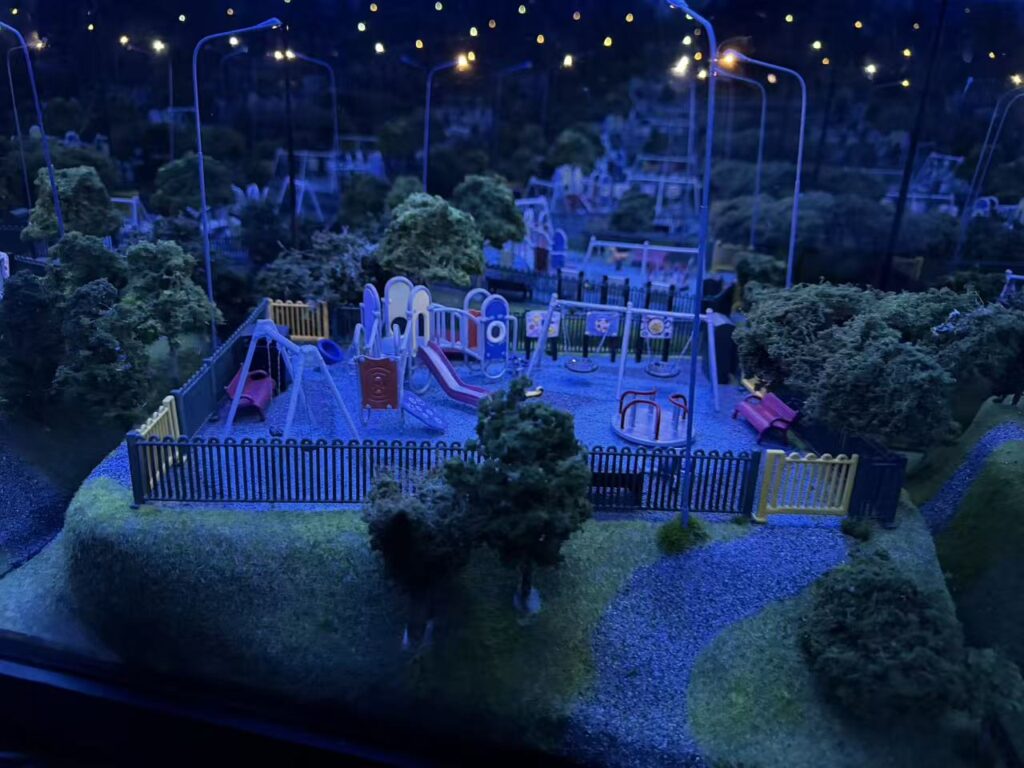
The miniature draws on familiar Glasgow playgrounds, while its blue light evokes the city’s blue hour and overcast atmosphere. The worn bench, marks across the floor and abandoned objects reflect an environment that may initially appear rough or neglected, yet gradually reveals the intimacy, warmth and openness Zhao encountered within Glasgow’s everyday life.
Still Playing holds absence and presence, loss and warmth, and past and present within the same space. The children are gone, but their sounds and traces remain; the absent child may have become the adult now looking at the work. By crouching, the viewer briefly occupies both positions at once. The mirrored loop offers neither a complete return nor a final escape: childhood cannot be entered again, yet it has not disappeared. It continues within the present—as memory, sensation and a way of seeing.
1. Miniature Playground Box
3D-printed and hand-painted playground structures, custom-cut glass and mirrored panels, two LED light strips in different colours with custom-made diffusers, a timber base and lid, and handmade miniature trees, grass and gravel terrain.
2. Wooden Bench
A handmade wooden bench constructed from timber slats and wooden supports.
3. Surrounding Installation and Sound
Chalk and crayon floor drawings, scattered pieces of chalk, children’s books, a soft-toy dog, a paper dog sculpture, and two sound recordings played through separate speakers: children playing in a park and an adapted music-box melody.
For Sale: enquiries welcome.
For Sale: enquiries welcome.
For Sale: enquiries welcome.
For Sale: enquiries welcome.
For Sale: enquiries welcome.
BORN FROM ONENESS, RETURNING TO ONENESS
One Thought, One World
One Thought, One World begins with a single, minute particle. Its opening unfolds through almost imperceptible changes over approximately four minutes, gradually dissolving the viewer’s sense of scale, direction and time, and drawing them into a seemingly boundless space of consciousness. Here, forms of being unexpectedly become thoughts. One of these thoughts, longing to experience the world as a human, eventually takes human form.
Combining NASA-released sonifications of nebulae and other astronomical phenomena with choral sound and black-and-white digital moving image, the work traces a progression from particle to consciousness and finally to the emergence of the human, constructing a cosmic narrative that moves from the microscopic to the vast. Rather than attempting to explain how humanity or the world came into being, the work invites the viewer to enter a particular state of consciousness: a single thought may give rise to an entire world, while also marking the moment in which Being temporarily takes human form.
Dharma Joy
Dharma Joy extends the black-and-white visual and sonic language of One Thought, One World, while shifting its focus from the emergence of the universe and the human to the individual’s inner world. The work follows a person moving beyond the surface of reality shaped by the material world, identity and boundaries, entering a deeper state of consciousness and re-encountering a condition in which separation from the world has never truly existed.
As the boundaries between self and world, inner and outer, temporarily dissolve, the individual returns to oneness and experiences a profound and boundless joy. Music carries the narrative and emotional progression of the work, making Dharma Joy not a direct illustration of a spiritual concept, but a sensory journey from separation back to non-separation, and from the external world back to Being itself.