

Pete Lannon
(he/him)
I am a multidisciplinary artist with a background in theatre and performance. My practice moves between live performance, sound, music and games, always taking a playful approach to exploring complex ideas. A lot of my work is preoccupied with the imagining of different masculinities that are rooted in care and nurturing, and begins from autobiography.
As well as making sound/music/games I’m co-artistic director of performance company SUPERFAN.
I’m also a member of Sprog Rock, a band that creates music for young children and their families.
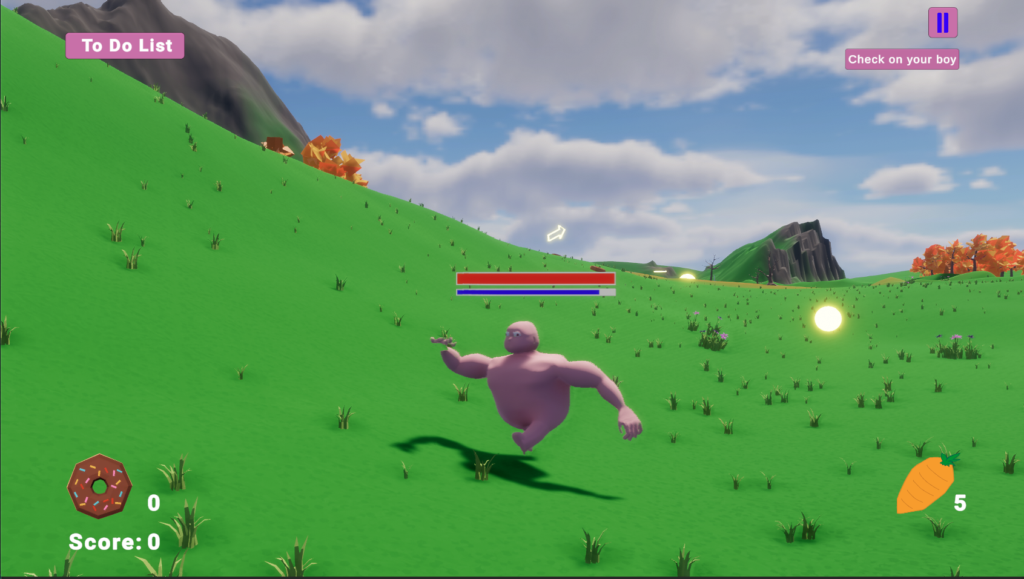
My Number One Boy
My Number One Boy is a prototype for a playful and silly adventure game in which you guide, protect, and care for your Boy in an open world full of quests to be completed (or ignored) and distractions aplenty. Part silly dad-sim, part frustrating open world exploration, the game draws on my own experience of parenthood and the joyful, exasperating responsibilities that come with being the person nominally in charge of a chaotic and inquisitive young child.
Your Boy may not always listen to you, and, while you may have a to do list of quests to complete, he is much more interested in exploring, playing, and eating donuts.
How can games allow their players to construct and inhabit different masculinities, and what does it look and sound like for those masculinities to be rooted in something other than patriarchal images of men as conquerors, heroes, or rulers? My Number One Boy is an attempt to ask this question.
Placed in the role of a father of a Boy, you have a list of quests to accomplish, but your Boy has other ideas – ideas that may get him into trouble. Can you complete your to do list while keeping your Boy happy and healthy? Should you? The game seeks to present game mechanics and sounds of hegemonic masculinity: achieving mastery over the environment or enemies and control over your avatar, completing challenges and scoring points. It aims to juxtapose these with alternatives necessitated by your Boy’s own desires: guiding, nurturing, and helping.
Boy voiced by Oran (age 3).
Game design, character modelling, sound design and music by Pete Lannon (age 37).
Screenshot: My Number One Boy
I Looked Behind Me and Saw the Smoke
A short film with sound & music. An attempt to capture the feeling of watching your child speed ahead. A bittersweet parent-child recasting of Orpheus & Eurydice. Originally mixed for Dolby Atmos.
Film, sound and music by Pete Lannon. Words, running and cycling by Oran.
Binaural sound – best experienced with headphones.
Failure Machine
Failure Machine is a prototype of a robot-building game exploring wonky physics and unexpected sound generation.
It is a game about making things, those creations not always working out, and the unexpected results of failure.
It is also an interactive journal game made in Twine, an art-writing piece documenting the experience of the game’s creation and the impulses behind it.
Created in Unity and using FMOD. The player can assemble a “robot” from a selection of materials, each with their own physics quirks and sound. Objects can be duplicated, enlarged, or destroyed. Once built, the player has limited control over their “robot”, applying force to their creation and watching it bounce or flail around the world, each different mix of body parts creating its own strange soundscape.
An edited recording of several play-throughs of Failure Machine showing the main mechanics and some of the strange and wonky possibilities.
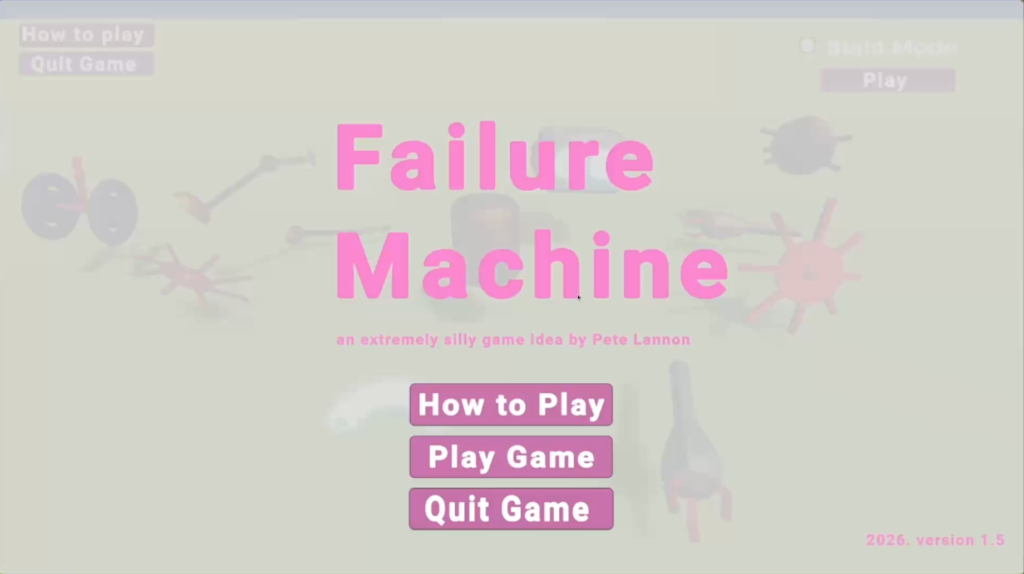
Screenshot of Failure Machine's title screen
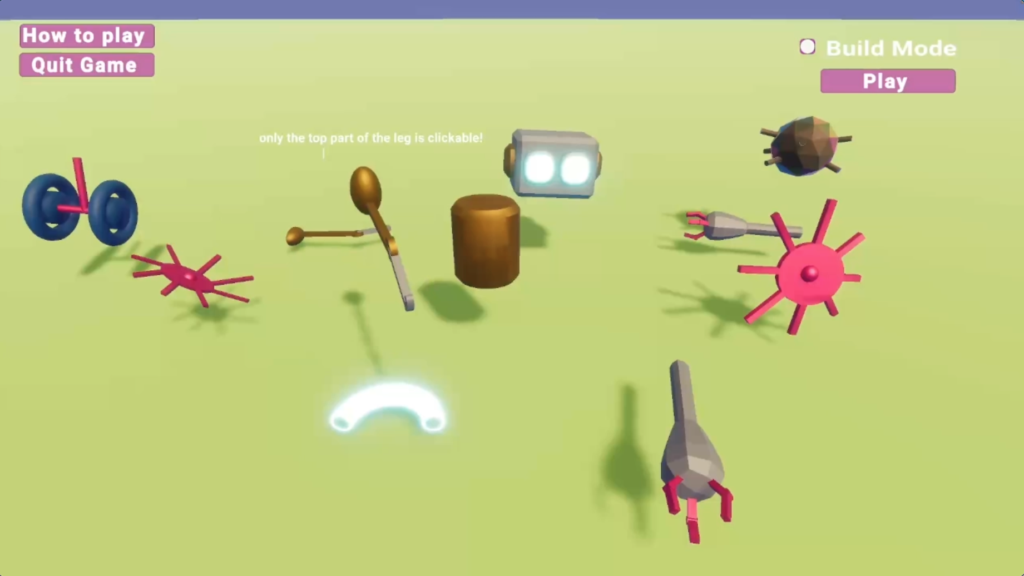
Screenshot from Failure Machine's Build Mode
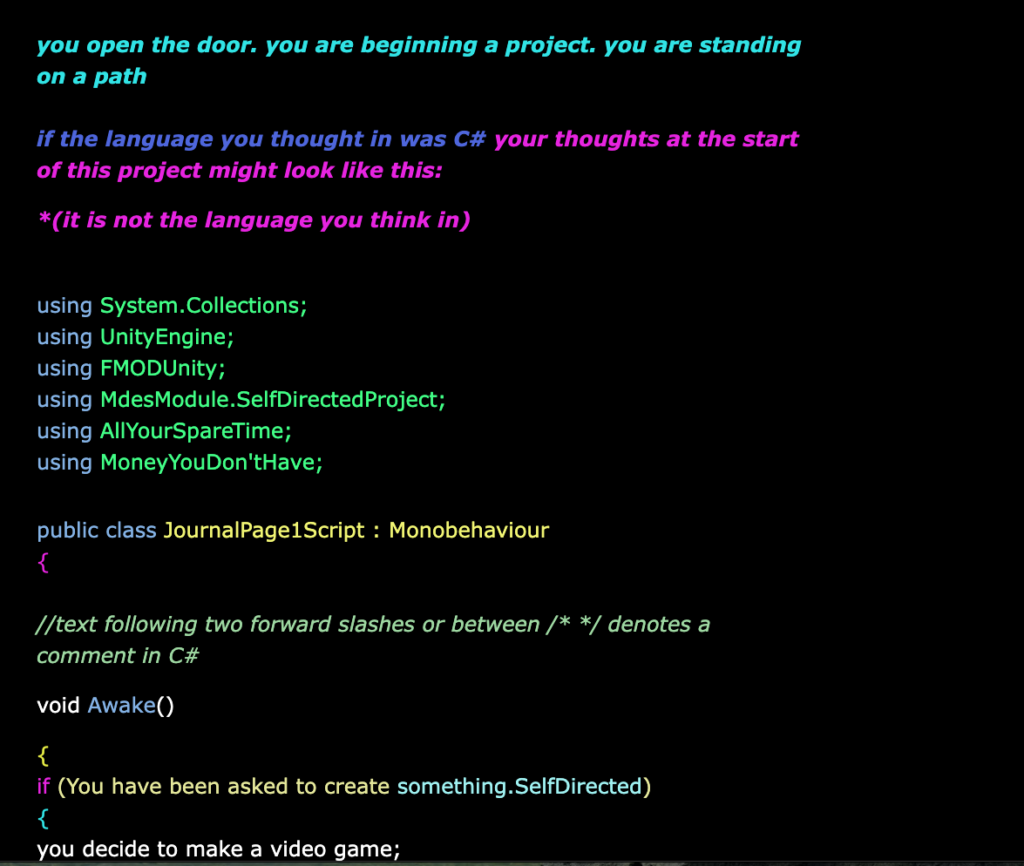
A screenshot of the opening of the Failure Machine journal game made in Twine.
The Vanishing Birds
A spatial audio work of narrative fiction made for 3rd-order ambisonics, designed to be played in an environment with 16 speakers.
A speculative work imagining a moment in which every bird in the world disappears, from three points of view.
Text by Pete Lannon & Kim Donohoe.
Performed by Ronan McMahon, Kim Donohoe and Pete Lannon.
Sound & music by Pete Lannon.
Binaural mix – please listen with headphones.
Echo Escape
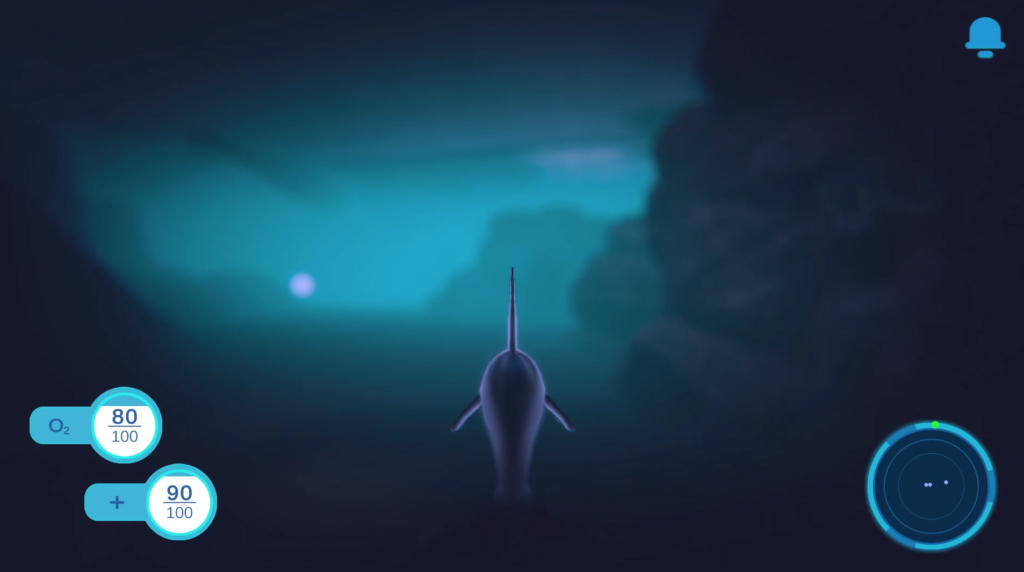
Echo Escape is a demo of a game in which you play as an Orca navigating the Strait of Gibraltar. Navigating with your echolocation, you must avoid the boats that swarm the strait and their destructive noise pollution.Echo Escape was an attempt to design a game with audio at its heart, tying the visual fidelity with the “echo” object and creating a responsive audio design that gave the player information about their environment and the dangers within. Using FMOD to create audio triggers and snapshots that transition between environments and change audio parameters based on proximity to other objects, boat size, and the orca’s status.
I created the music and the sound design for the gameplay, and implemented the dynamic audio.
Created as part of the Audio for Games elective with students from the Serious Games and Virtual Reality Course.
Designed by Marius Richter, Tianwei Yang and Pete Lannon.
The Man by the River (Clyde Built)
My first piece made on the Sound for Moving Image MDes. I wanted to use the starting point of the Clyde as a way to connect stories of men past and present, a considering of how those men have changed as the river has changed.