
Lili Xue
(she/her)
Lili Xue is a curator, writer and researcher based in Glasgow, currently completing the MLitt in Curatorial Practice (Contemporary Art) at The Glasgow School of Art. Her practice explores how exhibitions can become spaces for attention, uncertainty and embodied experience through writing, installation and collaboration.
With a particular interest in memory, translation and the uncanny, she develops research-led projects that invite slow attention, multiple interpretations and encounters between language, material and space. She is interested in moments when the familiar begins to feel strange, and in how estrangement may awaken curiosity and a renewed desire to explore. Rather than treating exhibitions primarily as explanatory structures, she seeks to create conditions through which audiences may sense, question and encounter the world differently.
Her interest in visual culture and writing began early. She drew throughout childhood, began writing literary prose as a teenager, and later developed fiction alongside her university studies. Before moving into curatorial practice, she worked across event production, marketing and professional services in Shanghai. These experiences developed her sensitivity to atmosphere, presentation and audience experience, as well as her skills in project coordination, stakeholder communication and working across institutional and cultural contexts.
Her current project, The Uncanny: What Remains, was developed with artists Subin Gang and Rebecca Rae. Bringing together poetry, installation, sound and collaborative material responses, the exhibition explores how writing, memory and fragments of language may be translated into spatial encounters.
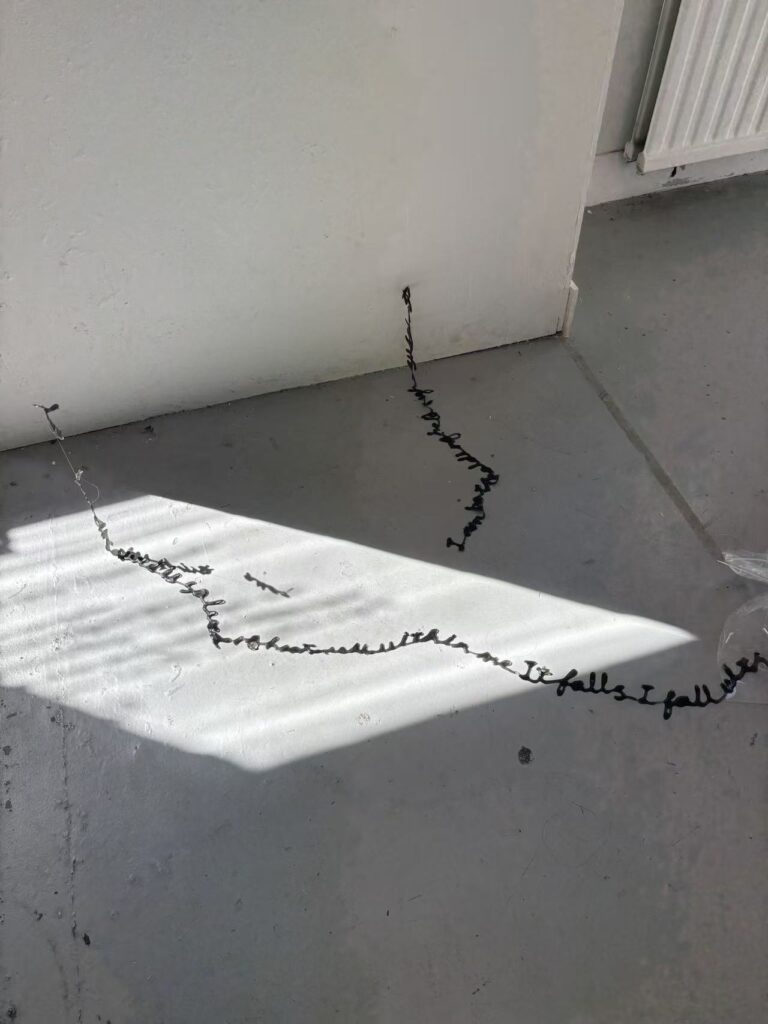
The Uncanny: What Remains
Curatorial Statement
The Uncanny: What Remains is a curatorial project developed by Lili Xue with artists Subin Gang and Rebecca Rae. Emerging from poetry, memory and fragments of language, the exhibition explores how writing may be translated into spatial, material and sonic encounters.
Through translucent curtains, partial texts, sound and collaborative material responses, the project invites visitors to move slowly through a space in which the familiar begins to feel strange. Rather than offering a fixed interpretation, it creates conditions for uncertainty, attention and multiple ways of encountering the work.
Artist Statements
Subin Gang
Swaying Poem treats language not simply as a tool for conveying meaning, but as a material surface that sways and transforms in response to its surroundings.
Lili’s poem is rendered in gelatine, a transparent and flexible material that responds to gravity, light, temperature, and humidity. Suspended in space, the letters remain partially legible while also blurring, folding, stretching, and changing shape. As a result, they may first be encountered as physical forms or material presences before they are read as language.
The work also emerges from a delay in the process of understanding the poem. As English is not Subin’s first language, its meaning is not immediately accessible. A second delay occurs through the ambiguity and indirect language of poetry itself. Produced through the conditions of collaboration, this double delay allows language to be encountered as something unfamiliar, temporarily detached from habitual meanings and assumptions.
In Swaying Poem, language occupies a shifting state between text, image, and sculpture. Rather than settling into a single, stable interpretation, the poem remains suspended: something that can be read, but also physically and spatially encountered.
Rebecca Rae
Based in Glasgow, Rebecca Rae is an emerging multidisciplinary artist whose work focusses on the comedic, vulnerable and repetitive absurdness of everyday ordinary life. They are currently working on exploring ideas of an “elsewhere”, a place where everything has a strange familiarity. Through sculpture, text, drawing and performance, they replicate copies of original objects and distort them until they resemble an object you faintly recall from some long-forgotten dream.
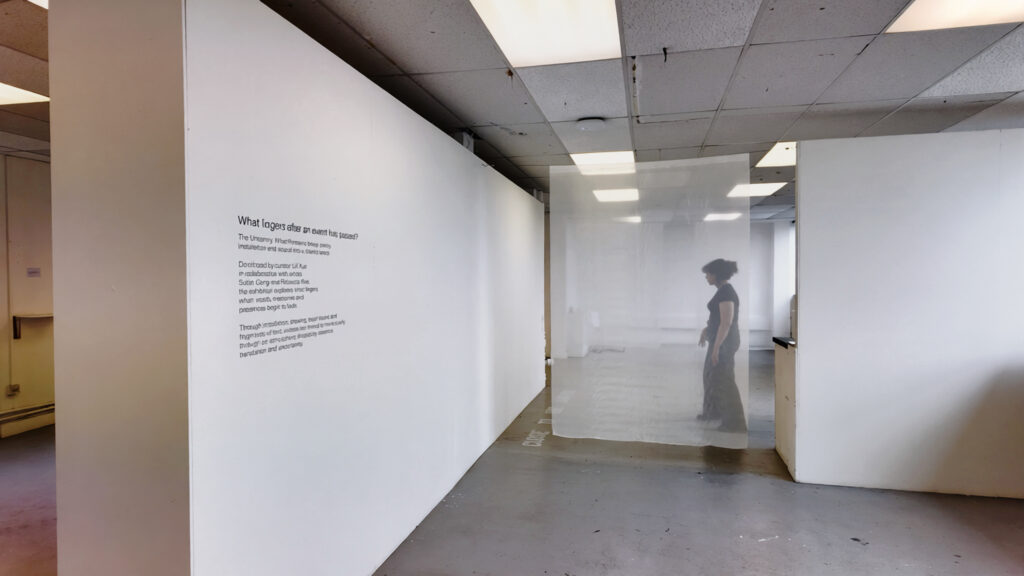
The Uncanny: What Remains, installation view, 2026. Curated and photographed by Lili Xue
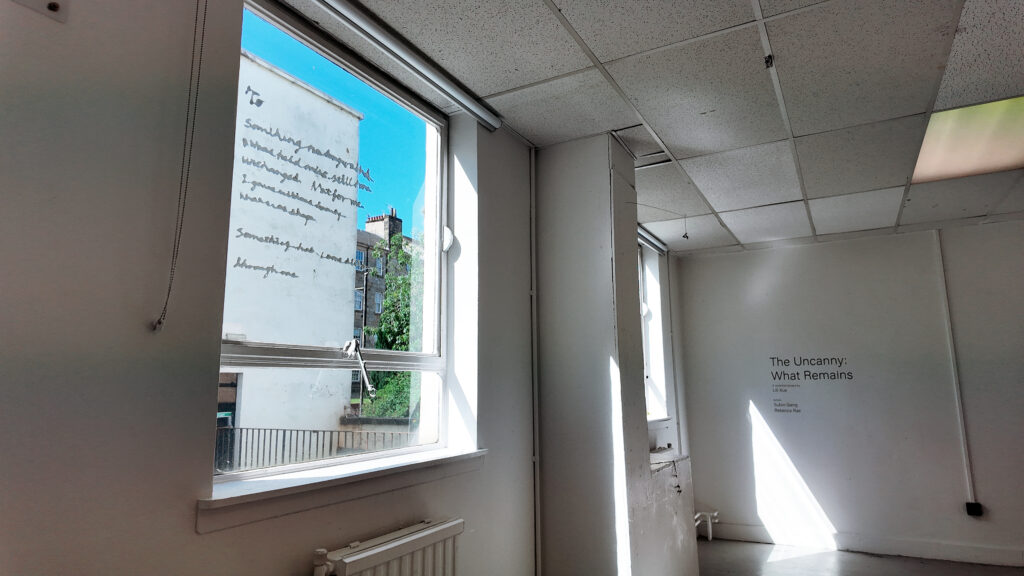
The Uncanny: What Remains, installation view, 2026. Curated and photographed by Lili Xue
Swaying Poem: In Conversation with Subin Gang, 2026. Filmed collaboratively by Subin Gang and Lili Xue, and edited by Subin Gang
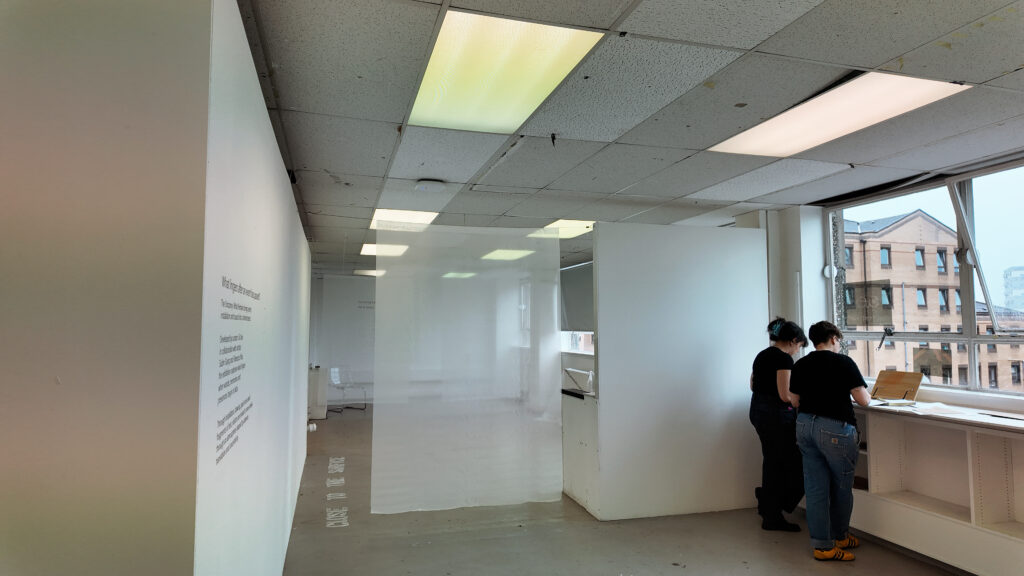
Visitors engaging with the exhibition materials in The Uncanny: What Remains, 2026. Photograph by Lili Xue
Lure in Loop, 2026. Sound work by Lili Xue, with voices by Subin Gang, Rebecca Rae and Lili Xue
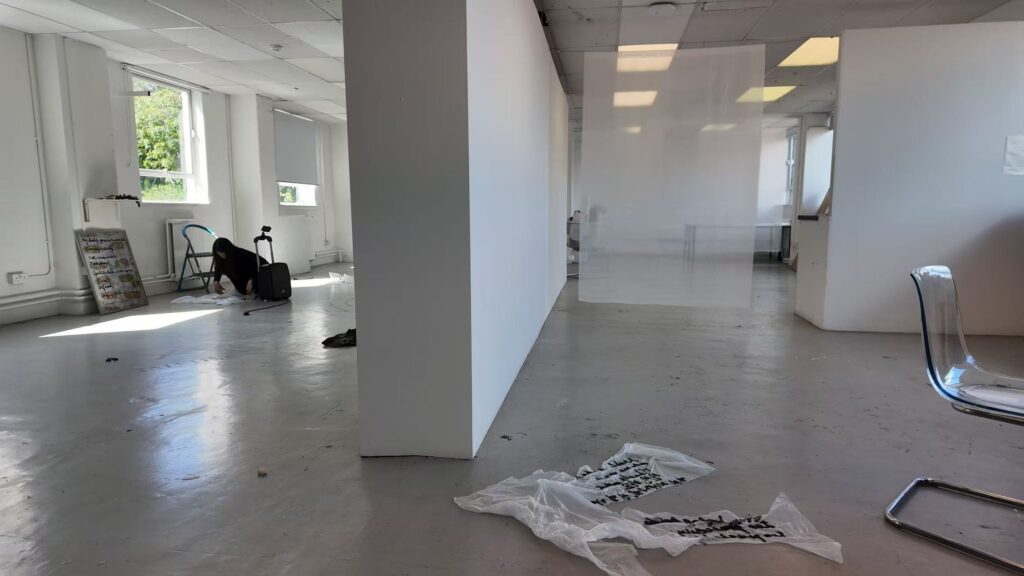
Subin Gang during the installation of The Uncanny: What Remains, 2026. Photograph by Lili Xue.
In Conversation with Rebecca Rae, 2026. Filmed and edited by Lili Xue.