
Shipeng Zhang
(ShiPeng Zhang)
I am fascinated by those invisible life signals. My works traverse the realms of art, biology and digital technology, using sensors, interactive programs, and video installations to listen to the internal fluctuations of plants.
I do not regard nature as an object to be admired, but instead attempt to establish a two-way perceptual dialogue. In my works, technology is no longer a cold tool, but a bridge that invites viewers to step out of their conventional human perspective and experience the existence states of other lives. The creation revolves around symbiosis, perceptual displacement, and species boundaries, and the media include installations, videos, and photography.
Silent Language
I took four pictures with distinct styles and used the same color scheme and edge-masking techniques for post-processing to showcase the communication and connection among plants.
This series of works adopts the unified visual language of the same color scheme (the characteristic tones of Scottish thistle flowers – red – gray – black) and edge-masking lines, transforming the life signals, communication networks, symbiotic relationships, and emotional connections of plants into perceptible visual forms. I hope to present the communication and connection between plants that go beyond human cognition through this.
Work One: “Flowing Life Patters”
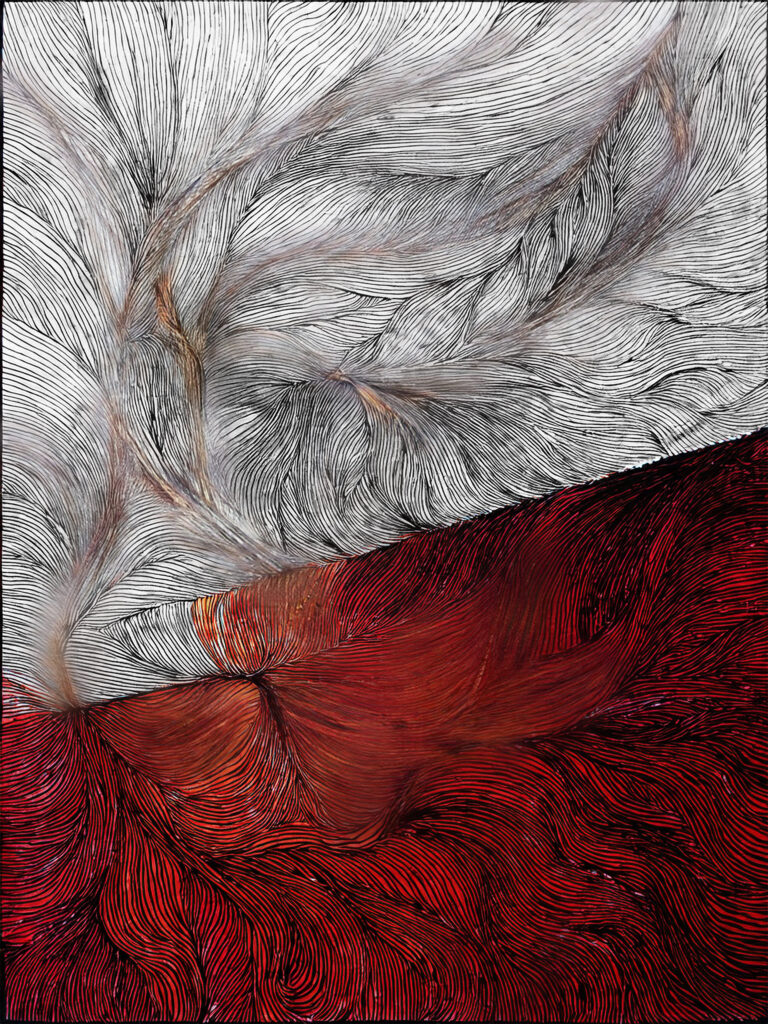
This work is a visual translation of plant electrical signals: the fine curves correspond to the biological electrical pulses that transmit information within the plants, the gray-white areas represent the silent growth state of the plants, and the red areas are the stress responses of the plants to external stimuli (touch, environmental changes). The intersection of the diagonal lines is not a separation, but an “interface” for signal transmission – the entanglement and connection of the lines symbolize the cross-regional communication achieved by plants through electrical signals, demonstrating the underlying logic of plants continuously transmitting information and connecting with each other in silence.
Work Two: “Collective Resonance in Tree Shadows”
Visual Content
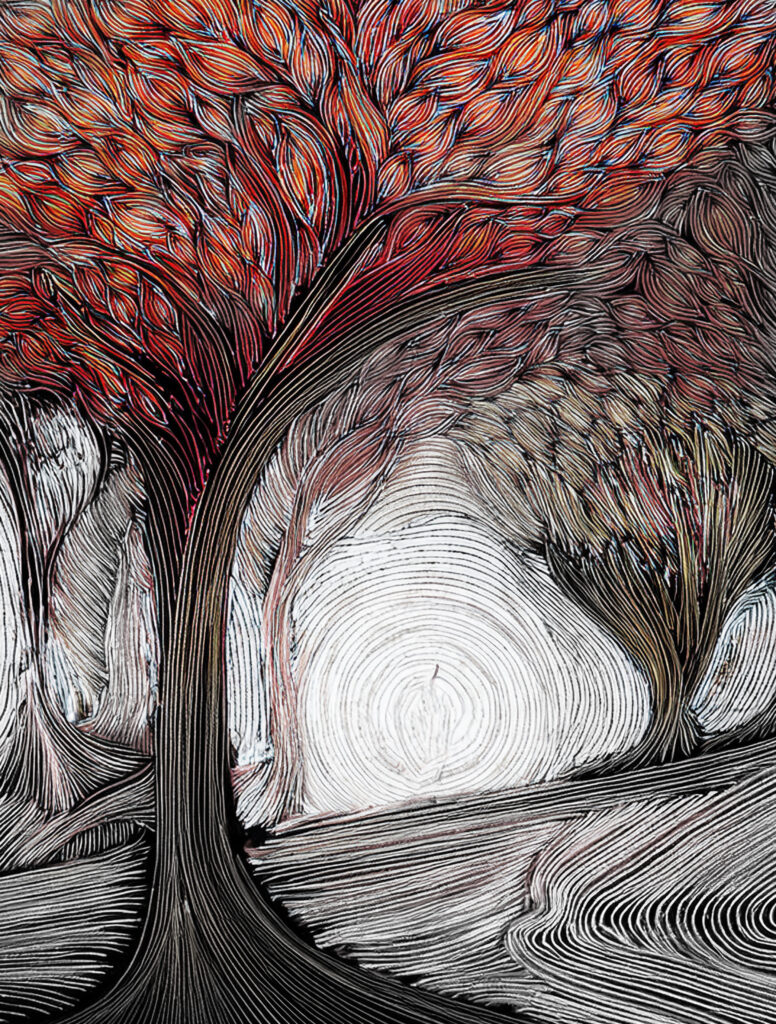
This work focuses on the symbiotic network of plant communities. The tree trunks are the “channels” for information transmission, the concentric rings at the center are the “resonance center” of the community, and the root systems on the ground are the visualized underground mycorrhizal network – plants share nutrients and transmit warning signals through the mycorrhizal system, forming a “forest internet”. The warm red tones represent the vitality of plants, the gray-white cold tones are the silent communication field, the mutual circling of the trees concretizes the collective connection of plants “watching out for each other and sharing information”, interpreting that plants are not isolated individuals but a mutually dependent life community.
Work Three: “Vertical Signal Web”
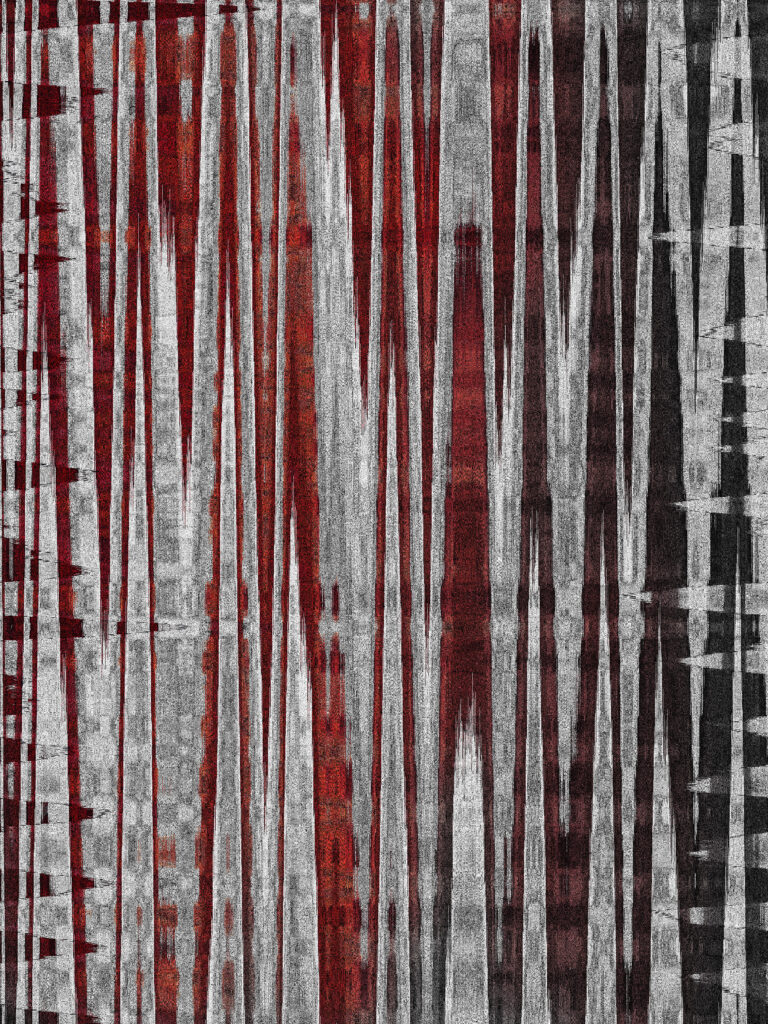
This work is an abstract expression of plant communication: the vertical lines correspond to the upward growth posture of plants, the interlaced grids represent the multi-dimensional communication network among plants – red represents the “alarm signals” transmitted by plants (such as pests, drought), gray represents the “nutrient sharing signals” of daily life, and black represents the hidden information transmission in the network. Additionally, I used edge-masking processing to dissolve the absolute boundaries of the lines, allowing the signals to flow freely in the intangible network, attempting to present the “silent but ubiquitous” connections in the plant world, thereby echoing the ecological essence of “interconnectedness of all things”.
Work Four: “Emotional Resonance in Vortices”
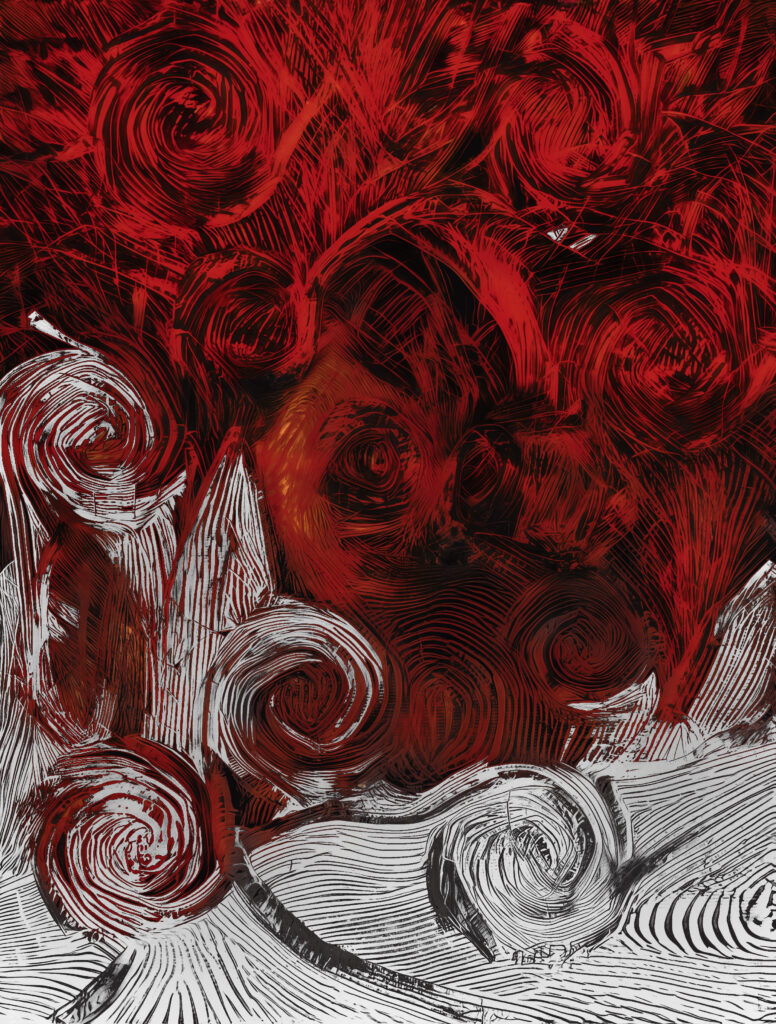
This work is a visual representation of plant emotions and consciousness: the spiral vortex is the concrete manifestation of plant life energy, red represents the “emotions” of plants, black represents the silent perception of plants, and the center’s golden color is the core of emotional resonance among plants. The entanglement and convergence of the vortex symbolize that plants can perceive each other’s life states and achieve emotional-level communication through the energy field, interpreting the deep connection between plants beyond physical contact, at the spiritual level.
For Sale: 500
For Sale: 500
For Sale: 500
For Sale: 500
The Self-Reflecting Thorn Bush
Human-centeredism has long limited human cognition. Humans have the dominant position and almost completely control narrative, aesthetics, and creation, while plants are relegated to being decorative props, food sources, and carriers of human emotions.
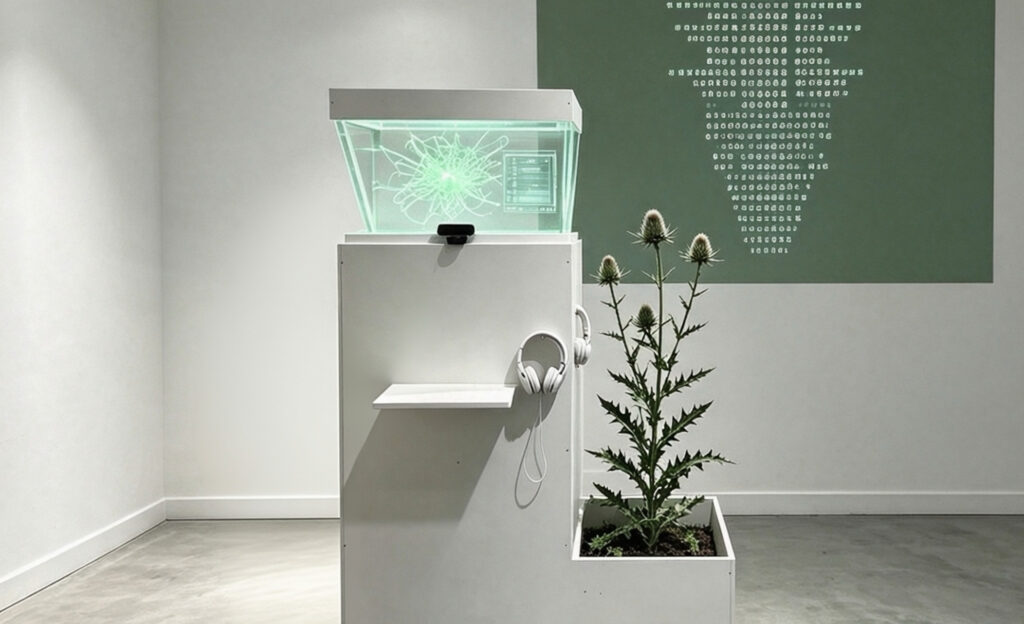
This interactive art piece draws on Scottish local culture and takes the Scottish thistle as the sole creative theme. This plant has a rare dual cultural identity: it is the national flower of Scotland and also the symbol of the thistle flower medal; however, it is also listed as an invasive weed and is often cleared using herbicides in farmlands and urban landscapes.
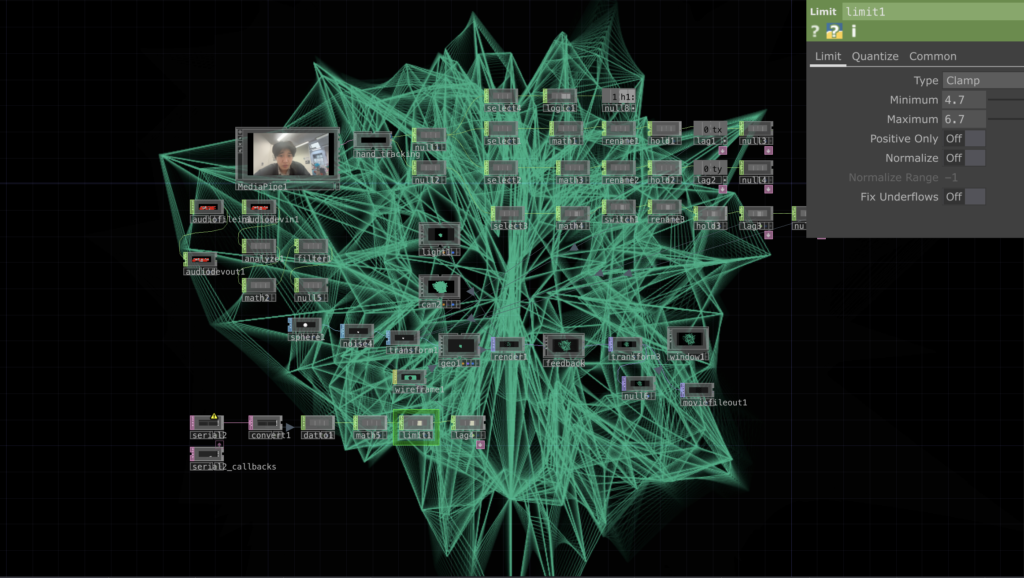
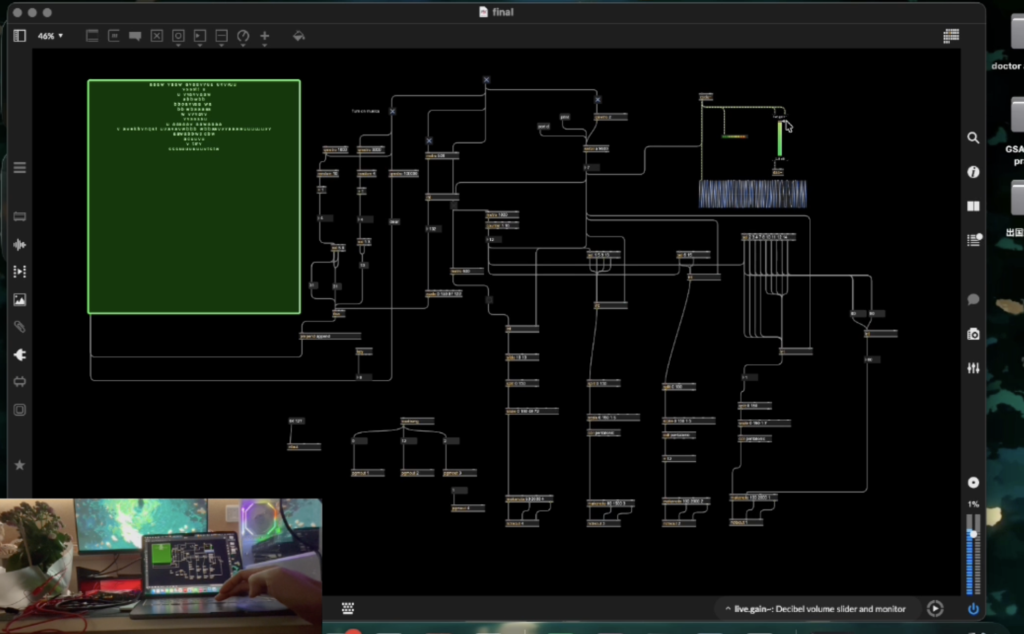
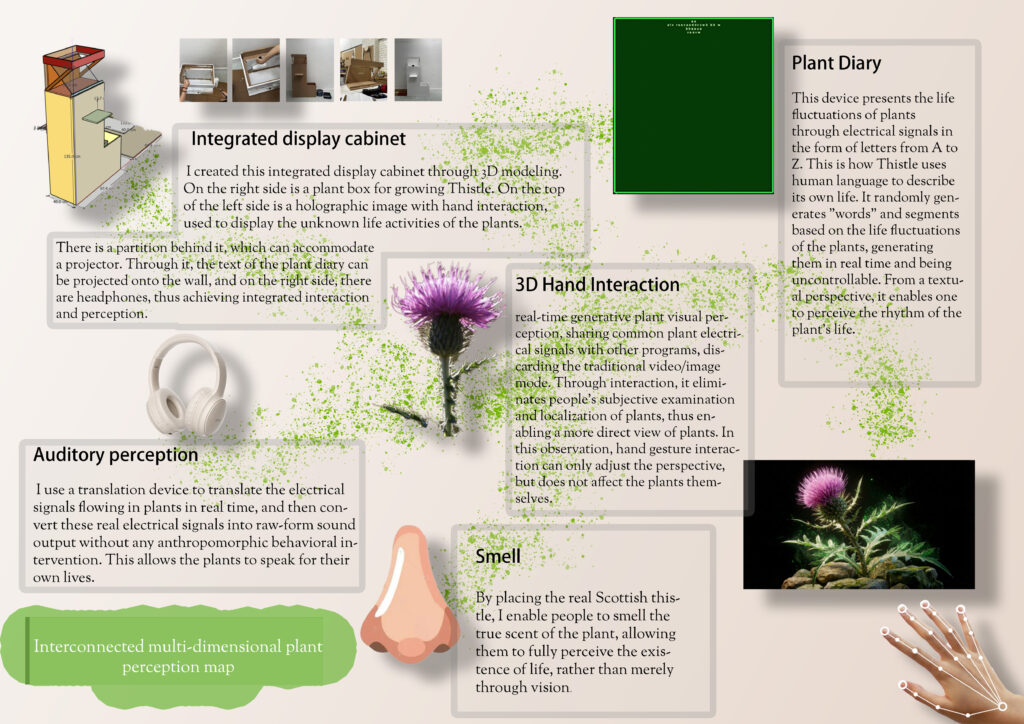
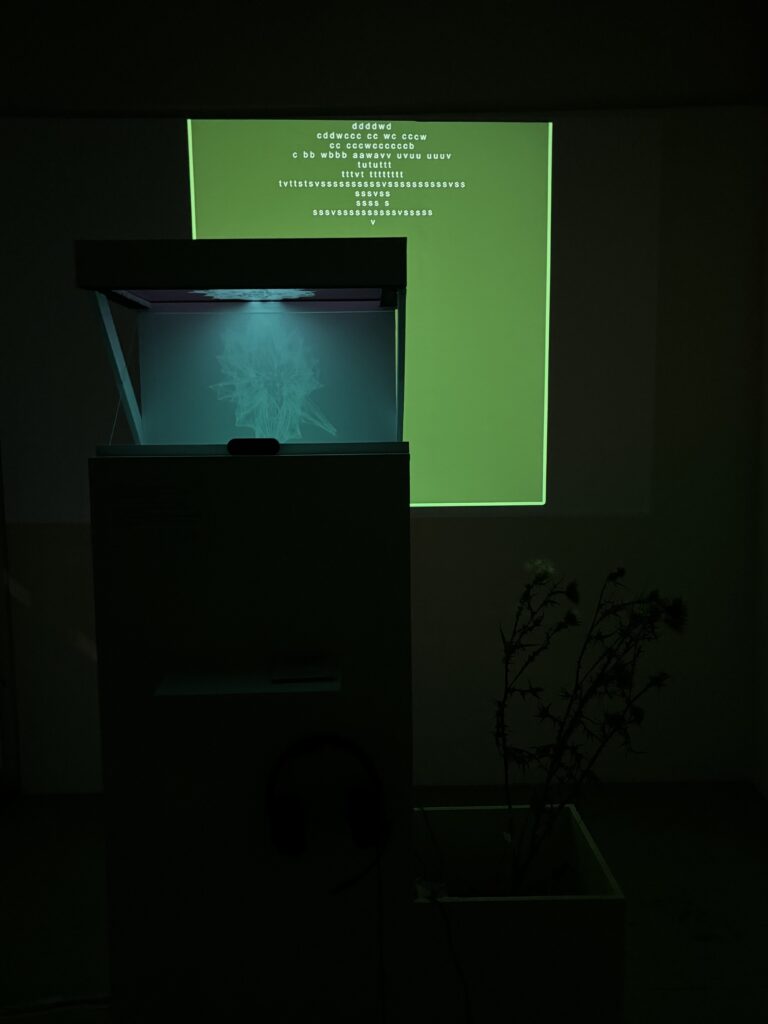
This research uses Plant SpikerBox hardware to objectively collect the electrophysiological data of native plants and builds a decentralized generation system based on Max and TouchDesigner, converting the action potentials of plants into emotionless diaries, native current sound fields, and low-intervention holographic images. The creator is defined as a transparent intermediary, fully returning the autonomous expression ability of plants and completely eliminating the human narrative hegemony over nature in media logic.
The entire multi-sensory field deliberately weakens the audience’s control and transformation capabilities over plants, relying on the four-layer sensory interaction of live Scottish thistle, text, holographic images, and native sound effects, to construct a cross-species symbiotic experience that directly touches upon common cognitive issues of the public, such as selective empathy, species identification, and labeling of weeds. Although the human interpretation of plant signal fluctuations as an inherent cognitive inertia cannot be completely eliminated, the multi-dimensional space narrative and theoretical annotations can still effectively weaken the subjective associations of the human-centered perspective, guiding the audience to break away from the utilitarian judgment framework of “useful/unnecessary” and recognize that plants have an independent and complete life perception system.
This practice proves that biosensing technology does not necessarily have to be a visual gimmick, but can be an effective carrier for critiquing species bias and practicing Donna Haraway’s theory of symbiotic creation; at the same time, it provides a differentiated creative path for local biotic art themed on wild plants, breaking away from the human-centered perspective, achieving a balance and unity of ecological philosophy, scientific data, and spatial artistic expression, and constructing a symbiotic perception field where humans, plants, and devices are mutually equal and intertwined.