
Zhengyang Jin
(He)
Chinese
FIVE MINUTES
The Rule Remains. The Body Varies.
In contemporary urban life, timetables, workplaces, public spaces and digital systems organise everyday behaviour into repeated routines. This project examines the first five minutes after waking, asking six participants to perform the same nine morning actions under a shared set of instructions. Their movements reveal subtle differences in wrist angle, direction, force, pause, range and trajectory.
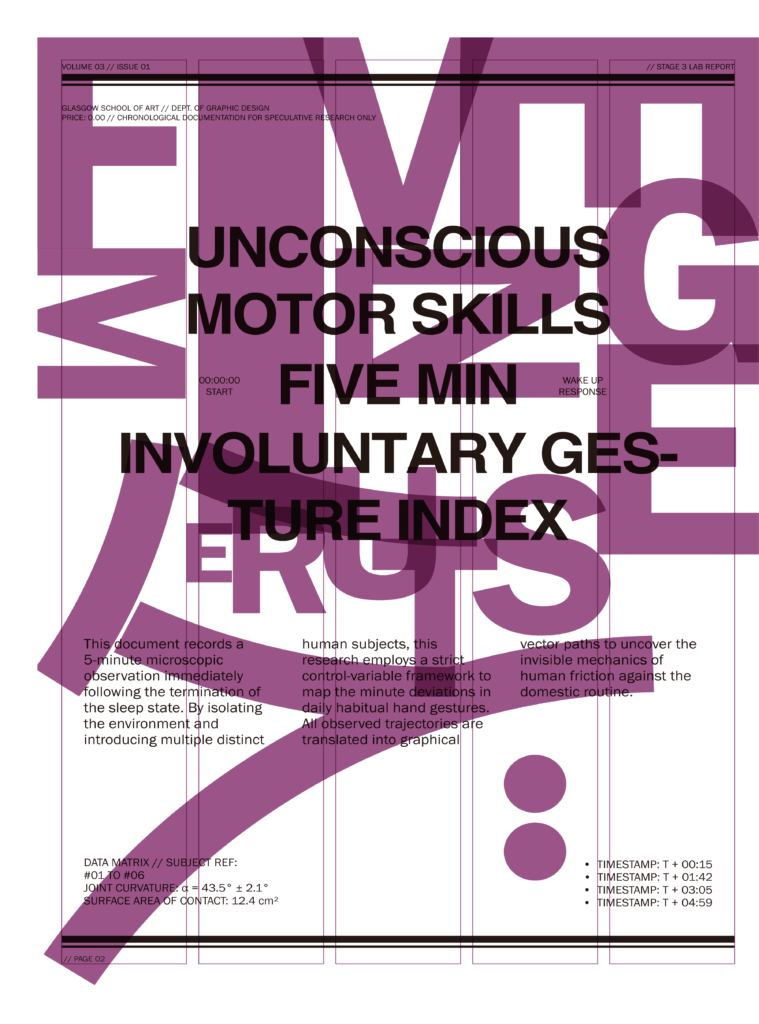
The recorded gestures are translated into dots, lines, arcs and abstract symbols, forming a visual language that makes these bodily variations visible. The symbols then move through a publication and a custom type system, interrupting consistent grids and geometric structures. Through the relationship between shared rules and individual movement, the project considers how standardised frameworks shape daily life while each body retains its own habits and rhythms. It invites viewers to look more closely at ordinary actions and recognise individuality within repetition: the framework can standardise an action, but it cannot fully define a person.
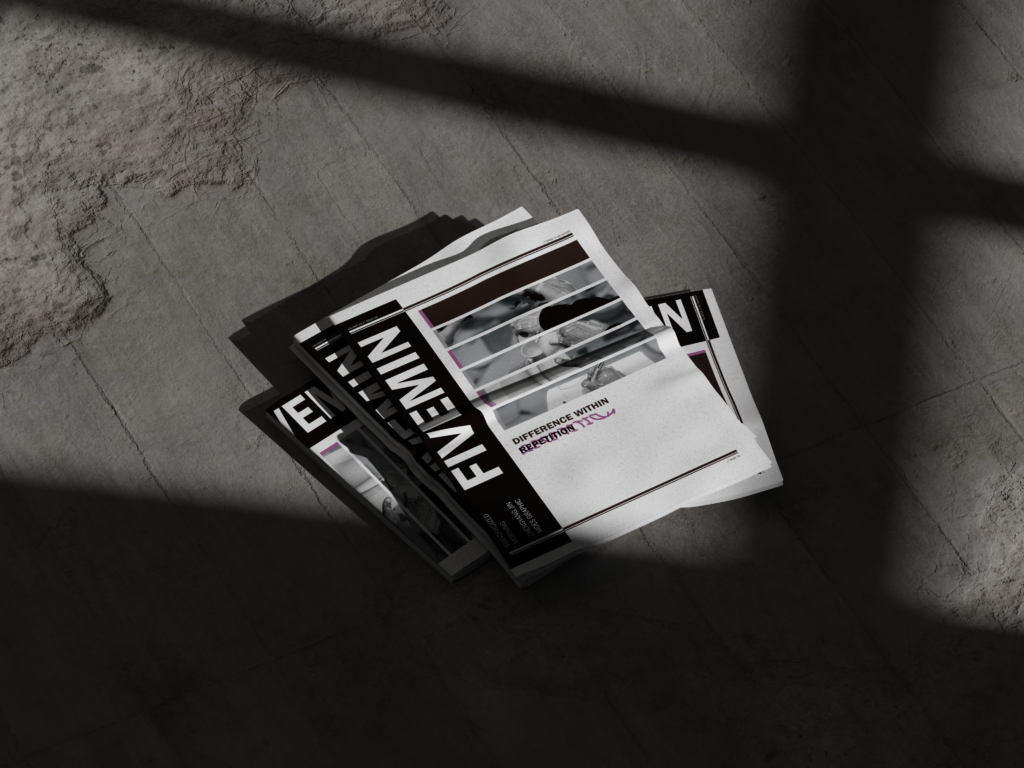
The cover establishes the project’s central relationship between repetition and difference. A controlled typographic structure provides a shared framework, while the gesture-derived forms introduce movement, variation and interruption.
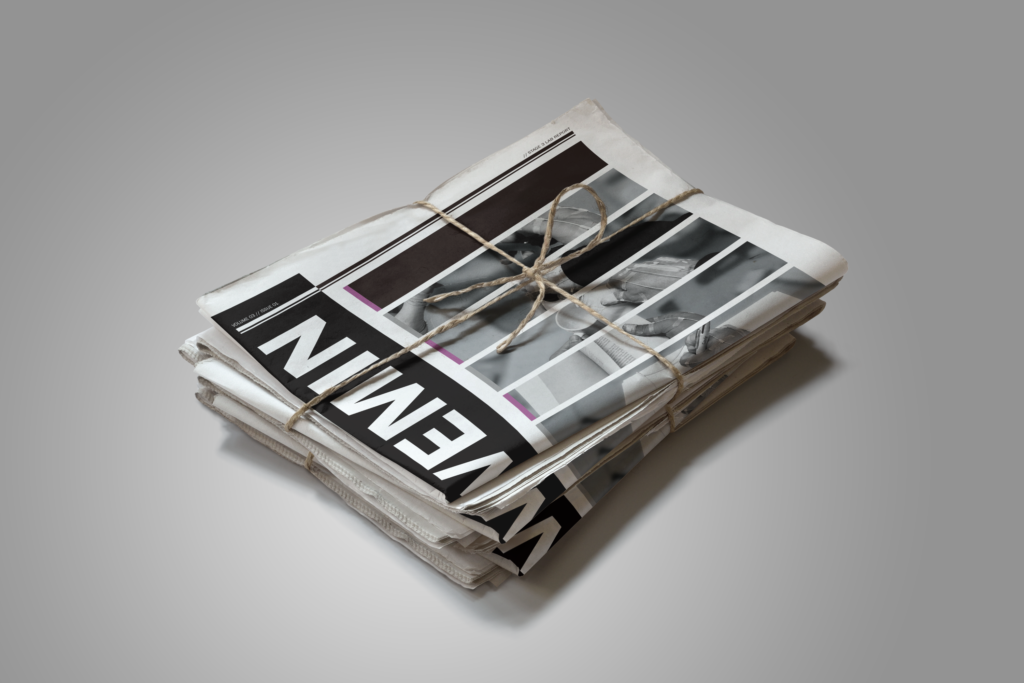
The cover establishes the project’s central relationship between repetition and difference. A controlled typographic structure provides a shared framework, while the gesture-derived forms introduce movement, variation and interruption.
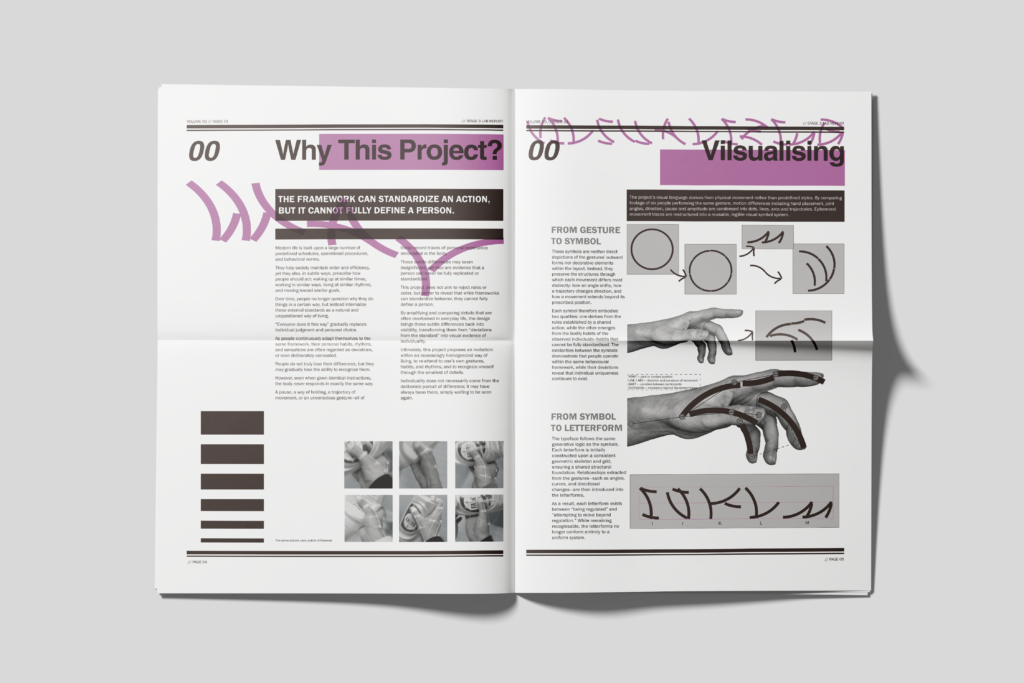
Nine ordinary actions form a shared five-minute morning score. Repeating the same sequence across six participants creates a consistent framework through which small differences in movement can be observed and compared.
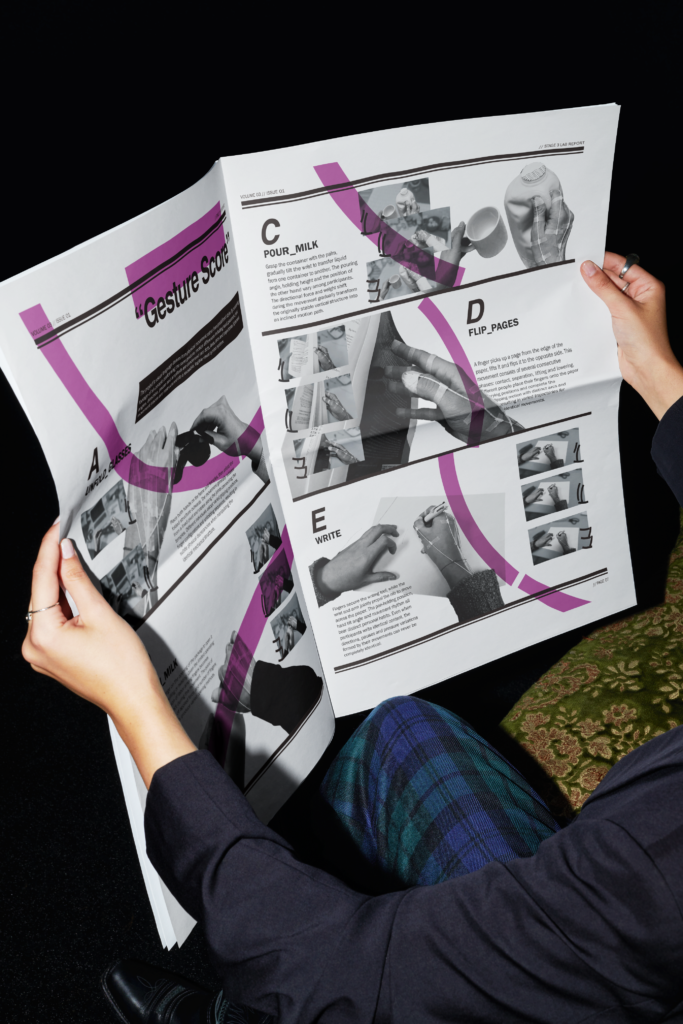
The newsprint format places the project within the material language of everyday life. Holding, unfolding and turning the publication slows down the viewing process, encouraging the reader to compare movements, symbols and participants across the sequence.
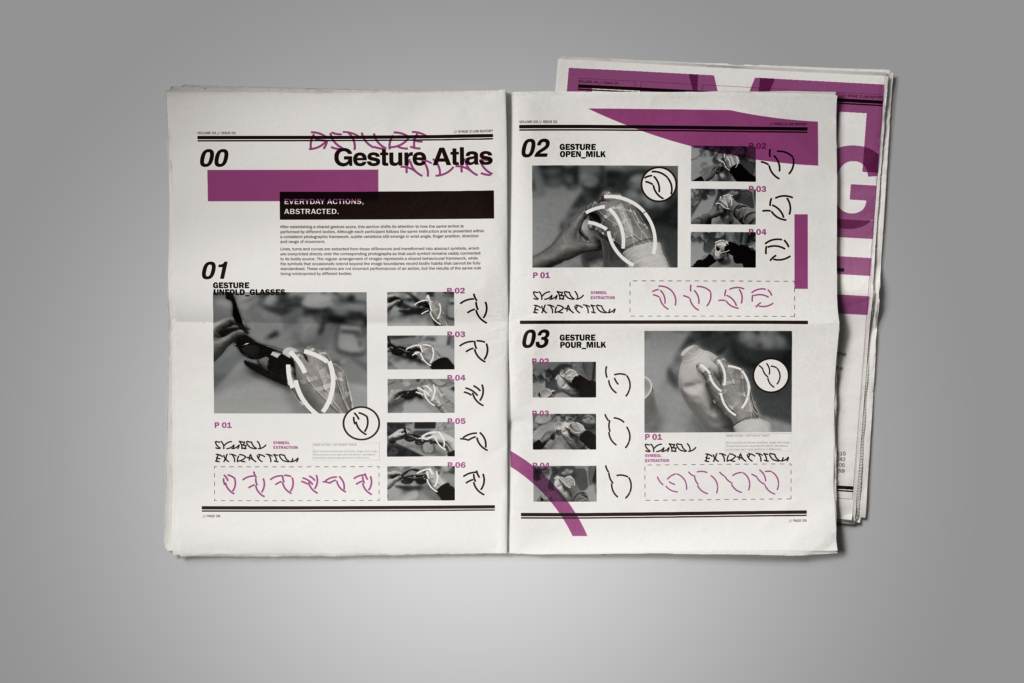
Six participants were recorded performing the same action under identical instructions. Placing the images together reveals differences in angle, speed, posture, direction and range that would usually disappear within the familiarity of the gesture.

Observable joints, angles, arcs, overlaps and trajectories are extracted from the recorded movements. These elements are condensed into a system of dots, lines and curves, preserving the structural characteristics of each participant’s gesture.
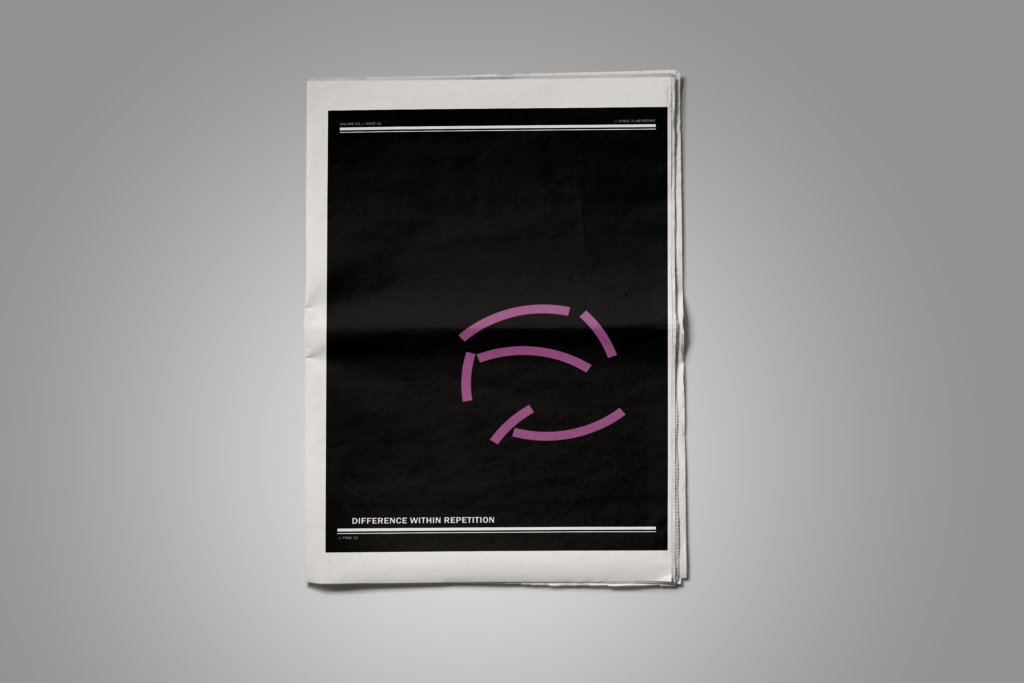
A stable grid reflects the systems that organise repeated daily behaviour. Gesture-derived symbols move across, overlap and extend beyond this structure, making individual variation visible within an otherwise controlled visual framework.