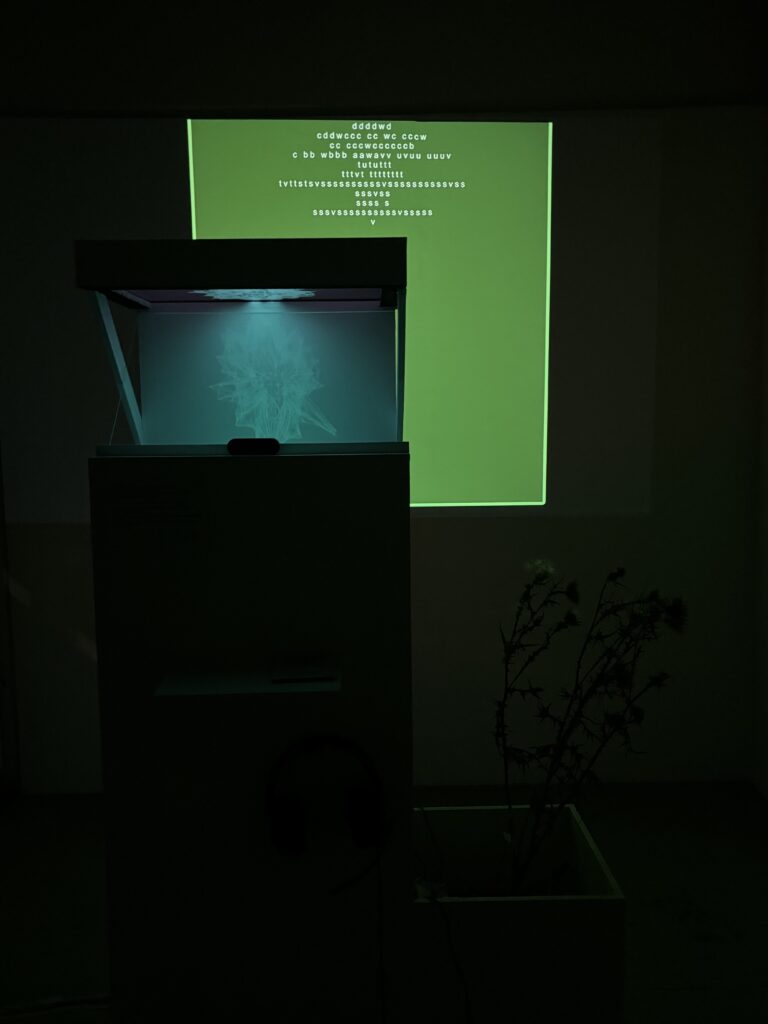
The Self-Reflecting Thorn Bush
Human-centeredism has long limited human cognition. Humans have the dominant position and almost completely control narrative, aesthetics, and creation, while plants are relegated to being decorative props, food sources, and carriers of human emotions.
This interactive art piece draws on Scottish local culture and takes the Scottish thistle as the sole creative theme. This plant has a rare dual cultural identity: it is the national flower of Scotland and also the symbol of the thistle flower medal; however, it is also listed as an invasive weed and is often cleared using herbicides in farmlands and urban landscapes.
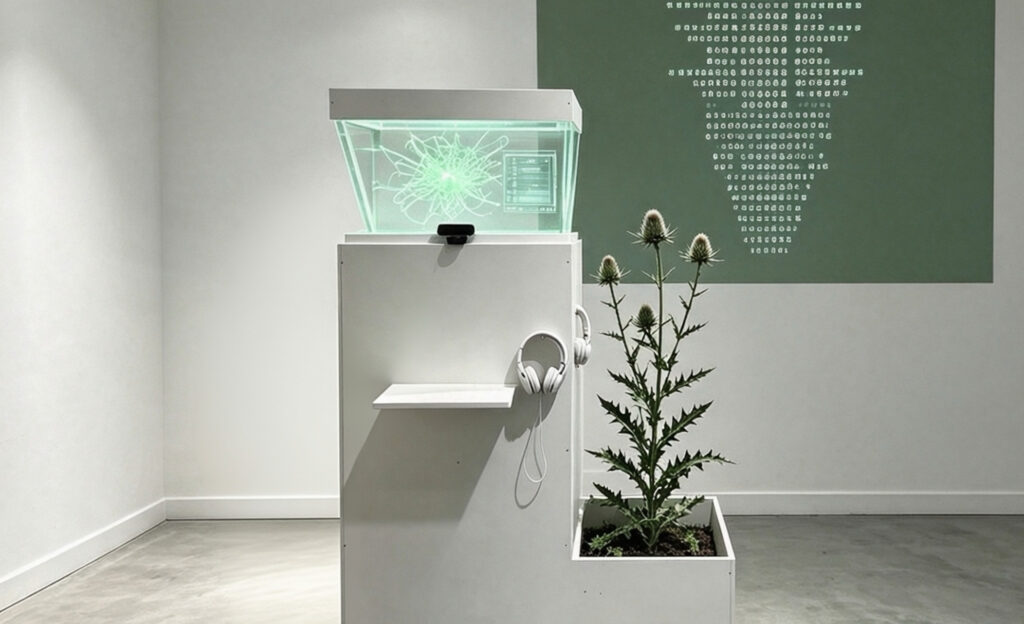
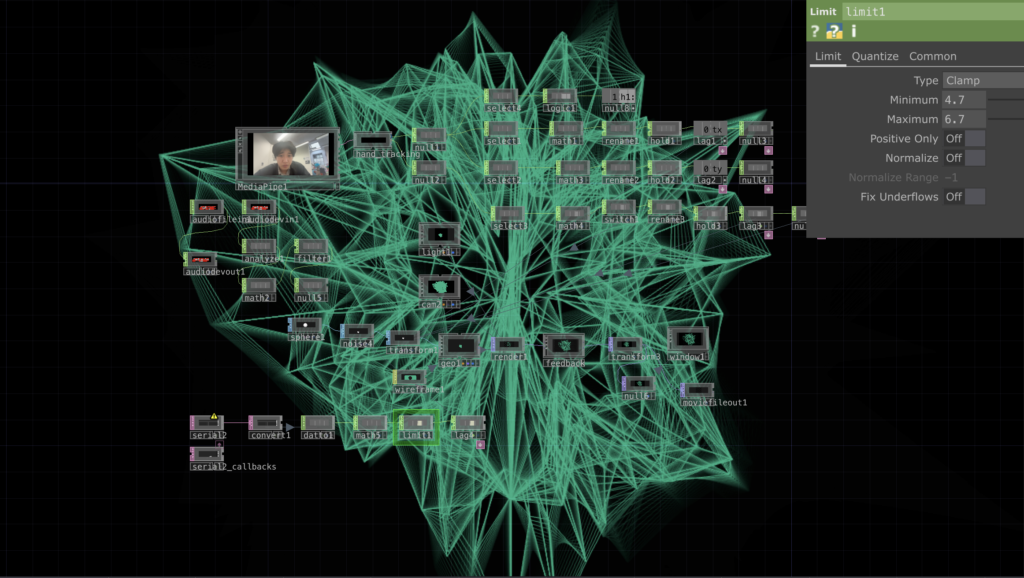
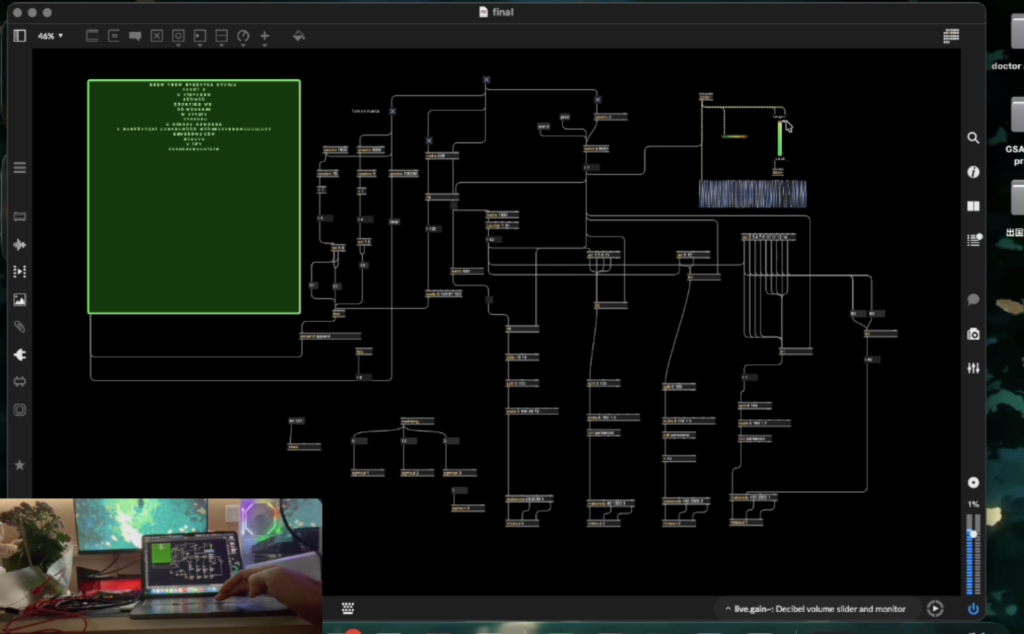
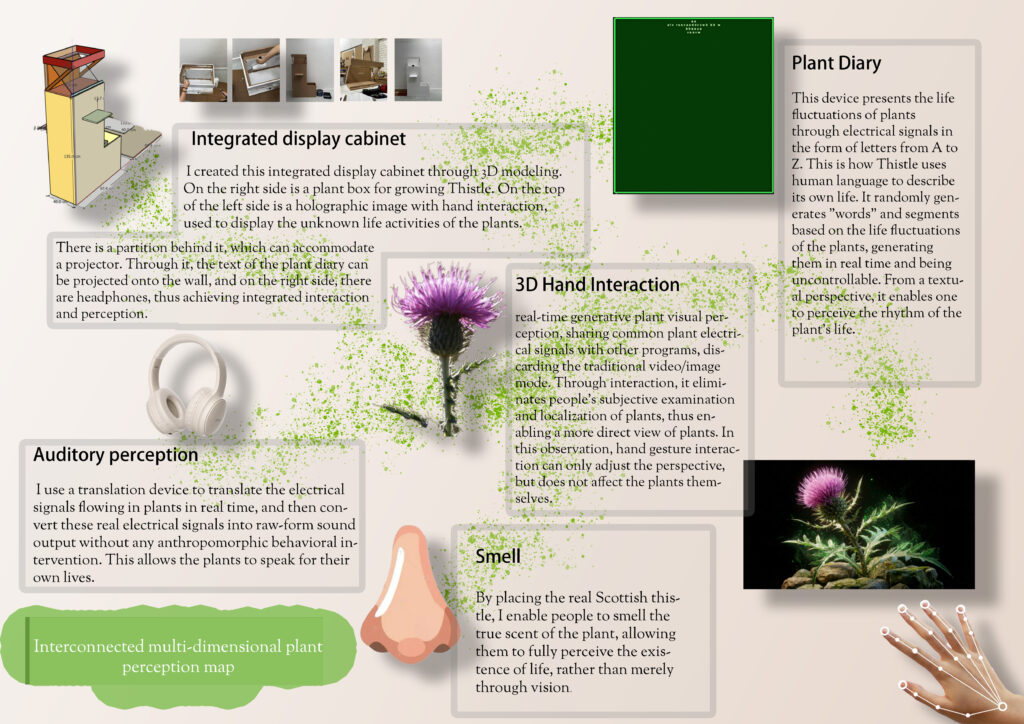
This research uses Plant SpikerBox hardware to objectively collect the electrophysiological data of native plants and builds a decentralized generation system based on Max and TouchDesigner, converting the action potentials of plants into emotionless diaries, native current sound fields, and low-intervention holographic images. The creator is defined as a transparent intermediary, fully returning the autonomous expression ability of plants and completely eliminating the human narrative hegemony over nature in media logic.
The entire multi-sensory field deliberately weakens the audience’s control and transformation capabilities over plants, relying on the four-layer sensory interaction of live Scottish thistle, text, holographic images, and native sound effects, to construct a cross-species symbiotic experience that directly touches upon common cognitive issues of the public, such as selective empathy, species identification, and labeling of weeds. Although the human interpretation of plant signal fluctuations as an inherent cognitive inertia cannot be completely eliminated, the multi-dimensional space narrative and theoretical annotations can still effectively weaken the subjective associations of the human-centered perspective, guiding the audience to break away from the utilitarian judgment framework of “useful/unnecessary” and recognize that plants have an independent and complete life perception system.
This practice proves that biosensing technology does not necessarily have to be a visual gimmick, but can be an effective carrier for critiquing species bias and practicing Donna Haraway’s theory of symbiotic creation; at the same time, it provides a differentiated creative path for local biotic art themed on wild plants, breaking away from the human-centered perspective, achieving a balance and unity of ecological philosophy, scientific data, and spatial artistic expression, and constructing a symbiotic perception field where humans, plants, and devices are mutually equal and intertwined.