
Ziyi Hua
(He/Him)
Designing a WebGL Career-Life Simulation to Support Youth Financial Literacy
Designing a WebGL Career-Life Simulation to Support Youth Financial Literacy
Ziyi Hua
Supervised by Kerri Thornton
August 2026
Dissertation submitted to The Glasgow School of Art
in partial fulfilment of the requirements for the award of
Master of Science in Serious Games & Virtual Reality
Abstract
This dissertation investigates how a short WebGL career-life budgeting simulation can communicate budgeting, saving, spending, credit, and opportunity cost to young people aged 11–18. Time to Talk Money was independently developed in Unity as a four-week, menu-driven prototype in which work, study, rest, percentage budgets, savings goals, emergency funds, purchases, random events, debt, and interest alter later choices. The research used a practice-based, prototype-led design with a formative mixed-methods evaluation. Eighteen adult GSA peers aged 21–28 played the same restricted WebGL build and completed 17 five-point rating items; 17 anonymous written response sets supplied qualitative evidence. Item-level counts, percentages, medians, IQRs, a straight-line sensitivity check, and inductive thematic analysis were used. Adult ratings were generally positive, with every item having a median of 4 in the full sample. Navigation, visible balances, interest in consequences, and perceived communication of financial concepts received the strongest support. Repeated daily decisions were weaker: E1 was positive for 14 out of 18, and the median of the seven non-straight-line records was 3. All 17 written respondents named at least one specific trade-off or delayed consequence. However, 12 hidden or persistent relationships and 15 shorter language or stronger visual scaffolding were identified. Based on the above, financial relationships are most understandable when the interface explains what will be exchanged before a choice, shows the immediate change, and keeps persistent reasons visible. These results are the adults’ initial impressions after a single session; they do not show learning, application, behaviour change or suitability for the target young people.
Declaration of Originality
All submitted dissertations will also be evaluated with Turnitin plagiarism software detection.
Name: Ziyi Hua
Course/Program: MSc Serious Games & Virtual Reality
Title of Work: Designing a WebGL Career-Life Simulation to Support Youth Financial Literacy
I confirm that all this work is my own except where indicated, and that I have (tick all boxes to confirm):
☒ Clearly referenced/listed all sources as appropriate
☒ Included a statement on the use of Generative AI and Assistive Technologies
☒ Referenced and added inverted commas to all quoted text (from books, journals, web, etc)
☒ Given the sources of all pictures, sound, data etc. that are not my own
☒ Not made any use of the report(s) or essay(s) of any other student(s) either past or present, or lifted extracts from web pages without appropriate referencing
☒ Not sought or used the help of any external professional agencies for the work
☒ Acknowledged in appropriate places any help that I have received from others (e.g. fellow students, technicians, statisticians, external sources)
☒ Complied with any other plagiarism criteria specified in course brief or other provided guidance
☒ I understand that any false claim for this work will be penalized in accordance with the GSA regulations
Signature (electronic): Ziyi Hua
Date: 15/08/2026
Acknowledgements
I would like to thank my supervisor, Kerri Thornton, for guidance on research scope, evaluation, session length, and clarity of presentation. I also thank Shona Cowan, external advisor, for the project context and permission to use the Time to Talk Money name. Finally, I am grateful to the 18 GSA peers who gave their time to test the prototype and provide anonymous feedback.
Table of Contents
Abstract……………………………………………………………………………………………………………. ii
Acknowledgements………………………………………………………………………………………….. iv
Table of Contents……………………………………………………………………………………………… v
List of figures…………………………………………………………………………………………………… ix
List of tables……………………………………………………………………………………………………… x
Chapter 1: Introduction……………………………………………………………………………………. 1
1.1 Background and Context………………………………………………………………………………….. 1
1.2 Research Aim and Questions…………………………………………………………………………….. 1
1.3 Project Scope and Contribution…………………………………………………………………………. 2
1.4 Dissertation Structure………………………………………………………………………………………. 2
Chapter 2: Literature Review……………………………………………………………………………. 3
2.1 Introduction…………………………………………………………………………………………………….. 3
2.2 Youth Financial Literacy and Everyday Money Decisions……………………………………. 3
2.3 Serious Games and Financial Literacy……………………………………………………………….. 4
2.4 Simulation, Experiential Learning and Financial Decision-Making……………………….. 6
2.5 Existing Financial Literacy Games and Practice Context……………………………………… 7
2.6 Designing Applied Games for Young People……………………………………………………… 8
2.7 Evaluation of Serious and Educational Games…………………………………………………….. 9
2.8 Research Gap………………………………………………………………………………………………….. 9
2.9 Conclusion……………………………………………………………………………………………………. 10
Chapter 3: Methodology………………………………………………………………………………….. 11
3.1 Introduction…………………………………………………………………………………………………… 11
3.2 Literature Search and Engagement Process……………………………………………………….. 11
3.3 Research Questions………………………………………………………………………………………… 13
3.4 Research Design and Evaluation Position…………………………………………………………. 13
3.5 Prototype Development Approach and Scope……………………………………………………. 14
3.6 Participants and Recruitment…………………………………………………………………………… 15
3.7 Evaluation Procedure……………………………………………………………………………………… 15
3.8 Questionnaire Design and Data Collection………………………………………………………… 16
3.9 Data Analysis and Mixed-Methods Integration………………………………………………….. 17
3.10 Ethical Considerations………………………………………………………………………………… 18
3.11 Methodological Limitations…………………………………………………………………………. 19
3.12 Conclusion…………………………………………………………………………………………………. 19
Chapter 4: Design and Development………………………………………………………………… 20
4.1 Introduction…………………………………………………………………………………………………… 20
4.2 Design Position and Project Context………………………………………………………………… 20
4.3 Learning Loop and Experiential Rationale………………………………………………………… 20
4.4 From Early Concept to Frozen Prototype………………………………………………………….. 21
4.5 Budgeting, Saving and Emergency Planning…………………………………………………….. 22
4.6 Work, Study, Skill, Career Progress, Health and Mood………………………………………. 24
4.7 Credit, Debt and Persistent Consequences………………………………………………………… 26
4.8 Interface, WebGL and Interaction Flow……………………………………………………………. 28
4.9 Feature Freeze and Evaluation Build………………………………………………………………… 30
4.10 Conclusion…………………………………………………………………………………………………. 31
Chapter 5: Evaluation and Findings………………………………………………………………… 32
5.1 Introduction…………………………………………………………………………………………………… 32
5.2 Participants and Response Completeness………………………………………………………….. 32
5.3 Procedure as Completed…………………………………………………………………………………. 32
5.4 Quantitative Results……………………………………………………………………………………….. 32
5.4.1 Usability………………………………………………………………………………………………… 32
5.4.2 Clarity……………………………………………………………………………………………………. 33
5.4.3 Engagement……………………………………………………………………………………………. 33
5.4.4 Perceived Educational Value…………………………………………………………………….. 33
5.5 Qualitative Findings……………………………………………………………………………………….. 35
5.5.1 Theme 1: concrete choices communicated trade-offs and delayed consequences 35
5.5.2 Theme 2: hidden and persistent relationships needed greater visibility…………… 36
5.5.3 Theme 3: youth-facing communication required shorter language and visual scaffolding 36
5.5.4 Theme 4: events and goal rewards supported engagement, while repetition remained 36
5.6 Mixed-Methods Integration…………………………………………………………………………….. 37
5.7 Conclusion……………………………………………………………………………………………………. 37
Chapter 6: Discussion……………………………………………………………………………………… 38
6.1 Introduction…………………………………………………………………………………………………… 38
6.2 Usability, Clarity and Engagement…………………………………………………………………… 38
6.3 Communication of Financial Concepts…………………………………………………………….. 39
6.4 Adult Formative Evaluation and the Intended Youth Audience…………………………… 41
6.5 Limitations and Future Research……………………………………………………………………… 41
6.6 Conclusion……………………………………………………………………………………………………. 42
Chapter 7: Conclusion…………………………………………………………………………………….. 43
7.1 Answer to the Research Question…………………………………………………………………….. 43
7.2 Project Contribution……………………………………………………………………………………….. 43
7.3 Limitations……………………………………………………………………………………………………. 44
7.4 Future Work………………………………………………………………………………………………….. 44
References………………………………………………………………………………………………………. 45
Appendix A: Tools, Software and Assistive Technologies…………………………………. 48
Principal Tools and Software……………………………………………………………………………………. 48
Generative AI and Assistive Technologies Statement………………………………………………….. 48
Appendix B: Ethics and Participant Documentation………………………………………… 49
Participant Information Sheet Issued to Participants……………………………………………………. 50
Blank Consent Form Issued to Participants………………………………………………………………… 53
Appendix C: Evaluation Instruments………………………………………………………………. 54
Post-Play Questionnaire…………………………………………………………………………………………… 54
Background Information………………………………………………………………………………………….. 54
Session Checks……………………………………………………………………………………………………….. 54
Agreement Statements……………………………………………………………………………………………… 54
Usability…………………………………………………………………………………………………………….. 54
Clarity………………………………………………………………………………………………………………… 55
Engagement………………………………………………………………………………………………………… 55
Perceived Educational Value…………………………………………………………………………………. 55
Open Questions………………………………………………………………………………………………………. 55
Appendix D: Qualitative Coding Framework and Audit Trail………………………….. 57
List of figures
Figure 4.1. Initial goal, employment and percentage-based budget-plan decisions.
Figure 4.2. Work, Study and Rest choices used to communicate opportunity cost.
Figure 4.3. Credit as an immediate resource and a persistent debt.
Figure 4.4. Subscription Renewal as a recurring-cost decision.
Figure 4.5. Final prototype interaction flow derived from TimeToTalkMoneyPrototypeUI.cs.
Figure 4.6. Weekly and final summary interfaces.
Figure 5.1. Distribution of responses across the 17 post-play agreement items (n = 18).
Figure 5.2. Written-response sets contributing to each qualitative theme (n = 17).
List of tables
Table 4.1. Early concept compared with the frozen prototype.
Table 4.2. Weekly percentage plans in the frozen prototype.
Table 5.1. Usability item responses (n = 18).
Table 5.2. Clarity item responses (n = 18).
Table 5.3. Engagement item responses (n = 18).
Table 5.4. Perceived educational-value item responses (n = 18).
Table 5.5. Group-level mixed-methods integration.
Chapter 1: Introduction
Financial literacy involves more than recalling terms: everyday decisions connect income, spending, saving, borrowing, risk, well-being, and future options. This dissertation investigates how those relationships can be represented in a short browser-based simulation and how participants perceived the resulting prototype.
Time to Talk Money is intended for young people aged 11–18. Its dissertation-stage evaluation involved adults because the young people expected through the external-advisor context were unavailable before submission. Adult feedback can guide interface and communication revisions, but it cannot establish youth learning or age-appropriateness.
1.1 Background and Context
The European Union/OECD (2023) framework refers to the application of knowledge, skills, attitudes and behaviours in money management, planning, risk and the broader financial environment as youth financial literacy. Time to Talk Money has reduced the scope of this large field to budgeting, needs and wants, saving, emergencies, credit, debt and opportunity cost; these concepts can be expressed as choices that affect future resources.
Previous studies have shown that financial literacy is positively associated with behaviour, and serious-game results vary depending on the design and teaching context (Wouters et al., 2013; Amagir et al., 2018; Kalmi and Rahko, 2022). Therefore, a simulation is considered to be a representation of connected decisions rather than a measure of their effectiveness, and the specific methods and shortcomings of such studies will be presented in Chapter 2.
The project has a concrete case of use. Shona Cowan provided the project name, external-advisor information, and revised 11-18 brief. The prototype was independently implemented in Unity and not developed based on Team SH15’s previous technical work. Kerri Thornton proposed shortening the length of play to about 10-15 minutes and strengthening wording and layout, thereby determining the main design problem as how to keep an inspiring effect without an internal financial circulation system.
1.2 Research Aim and Questions
The purpose of this study is to design and critically assess a compact WebGL simulation that presents some financial relationships through career-life choices and corresponding feedback. The basic problem is: How to design a WebGL career-life budgeting simulation that can convey financial literacy ideas such as budgeting, saving, spending, credit and opportunity cost to young people aged 11-18?
Supporting question: How do the adult participants evaluate the convenience, simplicity, interest and sense of learning of the prototype? The two kinds of evidence are asked. The realised artefact and the documented design rationale address how the concepts were represented; post-play ratings and written responses identify how one adult sample perceived that representation.
1.3 Project Scope and Contribution
Finally, a four-week Unity/WebGL simulation has been created to link income, budgeting, savings, spending, credit, emergencies and career-life choices through continuous effects. Application and prototyping convert general educational goals into observable norms. Study, for example, sacrifices current income for skills and later earning potential; credit solves an immediate problem by moving costs into future debt and interest.
Eighteen adult GSA peers aged 21-28 played the same restricted itch.io build and completed a custom post-play questionnaire. All 18 quantitative records were complete, and 17 individual written response sets were collected verbatim. Because the anonymous datasets could not be linked to individuals, only quantitative trends and qualitative explanations at the group level were used.
The three components are the independent artefact, the documented Design rationale and the transparent formation evidence base. It also forms a basic Design idea based on the connection between mechanics and feedback: explain a financial exchange before selection, show its immediate effect, and maintain an ongoing cause that will affect the future. The principle provides a special path for the future youth-oriented test.
1.4 Dissertation Structure
Chapter 2: Review of Youth Financial Literacy, Serious Games, Simulation, Existing Practices, Youth Participation and Evaluation. Chapter 3 is the literature study, research design, recruitment, remote operation, questionnaires, analysis, ethics and methodological limitations. Chapter 4 documents the implemented systems and the transition from early concept to frozen build. Chapter 5 is the research results; Chapter 6 is a comparison with previous studies; and Chapter 7 answers the research questions and discusses the contributions and deficiencies of this study.
Chapter 2: Literature Review
2.1 Introduction
This chapter presents the concept and supporting data for Time to Talk Money. The four links are: financial literacy for young people; the effect of serious games and simulations; youth participation in applied-game design; and suitable evaluation. We do not seek support for the game-based financial literacy education; we need to know what kind of proof each type of evidence can provide.
Therefore, there are types and kinds of evidence. Policy frameworks build competence, systematic reviews find cross-study patterns, intervention studies examine measured outcomes in specific populations, and product pages present current practices rather than effectiveness. Based on the above sources, the following design and experiment have been carried out.
2.2 Youth Financial Literacy and Everyday Money Decisions
The European Union/OECD (2023) has divided the competencies of children and young people into four areas in the financial literacy framework: Money and Transactions; Planning and Managing Money; Risk and Reward; and Financial Landscape. It is a system of policies for guiding curricula, programmes, games and assessment rather than an experiment in a single intervention. Thus, its purpose here is classification. Financial literacy is applying what we have learned about money to solve practical problems in life. That definition covers decisions on expenditure and saving, income and debt, etc., but it does not show that the framework itself is a digital simulation.
Amagir et al. (2018) have compiled data on school-based financial education programs from 2004 to 2015 and provided a reference basis. They used ERIC, Business Source Premier, EconLit and Web of Science for database searches, added journal and reference-list checks to the database search, and included experimental studies and reviews on knowledge, skills, attitudes, confidence or behaviour. Programs may increase people’s awareness and interest in finance, but there is no evidence to support the claim that they have changed behaviour. Experiential learning and age-appropriate, real-life situations were promising, but many studies failed to detail the teaching methods or transferable learning. The two-part implication is that practical activity can make financial ideas meaningful without extending behaviour outside the learning environment.
Together, the framework and the review limit the educational scope of Time to Talk Money. The prototype does not aim to teach advanced investment products or cover all the competences in the European Union/OECD framework. Focus on recurring decisions that can be made reasonably in a short career-life simulation, such as allocating income, differentiating needs from wants, saving for emergencies, managing credit and debt, linking study or work choices to later resources, etc. Therefore, the framework can connect to multiple domains and will have real-world applications, as proposed by Amagir and others. The synthesis is not that these topics are intrinsically better taught through games; rather, they can be introduced gradually as unfolding consequences over time to provide a foundation for players to explain how their choices affect subsequent choices.
It also specifies what is meant by financial learning in this thesis. Recognising a definition is a knowledge outcome; choosing to keep an emergency fund after an unforeseen expense is an applied judgment; altering actual financial behaviour is a behavioural result. The results have different proofs. Literature supports treating knowledge, judgement and behaviour as related but not interchangeable; thus, the following chapters do not use participant enjoyment or self-reported clarity as evidence of behaviour change. The framework provides the content categories, and the empirical review offers a caution that the transfer beyond the intervention should be studied separately.
2.3 Serious Games and Financial Literacy
Zyda (2005) considers a serious game to be a rule-based computer activity that uses entertainment for the sake of education or training. The first requirement is not the availability of teaching materials. A serious game should add a playable system of goals, rules, decisions and feedback to its non-entertainment purpose. Time to Talk Money meets that design requirement when players make constrained career-life and budget decisions, face consequences, and revise their choices later; the label itself does not claim educational success.
Connolly et al. (2012) have compiled the results of 129 empirical computer-game and serious-game studies on participants aged 14 and over systematically. Knowledge acquisition, content understanding and affective or motivational outcomes were the most frequently occurring positive results. The research subjects, designs and indices in these studies were all different. Although the review supports the possibility of multiple learning experiences, its diverse studies do not justify assuming the same effect for this financial-literacy prototype. A motivating effect in one subject does not lead to learning in other subjects, and it also fails to inspire continuous learning.
Wouters et al. (2013) have carried out meta-analyses on 77 learning comparisons and 31 motivation comparisons with 5,547 and 2,216 participants, respectively, to expand this work. Serious games showed a small advantage over traditional teaching in learning (d = .29) and retention (d = .36), but were not significantly more motivating (d = .26). The learning effect was strongest when games were combined with teaching, played several times, and used in cooperation. Therefore, the form of the game alone is not sufficient to motivate. Gameplay can be regarded as a part of the instructional sequence, and through explanation, repeated practice and reflection, learning may be achieved.
Hoseiny and Niknafs (2020), and Kalmi and Sihvonen (2022) have provided supporting conceptual references but not primary outcome data. The former introduces serious games for financial literacy, and the latter investigates the compatibility of education and entertainment in financial games. Together, they create a setting of scarce resources, uncertainty, delayed rewards and conflicting goals for play; this dissertation does not use them as the basis for measured learning.
Kalmi and Rahko (2022) are more direct evidence. They administered pre- and post-intervention questionnaires to 640 lower-secondary students in 42 Finnish schools to compare three game-based financial literacy interventions and their combinations with a control group receiving traditional teaching. Gains in financial knowledge were relatively large; the effect on behaviour was small. Non-random allocation and follow-up attrition restrict the causal inference for all students. Therefore, the disparity does not support game-based financial education as a feasible path to improved knowledge under school conditions, and this outcome is not sustained in behaviour.
The sources answer different questions and should not be combined into a single claim. Connolly et al. (2012) identify recurring outcomes in heterogeneous games; Wouters et al. (2013) estimate average learning, retention and motivation effects; Hoseiny and Niknafs (2020) and Kalmi and Sihvonen (2022) provide a financial-game context; and Kalmi and Rahko (2022) test the measured change in lower-secondary settings. Together they justify a conditional design opportunity, not a prediction that this prototype will reproduce another intervention’s effect.
2.4 Simulation, Experiential Learning and Financial Decision-Making
Kolb’s (1984) experiential-learning model is movement among concrete experience, reflective observation, abstract conceptualisation and active experimentation. In a financial simulation, a player encounters a decision, observes its result, forms or revises an explanation, and tests that explanation later. The model offers an analytical lens for the decision-feedback loop rather than evidence that this loop results in financial learning. It will be possible to find some reflective and iterative processes in the design to enable learning through experience rather than trial and error.
Pacheco-Velazquez, Salinas-Navarro and Ramirez-Montoya (2023) present a case study for this cycle in practice. Instrumental multiple-case study examined two logistics simulations with groups of 47 and 44 university engineering students over five weeks, and collected simulation performance data, assignments, examinations, course materials and surveys. The games supported exploration, choice and participation, but did not provide specific data on learning outcomes. Small sample sizes and no established baseline comparability limit the transferability of the results from a university engineering environment to youth financial literacy education; however, repeated simulations can still be used to operationalize experience and feedback.
The qualified result is as good as the positive observations. Visible participation and decision-making did not demonstrate learning on their own. Wouters et al. (2013) have found a stronger effect in the presence of gameplay and repetition, and Kalmi and Rahko (2022) have observed that while knowledge was acquired, behaviour change was minimal. Simulation can create a situation for applied reasoning by making choices and their consequences observable; instruction, reflection, measurement and time determine what can be claimed. Therefore, the prototype’s feedback should show why a budget, health, mood, education or career status has changed, not just reward a click.
This interpretation explains why a career-life simulation was selected, but does not turn the literature review into a list of interface specifications. Financial decisions are interdependent: education will change future income, work will alter the time and health, an emergency may deplete savings, and credit can sustain short-term spending power by reducing future resources. A simulation can show the above connections in a safe fictional environment and have the player try another way. Therefore, the literature supports the underlying decision-feedback-reflection reason. The specific way the prototype realises the above reasons, and any compromises that have been made in development, are shown in the Design and Development chapter.
2.5 Existing Financial Literacy Games and Practice Context
The first Time to Talk Money project is also available now. Founder Shona Cowan has described a fun and interactive money game for young people by young people on the company’s website (n.d.). This self-description introduces the intended audience and participatory aspirations of the dissertation, but it is not an independent evaluation and reports no learning outcomes, sample characteristics or experimental design. It thus records provenance and purpose rather than efficacy.
Personal Finance Lab’s Budget Game is one such existing digital method. A 12-month simulation shows how students can manage income and expenses, respond to planned and unplanned events, and aim to increase their net worth and credit score in a product page (Personal Finance Lab, n.d.). Its attribute is temporality; thus, a decision modifies a stable financial condition rather than concluding with a quiz answer. The page offers practice evidence that budgeting, credit and life events can be combined in a classroom-oriented simulation, but no independent outcome data is available.
The German Sparkassenstiftung’s Financial Literacy Game is a non-digital alternative. The first team has been organised to have participants manage a household budget and learn about financial literacy, saving and quality of life. The contents are: income and expenditure, needs and wants, inflation, risk, liquidity and savings (German Sparkassenstiftung for International Cooperation, n.d.). Social discussions and competing standards of success have been included in the financial decisions for this project. The page shows an existing educational work and does not present a controlled experiment; thus, although it introduces different forms and concepts, it is unknown whether people have learned or applied the lessons.
The three cases show that the design opportunity is relatively narrow and more justifiable than claiming that most financial-literacy tools are isolated quizzes. The above are some representative cases: a youth-oriented facilitated activity, an individual digital budget simulation, and a team-based household simulation. They also have repeated design elements – persistent resources, uncertain events, trade-offs, and discussion – that are in line with the academic literature on experiential learning. Time to Talk Money contributes a specific type: a browser-based career-life simulation that connects personal finance with education, work, health and mood. It is still unknown empirically whether that combination is clearer or more meaningful for users; this has not been determined by product comparison
2.6 Designing Applied Games for Young People
Saiger, Deterding and Gega (2023) examine what youth involvement actually means in applied-game development. Their scoping review searched ACM Digital Library, IEEE Xplore, Scopus, and Web of Science, screened 1,085 records, and included 47 studies. Participatory design appeared in 20 studies and co-design in 16, yet young people acted as genuine design partners in only 24 of 47. Comprehension, cohesion, confidence, accessibility, and time shaped participation. The numerical contrast warns that the label ‘co-design’ does not establish shared influence; researchers must show which decisions young participants could make and how their contributions changed the artefact.
That standard matters directly because the intended players are aged 11–18. A youth-centred aim is not sufficient to describe the present process as youth co-design. Saiger, Deterding and Gega (2023) instead require a future participatory phase to specify access and safeguarding conditions, identify which design decisions young people can influence, and report how their contributions change the artefact.
Hainey et al. (2016) add an educational-age perspective through a systematic review of games-based learning studies in primary education published between 2000 and 2013. Empirical work concentrated in mathematics, science, language, and social studies, and the authors called for stronger randomized, longitudinal, and comparative designs. Although the review concerns younger pupils across several subjects rather than this precise context, it identifies a general evidence problem: short studies can show immediate responses, whereas retention and the contribution of surrounding teaching require longer and comparative research.
Two tasks therefore need to remain distinct in later work. Participatory design should show how young people influence the artefact, including access, comprehension, and decision-making conditions. Outcome evaluation should test what changes after exposure and whether that change persists. A project may satisfy one task without satisfying the other, so both the design record and the evaluation design must be reported explicitly.
2.7 Evaluation of Serious and Educational Games
Petri and Gresse von Wangenheim (2016) present the reasons for coordinating evaluation claims with the research design. The initial 21,291 records in the system review included 11 pertinent articles on the seven systematic approaches to educational-game evaluation. Most of these approaches were developed in isolation, used different sets of quality factors, and offered little direction for data collection and analysis. Based on the above analysis, the concepts of ‘engagement’, ‘user experience’ and ‘learning’ should be further specified. Therefore, this dissertation divides reported experience from outcomes that require a different measure.
Steiner and others (2015) propose an integrated approach of software quality, learning effects and interest. The framework of reaction-level evidence does not require pre- and post-tests or comparison conditions for learning and transfer evidence, such as perceived usability or enjoyment. A clarity rating therefore reports a response to the experience rather than retaining financial knowledge. Perceived educational value can identify promising or confusing content, but it is not a direct measure of learning.
The division will be made operational for this assessment now. Usability asks whether participants could navigate and read the interface; clarity asks whether they could trace a financial cause and effect; engagement concerns attention to choices and consequences; and perceived educational value records whether the concepts appeared communicable. Open questions must have a decision or feedback mechanism for each judgment.
Reaction and usability data can help us find problems in the future educational trial in time. A misunderstanding of income and available funds may have led to modifications in feedback or terminology; thus, it should be confirmed whether that communication channel was understandable in the study environment. Chapter 3 presents the purpose of the recruitment, questionnaires and analysis plan.
2.8 Research Gap
The literature does not indicate that financial-literacy games are absent. It reveals a more particular research and design deficiency. Policy and review literature advocate for age-appropriate application of financial knowledge; general serious-game evidence shows small, conditional learning benefits; a financial-education study demonstrates stronger knowledge than behavioural changes; and existing products have shown that budgeting, life events, household trade-offs, and social play are already being used in practice. What is lacking is how to have a compact browser-based simulation that shows the connections among money, education, work, well-being and career advancement in a playable system.
Time to Talk Money addresses this problem as a design inquiry, not as a definitive effectiveness experiment. The prototype includes recurring income and expenses, savings, spending, emergencies, credit, study, employment, health and mood, and a choice in one area can change later options in another. The literature supports the logic of connected decisions and feedback, and also suggests that reflection and instructional context may be relevant. Therefore, the project will examine whether the integration can be realised in an organised manner and how formative adult participants can learn about the system’s connections. It does not assume that integration is new in all aspects or that a prototype will change behaviour.
Therefore, the deficiency is a lack of design integration and explanation. The above work has established that financial decisions can be simulated and that the effect of game-based learning is conditional; it has not indicated how a short individual WebGL artifact should present a cause that spans multiple screens. The above small problem directly connects the literature review to the applied feedback and visibility decisions in Chapter 4.
2.9 Conclusion
Youth financial literacy can be viewed as linked, applied decisions. The European Union/OECD (2023) provides the relevant domains, and Amagir et al. (2018) present more consistent knowledge and attitude outcomes from weaker behavioural evidence. Serious-game and simulation research also support decision-making in special circumstances rather than automatic motivation or transfer.
The resulting Design Position is to present the financial effect before the choice, immediately after it, and during its subsequent operation. Adult reaction-level evidence can guide iteration, and youth participation, knowledge, retention and transfer require age-appropriate involvement and stronger outcome measures. Chapter 3: Translating the Boundary into Research Design.
Chapter 3: Methodology
3.1 Introduction
This chapter explains how the dissertation investigated the design of Time to Talk Money and evaluated the frozen build. The study used practice-based, prototype-led design research with a formative mixed-methods evaluation. The creative artefact was part of the inquiry: building and revising the Unity/WebGL prototype made assumptions about financial relationships concrete enough to inspect, test, and discuss. Post-play ratings and written responses then provided descriptive and explanatory feedback on that artefact.
3.2 Literature Search and Engagement Process
The two places for the first search in this project were provided by the supervisor. First, there is Hoseiny and Niknafs’ (2020) paper on the capacity of serious games to promote financial literacy, which directly connects the subject of this study with the area of serious games. The second is Saiger, Deterding and Gega’s (2023) scoping review on children and young people’s participation in applied game design. This source was necessary because the intended audience of the game is young people aged 11-18, although the dissertation-stage evaluation will use adults for ethical and practical reasons.
Based on the two starting sources, I have built a structured set of search terms by extracting the key concepts from them and listing related synonyms and combinations. At this initial brainstorming stage, I also used AI to generate some keywords to expand the list of alternative words, and then performed the actual search, reading and selection manually. The resulting terms included “financial literacy”, “financial education”, “financial literacy serious game”, “personal finance game”, “budgeting simulation”, “game-based learning”, “applied games for young people” and “educational game evaluation”. Then, these terms were manually searched on Google Scholar, the GSA Library Search, IEEE Xplore, ScienceDirect, JMIR Serious Games and other relevant institutional resources, such as the OECD. The purpose of this stage was not to accept the sources automatically, but to build a search map around five themes: financial literacy content, serious games, simulation-based learning, youth-centred design and evaluation methods.
In practice, each theme was searched through the databases most likely to index it. For example, searching “serious game” combined with “financial literacy” in Google Scholar and IEEE Xplore returned conference work such as Hoseiny and Niknafs (2020) and confirmed the relevance of the two supervisor-recommended sources. Searching “serious games” and “game-based learning” together with “systematic review” in ScienceDirect (the Computers & Education journal) returned Connolly et al. (2012) and Hainey et al. (2016). Searching “games” with “financial education” through the GSA Library Search and Google Scholar led to the Routledge Handbook chapter by Kalmi and Sihvonen (2021). Searching “experiential learning” and “simulation” returned Kolb’s (1984) foundational text through the GSA Library, and Pacheco-Velazquez, Salinas-Navarro and Ramírez-Montoya (2023) in the International Journal of Serious Games. Searching “serious game evaluation” returned Petri, von Wangenheim and Borgatto (2016) in the Journal of Universal Computer Science and Steiner et al. (2015) in the ICERI conference proceedings. Finally, searching “financial competence framework” and “financial literacy definition” on the OECD website returned the OECD (2023) definition of financial literacy and the European Commission and OECD (2023) financial competence framework for children and youth.
Some of these searches produced far too many results to be workable. For example, broad combinations of “financial literacy” and “financial education” returned well over 100,000 results on Google Scholar. I therefore narrowed each search by adding terms such as “serious game”, “game-based learning”, “children”, “young people”, “adolescents”, “budgeting” and “simulation”. I prioritised sources that were written in English, published within roughly the last twenty years where possible, and available through peer-reviewed journals, academic books, conference proceedings, or recognised institutional sources. Older sources were included only where they provided an important theoretical foundation, such as Kolb’s (1984) experiential learning theory.
The selection process then applied inclusion and exclusion criteria. I included sources that were directly relevant to at least one part of the project: defining financial literacy for young people, justifying serious games or game-based learning, supporting simulation and experiential learning, informing design for young users, or guiding serious game evaluation. I excluded sources that focused mainly on adult investment behaviour, stock trading, corporate finance, gambling, or financial technology without a clear connection to youth learning or educational game design. Commercial or practice-based examples, such as Personal Finance Lab and Sparkassenstiftung’s Financial Literacy Game, were kept separately as contextual examples of existing practice rather than treated as peer-reviewed evidence of effectiveness.
Through this process, the review developed from two supervisor-recommended starting points into a more targeted set of sources organised around the five themes above: financial literacy frameworks (OECD, 2023; European Commission and OECD, 2023), serious games and game-based learning (Connolly et al., 2012; Hainey et al., 2016; Hoseiny and Niknafs, 2020; Kalmi and Sihvonen, 2021), simulation and experiential learning (Kolb, 1984; Pacheco-Velazquez et al., 2023), applied game design for young people (Saiger et al., 2023), and evaluation of serious games (Petri et al., 2016; Steiner et al., 2015). These sources form the basis of the sections that follow.
3.3 Research Questions
The main research question is: How to design a WebGL career-life budgeting simulation that can convey financial literacy concepts, such as budgeting, saving, spending, credit and opportunity cost, to young people aged 11-18?
Formative assessment refers to the supporting question of how older adults perceive the convenience, simplicity, appeal and perceived learning value of the prototype. The first is presented in the documented Design Rationale and finished prototype; the second follows the post-play participant feedback.
2.4Research Design and Evaluation Position
Candy and Edmonds (2018) differentiate practice-based research from creative practice alone by demanding that the artefact and its accompanying account make an additional contribution that can be observed by others. Therefore, the prototype, its decision system and the reason for feature modification formed connected research results. Zimmerman, Forlizzi and Evenson (2007) have also proposed a second condition for research by design: the artefact should embody a reasoned response to an under-constrained problem. The purpose is not to create a financial game; rather, we want to select and connect some financial concepts in a short time through a browser.
Prototype-led refers to how to create generated questions that cannot be solved by literature alone. For example, the general claim that opportunity cost should be felt is turned into a specific design problem: work must provide income at the cost of health and mood, study must sacrifice current income for future earning potential, and rest must restore well-being without earning money or skills. Realism, clarity, session length and cognitive load were all reduced as a result. Chapter 4 presents the countermeasures for the problems.
It was a formative assessment to help revise and correct the early work; otherwise, it would have been a final grade for learning. A one-shot post-play design was used; participants experienced the prototype and then filled out a post-play questionnaire. There was no pre-test, control group, random allocation, behaviour observation or delayed follow-up. The resulting evidence concerns reported experience after a single short session.
The study is a limited, formative type of mixed methods research. Closed Likert items produced ordinal summaries of the four pre-defined constructs, and written responses allowed participants to present their own interpretations, confusions and improvement priorities. The two strands were analysed independently and then compared in the interpretation. As the anonymous quantitative and qualitative records could not be linked to the same individuals, this comparison was carried out only at the group level. Agreement among the strands added to the design diagnosis; thus, instead of forcing a tension or disagreement in the final conclusion, it was retained (Creswell & Plano Clark, 2018).
3.4 Prototype Development Approach and Scope
Time to Talk Money was independently developed in Unity as a WebGL prototype. Team SH15’s earlier Phaser/Node project and its handover document provided background on the client context, but no source code, images, text, database, or other project files were reused. Shona Cowan, the external advisor, permitted use of the Time to Talk Money name and provided the revised brief for an intended 11-18 audience. The Unity artefact is therefore presented as a new implementation informed by the broader project context rather than as a continuation or technical derivative of Team SH15’s game (Team SH15, 2026).
The prototype was bounded to four in-game weeks of five days. Its menu-driven structure contains avatar, savings-goal, job, weekly budget, daily action, meal, optional-spending, event, daily-reflection, weekly-summary, and final-report screens. This boundary was chosen in response to Kerri Thornton’s advice that the play session should remain approximately 10-15 minutes and that wording and layout should be clear enough for independent use. Systems that required additional explanation without directly strengthening the central financial loop were removed or simplified.
All 18 participants received the same WebGL build, frozen on 12 August 2026. Restricting evaluation to one version prevented a response from being attributed to a feature or wording change that another participant did not encounter. The build was distributed through a password-protected, restricted itch.io page for desktop or laptop access through Chrome, Edge, or Safari 15 or later.
3.5 Participants and Recruitment
A purposive convenience sample of 18 adult GSA peers aged 21-28 was recruited through GSA networks before data collection. The inclusion criteria were being aged 18 or over, being recruited within the approved GSA context, being able to provide informed consent, and having access to a desktop or laptop with a supported browser. No participant under 18 was recruited, and participation was unpaid and voluntary.
Adults were used because the young people expected through the external-advisor context were on summer break and unavailable before the dissertation deadline. This changed the formative sample but not the intended 11–18 audience; the implications for population validity are addressed in Section 3.11.
The questionnaire collected age as a band rather than an exact date of birth, the browser used, and broad prior financial-education experience. It did not collect names, gender, student numbers, exact birth dates, personal financial circumstances, device details, or prior video game experience. Names and signatures appeared only on the separate consent documents.
3.6 Evaluation Procedure
The participation was off-site, unannounced and unsupervised. All invited participants first received a Participant Information Sheet. A person wishing to participate signed the consent form electronically in Word or PDF and returned it to the researcher. Only after receiving the signed form would the participant be provided with the restricted game link and password. All 18 participants completed the consent process, and none of the data were withdrawn.
Each participant opened the WebGL prototype on their desktop or laptop and played without the researcher present. Fourteen people reported 8-10 minutes; one reported 5-7 minutes; and three reported over 10 minutes. The prototype shows the current cash, savings, emergency fund, debt, health, mood, skill and goal progress, and can be evaluated without a verbal explanation.
After playing, each person took an individual link to the anonymous questionnaire. The form requested three non-identifying background variables and two process checks, followed by 17 five-point agreement items and five open prompts. Seventeen participants filled in the five open-ended prompts on their own in separate written files, and these responses were taken for analysis. The Google Forms open fields contained no substantive qualitative responses and were therefore not analysed. Then, briefly introduce the evaluation to inform the participants that it will be about their sense of ease of use and communication, not financial knowledge. No audio, video, screen recording, interviews, observation notes or gameplay analytics were collected.
Kerri Thornton has confirmed in writing that Google Forms can be used for the post-show questionnaire. The form used the researcher’s personal Google account for collection and did not require mandatory sign-in. Only the researcher had access to the responses. The questionnaire was anonymous at the time of collection, and no personal information such as name, gender, student number, specific date of birth, financial data, etc., was requested.
Questionnaire responses and the working analysis file were exported for analysis and kept separately from the signed consent documents. Raw questionnaire data, compiled anonymous written responses and consent records will be stored until the end of the dissertation project, at which time assessments and any related academic reviews or appeal periods have concluded. They will then be permanently deleted from the Google account and research storage. Only anonymised aggregate results and non-identifiable excerpts included in the dissertation or GSA showcase materials will be retained.
3.7 Questionnaire Design and Data Collection
The questionnaire was developed through a construct-led process rather than by assembling unrelated questions. Following Artino et al. (2014), the supporting research question was translated into four constructs: usability, clarity of financial cause and effect, engagement, and perceived educational value. Brooke’s (1996) System Usability Scale demonstrates the value of a short post-use instrument for a global subjective usability judgement. MEEGA+ evaluates educational games through usability and player-experience dimensions including learnability, operability, focused attention, relevance, and perceived learning (Petri, Gresse von Wangenheim and Borgatto, 2018). These frameworks informed usability, engagement, and perceived-value items; project-specific clarity items addressed budget allocation, spending, Work/Study/Rest trade-offs, and credit interest.
The study did not administer the complete SUS or MEEGA+ questionnaire. Items were rewritten and selected for this prototype, so no SUS score, MEEGA+ quality level, or claim of equivalent validation was calculated or reported. This was a deliberate trade-off. A complete generic usability scale would have enabled standardized comparison, but it would not by itself have explained whether the budget allocation, credit interest, or work-study-rest relationship was understood. The custom instrument gave up standardized scoring in order to obtain design-specific formative evidence.
Seventeen agreement statements are divided into usability, clarity, engagement, and perceived educational value. Each appears as a separate required multiple-choice item so its full wording remains visible in Google Forms; a matrix would truncate the long project-specific statements. All use the same five anchors from Strongly disagree to Strongly agree. The neutral midpoint allows a genuinely non-directional judgement (Chyung et al., 2017), while direct, consistently oriented wording reduces avoidable response error (Chyung, Barkin and Shamsy, 2018). Five open questions require a specific choice, screen, feedback message, or consequence and an explanation of how it produced the judgement. The full instrument appears in Appendix C.
Before administration, questionnaire version 1.2 was checked for required-response behaviour, display, and link order. Its 17 rating items and five open prompts were then frozen before the first formal response so that all participants encountered the same instrument. No substantive item wording changed during data collection.
3.8 Data Analysis and Mixed-Methods Integration
Likert responses were treated as ordinal, descriptive data. For each item, Chapter 5 reports the response count and percentage for all five categories, together with the median and interquartile range. No inferential significance test, population estimate, or validated scale score was calculated from the sample of 18. Eleven records selected the same score for all 17 items. They were retained because the researcher confirmed that the 18 submissions came from different participants, and a sensitivity analysis was used to test whether the interpretation changed among the seven non-straight-line records.
The 17 compiled written response sets were analysed using an abbreviated inductive thematic process based on Braun and Clarke (2006). All 85 responses were read multiple times, given short initial codes, compared among participants, and grouped into candidate themes. Then, all themes were checked against the whole set, related to the research question defined, recorded for participant coverage, and illustrated with short, anonymised excerpts. Frequency is in a range but not statistically significant. The condensed codebook and coding audit trail are shown in Appendix D.
The final interpretation included quantitative patterns in the qualitative explanations. Credit clarity ratings were compared to written descriptions of communication of a later cost via weekly interest or a credit-funded expense, for example. A specific misunderstanding that was referred to in the comments did not seem to be included in the summary statistics, even if the rating was high. The mixed method design is to compare the numbers, and the participant explanations reveal how the pattern was developed.
All calculations and codes were kept in an open analysis workbook. The quantitative records were consecutively numbered Q01-Q18, with written response sets numbered S01-S17. There is no key that connects a Q identifier with an S identifier and so the two types of data are only associated at the group level. Aggregate numbers of demographic variables are provided and combined variables which could identify a peer are not used.
3.9 Ethical Considerations
Ethical approval was obtained through the GSA Ethical Form 1 process before data collection. The approved scope restricted this dissertation-stage study to adults aged 18 or over recruited through GSA networks. It excluded under-18 participation, sensitive personal-finance questions, audio or video recording, deceptive procedures, and public internet recruitment. The approved activity involved ordinary computer use followed by a short questionnaire, and participants could stop without giving a reason.
Informed consent was separated from research responses. Signed Word or PDF consent documents necessarily contained names and signatures and were stored separately from the anonymous questionnaire and compiled written responses. The questionnaire did not collect email addresses or require sign-in. The dissertation appendix contains only blank copies of the Participant Information Sheet and consent form issued to participants, never signed forms or screenshots containing participant identities.
The game link was restricted to invited participants through a password-protected itch.io page. The prototype code did not record gameplay events, browser fingerprints, audio, video, or personal information. Although the hosting service may process ordinary technical access data under its own service terms, it was not used as a research-data collection mechanism.
3.10 Methodological Limitations
Population validity is the first restriction. Although adults can be valuable critical readers of a prototype, they are not in the developmental stage or in the school context as are all 11-18 year old students, nor do they have the same financial or media preference. Their answers can help in interface iteration, but will not determine the youth suitability. Later work should specify, and differentiate between, younger and older participants as the age range of the intended audience is itself wide and there is an assumption that one design is equally appropriate for both age groups.
The second constraint is the measurement. Immediate perception, not objective learning or behaviour, is recorded by a 1 shot self report questionnaire. Positive ratings can be caused by novelty, visual preference or previous financial expertise. The custom instrument enhances project specificity; however, it does not have the validation and benchmarking that is provided by an unaltered standardised scale. It was therefore interpreted and analysed on an item level for formative purposes.
The last restrictions are scale and exposure. The sample of 18 GSA peers is small and context-specific, the play period is short, and the one browser session does not allow for the observation of retention and transfer, and the random events may mean that participants do not face the same financial situations. While these limitations are not problematic in the context of identifying design problems in a “frozen” prototype, they do limit the ability to generalize to the target youth population and to make long-term financial behaviour claims.
3.11 Conclusion
The methodology joins an examinable design process to a bounded formative evaluation. Practice-based and research-through-design perspectives justify treating the artefact and design reasoning as evidence, while the questionnaire supplies item-level and explanatory feedback. Chapter 4 now shows how educational priorities, supervisor feedback, technical constraints, and prototyping shaped the frozen WebGL system.
Chapter 4: Design and Development
4.1 Introduction
This chapter explains the design of the frozen Unity/WebGL prototype as a sequence of reasoned decisions rather than a chronological code diary. Each section connects a problem to a design response and then identifies what the response makes visible to the player. The account is based on the final TimeToTalkMoneyPrototypeUI.cs implementation; features present only in the earlier flowchart are treated as discarded directions, not as finished functionality.
The central design challenge was compression. A career-life simulation could include housing, taxation, qualifications, career ladders, relationships, insurance, multiple loans, and many other systems. Kerri Thornton advised that the playable experience should remain approximately 10-15 minutes and that text layout and wording needed to support independent use. I interpreted this feedback as a requirement to preserve connected financial consequences while removing branches that required extensive explanation. The result is a four-week model that concentrates on budgeting, saving, spending, credit, emergency planning, and opportunity cost.
4.2 Design Position and Project Context
Shona Cowan’s revised brief aimed to enable young people aged 11-18 to manage their money. Team SH15’s previous browser game presented the concept of the client and classroom, but its handover describes a different Phaser/Node system with teacher sessions, multiplayer support, AI avatar generation, mini-games, and backend analytics (Team SH15, 2026). Continuing to implement this would have made the dissertation dependent on its architecture, assets and data practices. I built an independent Unity prototype and used only the broader context and project name with Shona’s permission instead.
The prototype is not shown as an extension of Team SH15’s software or a reproduction of its classroom experience. Its limited contribution is a menu-driven career-life loop that can show connected financial relationships in a short WebGL session.
4.3 Learning Loop and Experiential Rationale
Kolb (1984) believes that experience is learning achieved through the cycle of doing, reflecting, conceptualising and experimenting further. I have turned that large model into a daily game loop. The player selects work, study or rest; buys a necessary meal; makes an optional evening choice; may meet an unexpected event; and then reads an end-of-day consequence summary. At the end of each week, compare the planned proportion of the budget with actual expenses and the total balance. The following week, the plan will be changed by the player.
Reflection is used to achieve this, not assumed. Each day, the interface will show the selected action, event results, predicted future work income and any permanent phone or subscription changes. The weekly screen shows gross income, needs, wants, emergency expenses, automatic savings, emergency contributions, debt and goal status. This feedback answers the practical question ‘what changed due to my choice?’ and then prompts the player to choose again.
A loop provides repeated chances to link a choice with a consequence; clarity items and written explanations assess whether these connections were clear to the participants.
4.4 From Early Concept to Frozen Prototype
The first flowchart proposed a general progression system: random Discount and Loan events, a Trust statistic, career unlocks and new job paths, and an end state when a savings goal was achieved. Kerri did not list all the deletions. She wanted the class to be shorter and clearer. Based on the above instructions, I have found that each added rule will require the player to learn before the core financial connections can be understood.
.
Table 4.1. Early concept compared with the frozen prototype
Early direction
Frozen implementation
Reasoned effect
Career unlocks and new job paths
One starting job; Career Progress changes income bonuses
Preserves delayed career reward without another navigation branch
Trust statistic
Removed
Avoid a social score not required to explain the financial loop
Discount and loan random events
Four focused events: phone, subscription, peer pressure, health expense
Keeps events tied to emergency funds, recurring cost, wants, and credit
Goal achievement ends the game
Goal can be purchased and play continues
Allows the benefit and remaining opportunity costs to be experienced
Broad career-life flow
Four weeks, five days, optional early end
Creates a consistent short evaluation build
Only in the end, when there is a visible financial relationship, complexity is being retained. Career Progress remains, but rather work income is adjusted at two income thresholds. Credit remains, but it’s displayed as a debt along with weekly interest instead of a list of loan products in a portfolio. Although non-financial, increases in productivity will later be the fruition of Health and Mood. For this reason, the other systems were not assumed to be devoid of educational value but, instead, their value was assumed not to satisfy the prototype’s short-communication goals.
For the same reason, Text and Layout were changed. The immediate cost (in money) and primary effect (before the decision is made) are displayed on each decision card. Selections are then named in explanations. The summary clarifies that the concept of credit is not simply the reception of money, but the fulfillment of a need which means that a debt is created. As Kerri said, there is no need for the player to learn new formulas and the use of a “before and after” structure repeatedly helps to organise one’s speech.
4.5 Budgeting, Saving and Emergency Planning
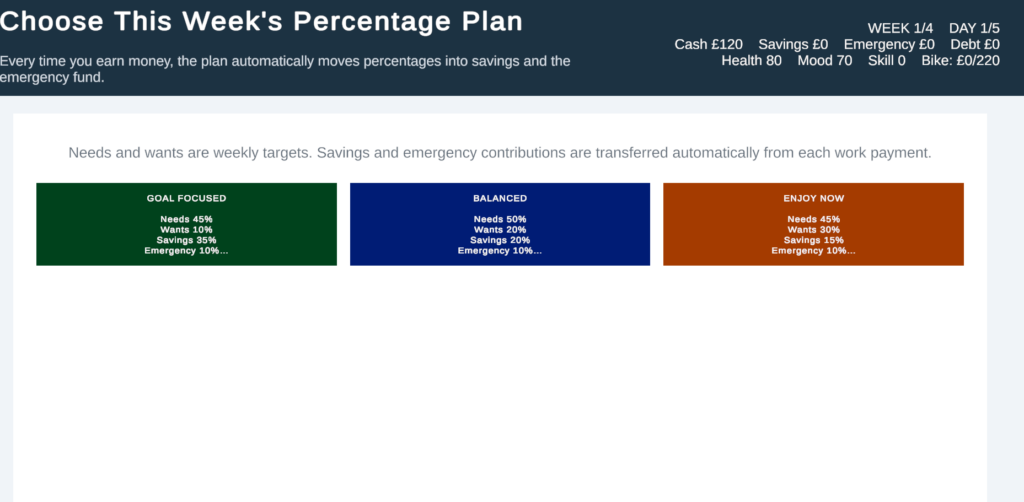
At the beginning of each week, one of the three per-week plans is selected. Percentages were used instead of fixed weekly amounts because work income varies by job, skill level, career stage, health and mood, and the Laptop goal varies. The percentage plan is still understandable when earnings fluctuate: every work payment automatically allocates a portion to savings and an emergency fund, and only the rest is available for spending.
Table 4.2. Weekly percentage plans in the frozen prototype
Plan
Needs
Wants
Savings
Emergency
Goal Focused
45%
10%
35%
10%
Balanced
50%
20%
20%
10%
Enjoy Now
45%
30%
15%
10%
The plans show the trade-off without designating one choice as universally correct. Goal-focused accelerates savings but lowers the wants target; enjoy now increases current discretionary funds but slows goal progress; balanced is the middle ground. Needs and Wants percentages are reference values, not fixed envelopes. At the end of each week, the target amounts for gross income and actual needs-and-wants spending in the game are displayed. This can be used to discuss overspending or underspending as a problem of intention-behavioural inconsistency.
Savings and an emergency fund are kept separately for different reasons. Savings support a particular goal, and the emergency fund can cover a cracked-phone repair (£35) or health expenses (£25) without drawing from daily funds. If the player does not have that buffer, the same event may be paid for in cash, on credit, delayed, or ignored, each with a different future cost. Therefore, the Design shows how emergency savings protect both current spending flexibility and future well-being.
The player begins with £120 cash, Health 80 and Mood 70. The three objectives have different time scales and functions. Headphones are £120; they add 10 Mood upon purchase and reduce future work/study Mood loss. A Bike costs £220 and saves the usual £4 transport fee, plus offers health benefits. A Laptop costs £300, adds 5 Skill to the purchase, multiplies the study gain by 1.5, and increases work income by 10%. For these reasons, the goal is no longer to show off a progress bar but to decide when to turn saved money into an asset.
Achieving the goal does not conclude the class. The weekly summary shows that the goal is affordable and asks if one wishes to purchase it. Continued play serves two purposes: to have enjoyed the purchased benefit and to experience the opportunity cost of spending accumulated savings over the past few weeks. Although the current frozen build offers only one goal per session instead of selecting a second goal, replaying the short prototype can be used to compare the three goal strategies. Figure 4.1 shows the linked goals, employment and budget-plan decisions that set up the player’s initial financial situation.
Figure 4.1. Initial goal, employment and percentage-based budget-plan decisions: (a) savings goal and functional benefit; (b) starting job and well-being cost; and (c) weekly allocation plan. Source: Author’s prototype.
4.6 Work, Study, Skill, Career Progress, Health and Mood
The first group of choices is an opportunity cost triangle. Work gives income today but decreases health and happiness. Study is not a source of income that day, but it enhances skills and job opportunities to increase income in the future. While rest does not offer income or skills, it does offer to restore 15 health points and 12 mood points to be used for efficiency later on. As long as Health is less than 15, work and study will not be available until the player rests. Hence, money is not the sole criterion to decide the choice.
There are different short-term trade-offs with the Starting Jobs. Cafe Helper has a base income of £35 with moderate well-being cost, Shop Assistant has a base income of £45 but decreases 10 Health and more Mood per workday, while Dog Walker has a base income of £25 and the lower well-being cost. These jobs are not meant to be realistic pay demands. They are values that are intentionally lowered to let the player consider the higher immediate gain vs. the indirect loss of productivity.
A delayed effect is explicitly shown in the work income. Each 10 Skills will increase a worker’s pay by £3. Career Progress is an increase of £5 after 40 and £10 after 80. Once the health falls below 50, income decreases, and below 30, it further decreases; the same holds true for mood, with 80 or above having a small positive multiplier. Income explanation is displayed to view base income, skill bonus, career bonus and final adjusted income to see how a non-financial state affects money.
Regular studies provide 12 Skills and improve Career Advancement – but dependent on previous options. A broken phone will result in a 50% reduction of the Study Gain for the three days; low Health/Mood will result in a 25% reduction; a new Laptop will result in a 50% increase. So, the opportunity cost of studying is not only the current wage that one forgoes. The future value will also be reduced if the student can’t get other study materials.
The rules are the same for food and optional expenses. The basic meal provides 0 Health for £6, the balanced meal provides 4 Health for £10 and the healthy meal provides 8 Health and 2 Mood for £16. At dusk, the player has the option of spending £18 for 12 Mood, spending £12 for 6 Mood, transferring an extra £10 to their savings, holding on to cash and borrowing £20. These are not the actual prices in the UK at present. The main action screen state of each immediate sacrifice and later benefit to be considered prior to selection as shown in Figure 4.2.
Figure 4.2. Work, Study and Rest choices showing the immediate resource exchanges used to communicate opportunity cost. Source: Author’s prototype.
4.7 Credit, Debt and Persistent Consequences
Credit is provided because a person cannot or chooses not to pay in cash. It can cover the necessary £6 meal, provide £20 in discretionary funds, and pay for the £25 health and £35 phone events. Each use immediately raises Debt. At the end of each week, the overdue debt will be charged at 5% interest and a minimum of £1. The weekly screen will show a repayment of up to £20 when sufficient funds are available.
This Design does not view credit as being intrinsically irresponsible, or as having no consequences. Credit can solve for the urgent need: drugs for healing, a cell phone to study, and food for life. Later, there was a drop in interest and cash. Thus, there is time transfer in debt: the benefit is now, the cost is some of it later.
Each day there are four random events which are selected after the evening selection with a probability of 0.55. Cracked phone: Repair or delay; Subscription renewal: Commit to £12 per week for a small mood boost; Peer pressure: Spend £20 for 14 mood points or save cash and suffer a 15-health penalty; Health expense: Emergency fund vs. cash, credit and 15-health penalty. Because the consequences carry on from one screen, these are not in the financial model as individual quiz questions, but events.
Persistent, Inspectable end-of day and end-of-week summaries. A delayed phone repair continues to cause a loss of Mood each day and halves study gains while active. Kept subscription is £12 per week, any shortfall will be made up for from debt. The rules indicate that some small, recurring or delayed decisions will limit future choices; thus, the prototype shows the concept of opportunity cost over time. Figure 4.3 is later put together with a later credit state and Fig. 4.4 is a recurring subscription cost that is paid each week.
Figure 4.3. Credit as a temporal trade-off: (a) an immediate £20 cash option creating £20 debt; and (b) a later weekly summary showing persistent debt and a repayment choice. Source: Author’s prototype.
Figure 4.4. Subscription Renewal presenting a recurring weekly cost against a continuing Mood benefit. Source: Author’s prototype.
4.8 Interface, WebGL and Interaction Flow
The prototype builds the interface at runtime using a single C# MonoBehaviour and Unity UI and TextMeshPro. A Screen Space Overlay Canvas scales from a 1280 × 720 reference resolution. Each screen clears the previous interface and then creates a header, optional statistics panel, content area and footer. This structure will have a unified hierarchy: title and instruction at the top, decision cards in the middle, persistent statistics when necessary, and an optional End Session action in the footer.
Kerri’s Layout feedback was addressed by making costs, gains and disabled conditions visible in the choice cards and repeating key balances in the header. Colour can distinguish between ordinary, goal-oriented, warning and credit-related actions, but the decision meaning is also presented in text; therefore, colour is not the sole indicator. The Layout is suitable for desktop and laptop computers, not mobile phones, and in line with the evaluation protocol.
Figure 4.5. Final prototype interaction flow derived from TimeToTalkMoneyPrototypeUI.cs.
Figure 4.5 corrects the earlier design flow. Food and optional spending occur as separate decisions; only the four implemented event types are shown; Trust and career-unlock branches are absent; goal purchase is handled at the weekly summary; and the session ends after four weeks or through the optional early-end control. The diagram is therefore a representation of the frozen implementation rather than an aspirational feature list.
4.9 Feature Freeze and Evaluation Build
The evaluation build was frozen on 12 August 2026 at the point represented by the final C# script. All 18 participants received the same restricted WebGL build. No decision, value, wording, or layout was changed during the 13–14 August data-collection period, so each response refers to the same implementation.
The build records session time only inside the player’s local running state for the final on-screen report; it does not transmit analytics. Evaluation evidence comes from the separate questionnaire. This separation keeps the prototype technically simple and aligns the study with the approved plan not to record participants’ screens or gameplay behaviour. Figure 4.6 shows how the frozen build consolidated continuing financial states at weekly and final reflection points.
Figure 4.6. Summary interfaces: (a) a weekly comparison of plan, spending and future resources; and (b) the final financial, goal and learning report. Source: Author’s prototype.
4.10 Conclusion
The frozen prototype responds to the research question by connecting financial concepts rather than presenting them as isolated definitions. Percentage plans structure income; meals and optional spending distinguish needs and wants; goals and emergency funds separate future purposes; work, study, and rest create opportunity costs; and credit transfers costs into later weeks through debt and interest. Daily and weekly summaries explain how those systems interact.
The design remains a simplified communication model rather than a realistic household-finance calculator. Its values are illustrative, and its short scope omits many features from the early concept.
Chapter 5: Evaluation and Findings
This chapter reports item-level results, four qualitative themes, and their group-level integration.
5.1 Introduction
On August 13-14, 2026, questionnaire version 1.2 and the frozen build from August 12 were used to collect data. Eighteen adults completed all the rating items, 17 provided written response sets, and there were no technical problems or withdrawals.
5.2 Participants and Response Completeness
Seventeen were aged 21-24, and one was aged 25-28. Nine Edge, four Chrome, three Safari, and two others were used. The previous financial education was listed as ‘none’ by one person, ‘little’ by twelve, ‘some’ by four, and ‘a lot’ by one. Fourteen played for 8-10 minutes, one for 5-7 minutes, and three for over 10 minutes.
All 18 quantitative records are available. Eleven all-agree patterns were kept because each submission came from a different person; seven different records were generated for the sensitivity check. The 17 qualitative sets could not be linked to Google Forms records, so integration remained group-level.
5.3 Procedure as Completed
Procedures in Chapter 3. The only analytic deviation was that 17 separate qualitative files were returned instead of 18; their verbatim responses were compiled as S01–S17 and could not be linked to the Google Forms data.
5.4 Quantitative Results
5.4.1 Usability
All usability items had median 4 and IQR 0. U4 was relatively weak and had three neutral responses; U1-U3 were all rated positively.
Table 5.1. Usability item responses (n = 18)
Item
SD
D
N
A
SA
Mdn
IQR
U1 Understand each screen without assistance
0 (0.0%)
0 (0.0%)
0 (0.0%)
17 (94.4%)
1 (5.6%)
4
0
U2 Buttons and navigation supported choices
0 (0.0%)
0 (0.0%)
0 (0.0%)
16 (88.9%)
2 (11.1%)
4
0
U3 Main financial balances were easy to locate
0 (0.0%)
0 (0.0%)
0 (0.0%)
15 (83.3%)
3 (16.7%)
4
0
U4 Text and layout were easy to read
0 (0.0%)
0 (0.0%)
3 (16.7%)
14 (77.8%)
1 (5.6%)
4
0
5.4.2 Clarity
All clarity items had median 4 and IQR 0. Immediate spending consequences (C2) received exclusively positive ratings, whereas delayed credit costs (C4) received three neutral responses.
Table 5.2. Clarity item responses (n = 18)
Item
SD
D
N
A
SA
Mdn
IQR
C1 Budget percentages and payment allocation
0 (0.0%)
0 (0.0%)
1 (5.6%)
15 (83.3%)
2 (11.1%)
4
0
C2 Spending changed cash, savings, or debt
0 (0.0%)
0 (0.0%)
0 (0.0%)
16 (88.9%)
2 (11.1%)
4
0
C3 Work, Study, and Rest consequences
0 (0.0%)
0 (0.0%)
1 (5.6%)
16 (88.9%)
1 (5.6%)
4
0
C4 Credit solved a need but created later cost
0 (0.0%)
0 (0.0%)
3 (16.7%)
14 (77.8%)
1 (5.6%)
4
0
5.4.3 Engagement
All engagement items had median 4 and IQR 0. E1 was weakest, with two disagreements and two neutral responses, while E2 and E3 received exclusively positive ratings.
Table 5.3. Engagement item responses (n = 18)
Item
SD
D
N
A
SA
Mdn
IQR
E1 Repeated daily decisions held attention
0 (0.0%)
2 (11.1%)
2 (11.1%)
14 (77.8%)
0 (0.0%)
4
0
E2 Interest in consequences of choices
0 (0.0%)
0 (0.0%)
0 (0.0%)
17 (94.4%)
1 (5.6%)
4
0
E3 Feedback prompted thought before next choice
0 (0.0%)
0 (0.0%)
0 (0.0%)
17 (94.4%)
1 (5.6%)
4
0
E4 Session pacing suited its purpose
0 (0.0%)
0 (0.0%)
2 (11.1%)
15 (83.3%)
1 (5.6%)
4
0
5.4.4 Perceived Educational Value
All perceived educational-value items had median 4 and IQR 0. V1, V3, and V5 received exclusively positive ratings; V2 and V4 each received one neutral response.
Table 5.4. Perceived educational-value item responses (n = 18)
Item
SD
D
N
A
SA
Mdn
IQR
V1 Distinguish needs from wants
0 (0.0%)
0 (0.0%)
0 (0.0%)
17 (94.4%)
1 (5.6%)
4
0
V2 Small choices affected a long-term goal
0 (0.0%)
0 (0.0%)
1 (5.6%)
16 (88.9%)
1 (5.6%)
4
0
V3 Purpose of an emergency fund
0 (0.0%)
0 (0.0%)
0 (0.0%)
17 (94.4%)
1 (5.6%)
4
0
V4 Immediate benefit and later cost of credit
0 (0.0%)
0 (0.0%)
1 (5.6%)
16 (88.9%)
1 (5.6%)
4
0
V5 Opportunity cost
0 (0.0%)
0 (0.0%)
0 (0.0%)
16 (88.9%)
2 (11.1%)
4
0
Among the seven differentiated records, 16 items retained median 4. E1 fell to median 3 (IQR 1.5), while U4 and C4 remained at 4 but had four of seven agreeing; repetition, readability, and delayed credit clarity therefore remained the least stable areas. Figure 5.1 displays the complete response distribution and makes the comparatively weaker U4, C4, E1 and E4 patterns visible without combining the items into an unvalidated total score.
Figure 5.1. Distribution of responses across the 17 post-play agreement items (n = 18). Numbers inside segments are participant counts. Source: Author’s analysis of questionnaire data.
5.5 Qualitative Findings
The 17 written sets produced 85 responses. Repeated reading, initial coding, cross-participant comparison and full-dataset review produced four themes. Coverage refers to the extent; quotations are verbatim and labelled S01-S17. Appendix D is the condensed codebook and coding audit trail.
5.5.1 Theme 1: concrete choices communicated trade-offs and delayed consequences
All 17 respondents named the same financial relationship. S03 wrote that borrowing provided immediate funds, but it resulted in a debt and interest payment later on; Study also recorded its saving goals, emergency funds and purchases in the same way, noting what was gained, what had to be forfeited, and when the outcome appeared.
5.5.2 Theme 2: hidden and persistent relationships needed greater visibility
Twelve respondents could not find the rules on the screen easily. S10 wrote that there were several factors in the income calculation, and he did not know why the amount changed at times. Requests for income breakdowns, active-effect panels, thresholds, and persistent goal benefits indicate that continuing causes should be listed next to the values they affect.
5.5.3 Theme 3: youth-facing communication required shorter language and visual scaffolding
Fifteen respondents mentioned terminology, text density, icons or information hierarchy. S06 indicated that “spendable income” may not be clear to an 11-year-old. The proposed mechanism is as follows: define terms upon first use, place feedback near the altered value, and present primary results before secondary details.
5.5.4 Theme 4: events and goal rewards supported engagement, while repetition remained
Eight respondents associated engagement with events, future consequences, goals, speed or repetition. S17 wrote that “the daily loop became somewhat monotonous near the end, and more visual changes could enhance engagement”. This indicates a reduced novelty and an unchanged decision cycle; thus, events and subsequent consequences created anticipation, but visual or sequencing modifications may have been more effective additions than extra systems. Figure 5.2 shows the coverage of themes and also indicates that one response set can belong to multiple themes.
Figure 5.2. Number of written-response sets contributing to each qualitative theme (n = 17). Respondents could contribute to more than one theme, so counts are not mutually exclusive. Source: Author’s thematic analysis.
5.6 Mixed-Methods Integration
Table 5.5 compares the group-level patterns. The strands could not be linked by participants, so the table integrates constructs rather than individual records.
Table 5.5. Group-level mixed-methods integration
Construct
Quantitative pattern
Qualitative explanation
Integrated inference
Usability
Median 4 throughout; U4 comparatively weaker.
Requests focused on shorter wording and clearer hierarchy.
Interaction flow was workable; information presentation remains the revision priority.
Clarity
Immediate spending changes were stronger than delayed credit clarity.
Persistent costs, thresholds, and income factors were sometimes hidden.
Causal explanations should remain visible while an effect continues.
Engagement
E1 was weakest; consequence-focused E2–E3 were stronger.
Events created anticipation, while the daily loop became repetitive.
Vary presentation and sequence without expanding system scope.
Perceived value
All items had median 4 with few neutral responses.
All 17 respondents named a concrete relationship or trade-off.
The concepts were perceived as communicable; learning outcomes were not tested.
5.7 Conclusion
Most adults rated the prototype positively; however, readability, delayed causal relationships and repetition were relatively weaker. Written responses show the pattern that immediate exchanges are clear, but extended or multi-factor effects require more visibility.
Chapter 6: Discussion
This chapter will present what the results suggest for the design problem, how they are consistent with previous studies, and what is missing in the evidence.
6.1 Introduction
The prototype linked budgeting, saving, spending, credit and opportunity cost in a four-week career-life system. Based on the above results, direct exchanges are more legible than persistent effects, multi-factor calculations, dense text, and repeated structures. Therefore, the problem is not that the general evaluation is unfavourable; rather, it is what the pattern shows in terms of communication design.
The following discussions are based on the evidential levels in Chapter 2. Previous frameworks and studies have explained why applied decisions, feedback and reflection are plausible design choices; this current study will show how one adult GSA sample perceived one implementation. Interpretation refers to how the Design Rationale, item-level Patterns and written explanations are related.
6.2 Usability, Clarity and Engagement
Petri and Gresse von Wangenheim (2016) found that most evaluations of educational games use inconsistent quality factors and offer little analytical support. Separate Usability, Clarity, Engagement and Perceived Educational Value to avoid combining different judgments into one score. Navigation and balance-finding were more reliable than text readability; thus, the remaining usability issue likely lies in information presentation rather than interaction flow. Steiner and others (2015) have not applied the previous results to reaction levels.
It won’t need that one anymore. If the participants are able to go through the activities alone and the terminology and reporting hierarchy is not obvious, then they will need to be rebuilt. Revisions should introduce new vocabulary on first mention, reduce the length of explanation blocks, add icons to accompany text, and add layers of summary to display key findings first. The changes have involved decreasing the demand for reading and inference while not changing the financial information being communicated.
Time order was used to introduce clarity. The monitoring of immediate cash repayments was fairly straightforward, and no other accounts or days were spread out related to savings and debts to be repaid. The problem is not that there should not be explanations at all places, it is as much a question of when to give them. A choice should have a brief description of the exchange prior to being selected, display a change upon selection, and remain labeled whilst subscriptions, damage, item benefits, thresholds or interests are in effect.
It was the second time, not the repetition. Events and next-day effects generated more anticipation but an unchanged daily rhythm diminished attention, following the current pattern and Wouters et al. (2013) did not find any automatic motivational advantage for serious games. If the state is changed, this may be reflected in a change of appearance; a slight reordering of the existing options can renew the cycle without having to discard and rebuild the discarded system and so reduce the cognitive load of explanation.
In short, the above factors are all manifestations of a single interface problem. Dense words increase the cost to the user’s experience; there is no explanation for why; and an unchanging display offers less incentive for repeat selection. A persistent but compact information layer could address the three by showing only the active cause, affected value, and next consequence, and the detailed explanation would be available on demand.
6.3 Communication of Financial Concepts
The European Union/OECD (2023) defines financial literacy as the ability to apply knowledge, skills, attitudes and behaviours in actual life. Amagir et al. (2018) also find experiential, age-appropriate activities to be effective and have observed fewer behavioural changes compared with knowledge and attitudes. The prototype operationalised application by altering the later resources or choices of each decision. Explanations by participants are more informative when they specify both sides of a trade-off and not just a subject.
Budget plans linked intention with later spending, but the results showed an ambiguity in what percentage meant. Some participants treated Needs and Wants percentages as enforceable limits, whereas the implementation used them as comparison targets. Set a specific limit before the first distribution of the mechanism, show the remaining goal during purchases, and alert users of overspending without blocking their purchase. Preserve agency and explicitly present the plan-versus-actual comparison.
Goal savings and the Emergency Fund modelled two purposes for money that will not be spent immediately. The two were different in an emergency when the protected fund was used or the goal purchase had to be modified. However, based on a later event, the cause of the delay is unknown. A short first-use explanation should define goal savings as planned future expenditures and the emergency fund as a buffer for unforeseen expenses, and then let events demonstrate this idea rather than presenting it theoretically.
Work, study, rest, food and optional spending all represent opportunity costs by using one resource to reduce another. The above structure corresponds to Kolb’s (1984) action-observation-revision cycle: a current choice modifies income, skills, health, mood or future efficiency, and a subsequent summary discloses the trade-off. Pacheco-Velázquez, Salinas-Navarro and Ramírez-Montoya (2023) did not find, however, that visible experimentation alone produced conclusive learning evidence. Therefore, the Design’s contribution is an observable relationship and an opportunity for reflection, not an assumed result.
Credit brought about a time cost. It could cover a short-term living expense or other needs, but it still carried a debt and interest. The whole trade-off was communicable, but uncertainty about the time of the interest shows why a delayed consequence requires precision at the time of borrowing. State the rate, minimum charge and end-of-week timing of the credit option to link the later update with the earlier choice without showing credit as either consequence-free or inherently irresponsible.
The same problem also applies to subscriptions, item benefits, Health and Mood thresholds, Career Progress and income adjustments. These states were realised but could be disconnected from the later numbers they affected. A persistent-effects panel and a causal breakdown of the altered values would reduce memory dependence. Therefore, the core answer to how the simulation communicates is a three-stage causal visibility: explain the exchange before selection, show its immediate effect, and maintain visibility of the active cause as it continuously influences subsequent results.
This reason also shows that the reduction in scope was educational rather than purely practical. Trust, multiple loan or discount systems, and career-unlock branches would have created additional states requiring explanation but would not have necessarily made the central relationships clearer. Fewer mechanics were retained to save funds for budgets, savings, credit, and other opportunities over time. In the future, enhance the visibility of these relationships first and then expand the system.
The above literature further indicates that the visibility principle may support an instructional sequence rather than replace it. Wouters and others (2013) found that additional and repeated play had a stronger effect, and Kolb (1984) proposed reflection after experience and renewed action. A group session once a week could be organised to present a cause-and-effect chain, discuss strategies and adjust the future plan. That proposal is based on the design analysis, but whether it has been learned is unknown at present.
6.4 Adult Formative Evaluation and the Intended Youth Audience
Saiger, Deterding and Gega (2023) believe that participation should be about genuinely affecting the design decisions, rather than being called “co-design”. The adult sample had a narrower formative function; it provided specific terms, calculations, thresholds, persistent states and screen hierarchies for revision before allowing young people to enter a separate approval process. The above concrete diagnoses are useful design hypotheses, not indicators of young people’s preferences or understanding.
The 11-18 age group also includes different reading levels, schools, financial independence, work experience and familiarity with credit. If one were to consider this a uniform audience, the differences shown during participation would be lost. Future work will recruit analytically distinct age groups, record which decisions each group was able to influence, and then combine participatory usability work with the comparative and longitudinal evidence requested by Hainey et al. (2016).
Nevertheless, the adult stage can also be placed in that order. Removing avoidable navigation, wording and state-visibility problems before the youth participation allows later sessions to focus on age-specific meaning and design influence rather than preventable defects. Therefore, the present evaluation preparation for co-design does not prove that co-design has already taken place.
6.5 Limitations and Future Research
The sample size is small, context-specific, and only includes people aged 21-24. Design education, institutional familiarity or a desire to help may have prompted favourable ratings. Eleven all-agree response patterns further reduced differentiation. They were kept because the records showed different people, and the sensitivity analysis showed that repeating them was not very reliable for the differentiated responses. Neither analysis provides population data.
The customised questionnaire only collected project-related information and lacked validated scales or learning indicators. A single self-report will show novelty, visual preference, prior knowledge or acquiescence. There was no pre-test, comparison, repeated exposure, delayed follow-up, observation, or gameplay analytics, so the reported interpretations could not be compared with behaviour in the prototype or with retained financial judgement.
Mixed-methods integration was also absent. Seventeen qualitative files could not be associated with the 18 Google Forms, and the eighteenth written set was missing. By chance, some people had better access to credit and subscriptions than others. A future study could use a single anonymous code to link ratings, written responses and logged exposure, keep consent separate, and collect only data that serve the research question.
The Construction also limits the interpretation. Its illustrative prices, simplified four-week economy, desktop-only display and menu-driven operation do not cover the full scope of household finance or the accessibility requirements of all people. The above restrictions are suitable for the short-term prototype; however, further tests will need to be conducted on various devices and accessibility modes in the future.
The first to be optimised are short terms, clear budget targets, visible active effects and thresholds, causal income breakdowns, precise credit-interest timing, a simplified final report, and visual variations in the existing loop. A separately approved youth phase should then use age-appropriate information, consent or assent, safeguarding and documented design influence. Participatively revise the piloted knowledge and judgment indicators, then conduct a reasonable comparison across several sessions and delay the follow-up. Given that Wouters et al. (2013) found better learning outcomes by adding and extending play, a guided lesson could also explore explanation, comparison and reflection.
6.6 Conclusion
The prototype’s main strength was linking choices across time; its main weakness was not showing the continuing causes. Immediate exchange was feasible if choice, update and feedback were close in time; otherwise, the persistent rule could not be traced after the initial screen closed. Thus, a Design Answer based on three-stage causal visibility is proposed. Prior research supports using games for decision practice, but youth participation, motivation, learning, and transfer require their own evidence.
Chapter 7: Conclusion
This dissertation has designed, implemented and formed-evaluated Time to Talk Money, an independent four-week Unity/WebGL career-life budgeting simulation.
7.1 Answer to the Research Question
The main problem is how to present budgeting, saving, spending, credit and opportunity cost in a WebGL career-life simulation for young people aged 11-18. Artefacts answer by connecting the ideas rather than isolating them. Percentage plans allocate changing income; goal savings and the emergency fund distinguish planned and protective purposes; meals and optional purchases separate needs from wants; work, study, and rest exchange current pay, future earning potential, and well-being; events introduce unexpected and recurring costs; and credit solves an immediate problem by shifting some of the cost to a later debt and interest.
The above mechanisms serve to provide a prior, an immediate outcome and a subsequent state for the financial decision. A percentage selection will be shown for the automatic transfer and weekly plan-versus-actual. Study is an opportunity cost of not working today and will affect future skills and income. Credit becomes temporal rather than moralized when its present benefit and later charge are both shown. Daily and weekly summaries offer a time to review these links and adjust the following plans.
Based on the above analysis, strengths and deficiencies in the communication system have been identified. Direct exchange and visible balance updates were more secure than interest timing, subscriptions, item benefits, thresholds, multi-factor income and final-report hierarchy. The design answer of the three-stage causal visibility is to explain the exchange before selection, show the immediate update, and maintain a persistent cause visible for as long as it continues to affect the results. The supporting adult perceptions identify revision priorities but do not establish youth learning or suitability.
7.2 Project Contribution
The project has three linked outputs. First, it offers an independently implemented Unity/WebGL artifact that integrates personal finance with education, work, health, mood and career development in a short-browser experience. Secondly, it shows that under external circumstances, Kerry Thornton’s comments, implementation limitations and scope adjustments have altered the original broad flowchart into a four-week evaluable system. Third, it provides an open formative evidence basis that includes item-level ordinal results, a sensitivity analysis, coded verbatim responses and group-level mixed-methods integration.
The Three-Level Visibility Rule combines these outputs. It is not presented as an all-encompassing rule, but rather as an evidence-based proposal derived from the connection between applied mechanics and participants’ explanations. It indicates a way for future young people to study, be improved upon, or confirmed.
7.3 Limitations
Eighteen adult GSA peers were selected as the sample, and among them, eleven were all-agree patterns. The custom self-report instrument did not include a validated learning measure, comparison group, repeated session or follow-up; 17 qualitative sets could not be linked to quantitative records. Random events led to uneven exposure, and the simplified desktop build only showed a narrow four-week economy. Bounds limit the extent of generalisation and causality.
7.4 Future Work
The next build should simplify terminology and results, label budget percentages as targets, expose active effects and thresholds, explain income and interest causally, and vary the presentation across the loop. The separately approved youth phase should recruit analytically different age groups, use age-appropriate consent or assent and safeguarding, and document how the young people’s contributions alter the artefact.
Subsequent evaluation should use piloted financial-knowledge and judgement measures, linked anonymous records, an appropriate comparison, multiple sessions, and delayed follow-up. A guided mode can also determine whether adding explanations, strategy comparisons and peer reflections is suitable for free play. Time to Talk Money is thus a finished dissertation prototype and evidence-based starting point; it makes financial relationships playable, identifies where communication becomes opaque, and sets the next question precisely enough for testing.
References
Amagir, A., Groot, W., Maassen van den Brink, H. and Wilschut, A. (2018) ‘A review of financial-literacy education programs for children and adolescents’, Citizenship, Social and Economics Education, 17(1), pp. 56–80. Available at: https://doi.org/10.1177/2047173417719555.
Artino, A.R. Jr, La Rochelle, J.S., DeZee, K.J. and Gehlbach, H. (2014) ‘Developing questionnaires for educational research: AMEE Guide No. 87’, Medical Teacher, 36(6), pp. 463–474. Available at: https://doi.org/10.3109/0142159X.2014.889814.
Braun, V. and Clarke, V. (2006) ‘Using thematic analysis in psychology’, Qualitative Research in Psychology, 3(2), pp. 77–101. Available at: https://doi.org/10.1191/1478088706qp063oa.
Brooke, J. (1996) ‘SUS: A quick and dirty usability scale’, in Jordan, P.W., Thomas, B., Weerdmeester, B.A. and McClelland, I.L. (eds.) Usability Evaluation in Industry. London: Taylor & Francis, pp. 189–194.
Candy, L. and Edmonds, E.A. (2018) ‘Practice-based research in the creative arts: Foundations and futures from the front line’, Leonardo, 51(1), pp. 63–69. Available at: https://doi.org/10.1162/LEON_a_01471.
Chyung, S.Y., Barkin, J.R. and Shamsy, J.A. (2018) ‘Evidence-based survey design: The use of negatively worded items in surveys’, Performance Improvement, 57(3), pp. 16–25. Available at: https://doi.org/10.1002/pfi.21749.
Chyung, S.Y., Roberts, K., Swanson, I. and Hankinson, A. (2017) ‘Evidence-based survey design: The use of a midpoint on the Likert scale’, Performance Improvement, 56(10), pp. 15–23. Available at: https://doi.org/10.1002/pfi.21727.
Connolly, T.M., Boyle, E.A., MacArthur, E., Hainey, T. and Boyle, J.M. (2012) ‘A systematic literature review of empirical evidence on computer games and serious games’, Computers & Education, 59(2), pp. 661–686. Available at: https://doi.org/10.1016/j.compedu.2012.03.004.
Creswell, J.W. and Plano Clark, V.L. (2018) Designing and Conducting Mixed Methods Research. 3rd edn. Thousand Oaks, CA: SAGE.
European Union/OECD (2023) Financial Competence Framework for Children and Youth in the European Union. Paris: OECD Publishing. Available at: https://doi.org/10.1787/bf059471-en.
German Sparkassenstiftung for International Cooperation (n.d.) Financial Literacy Game. Available at: https://www.sparkassenstiftung.de/en/products/business-games/financial-literacy-game (Accessed: 12 August 2026).
Hainey, T., Connolly, T.M., Boyle, E.A., Wilson, A. and Razak, A. (2016) ‘A systematic literature review of games-based learning empirical evidence in primary education’, Computers & Education, 102, pp. 202–223. Available at: https://doi.org/10.1016/j.compedu.2016.09.001.
Hoseiny, S. and Niknafs, A. (2020) ‘Study of the serious games capacity in promoting financial literacy’, in 2020 International Serious Games Symposium (ISGS). Piscataway, NJ: IEEE, pp. 81–87. Available at: https://doi.org/10.1109/ISGS51981.2020.9375426.
Kalmi, P. and Rahko, J. (2022) ‘The effects of game-based financial education: New survey evidence from lower-secondary school students in Finland’, The Journal of Economic Education, 53(2), pp. 109–125. Available at: https://doi.org/10.1080/00220485.2022.2038320.
Kalmi, P. and Sihvonen, T. (2022) ‘Education or entertainment? On the potential of games in financial education’, in Nicolini, G. and Cude, B.J. (eds.) The Routledge Handbook of Financial Literacy. New York: Routledge, pp. 259–273.
Kolb, D.A. (1984) Experiential Learning: Experience as the Source of Learning and Development. Englewood Cliffs, NJ: Prentice Hall.
Pacheco-Velázquez, E., Salinas-Navarro, D.E. and Ramírez-Montoya, M.S. (2023) ‘Serious games and experiential learning: Options for engineering education’, International Journal of Serious Games, 10(3), pp. 3–21. Available at: https://doi.org/10.17083/ijsg.v10i3.593.
Personal Finance Lab (n.d.) Personal Budgeting Game. Available at: https://www.personalfinancelab.com/budget-game/ (Accessed: 12 August 2026).
Petri, G. and Gresse von Wangenheim, C. (2016) ‘How to evaluate educational games: A systematic literature review’, Journal of Universal Computer Science, 22(7), pp. 992–1021. Available at: https://www.jucs.org/jucs_22_7/how_to_evaluate_educational/jucs_22_07_0992_1021_petri.pdf (Accessed: 12 August 2026).
Petri, G., Gresse von Wangenheim, C. and Borgatto, A.F. (2018) MEEGA+: A Method for the Evaluation of Educational Games for Computing Education. Technical Report INCoD/GQS.05.2018.E. Florianópolis: INCoD/UFSC. Available at: https://www.ufsm.br/app/uploads/sites/517/2022/08/Relatorio-Tecnico-INCoD_GQS_05_2018_E.pdf (Accessed: 12 August 2026).
Saiger, M.J., Deterding, S. and Gega, L. (2023) ‘Children and young people’s involvement in designing applied games: Scoping review’, JMIR Serious Games, 11, e42680. Available at: https://doi.org/10.2196/42680.
Steiner, C.M., Hollins, P., Kluijfhout, E., Dascalu, M., Nussbaumer, A., Albert, D. and Westera, W. (2015) ‘Evaluation of serious games: A holistic approach’, in ICERI2015 Proceedings: 8th International Conference of Education, Research and Innovation, Seville, Spain, 18–20 November 2015. Valencia: IATED Academy, pp. 4334–4342. Available at: https://research.ou.nl/en/publications/evaluation-of-serious-games-a-holistic-approach (Accessed: 12 August 2026).
Team SH15 (2026) Time to Talk Money Handover Document. Unpublished project handover prepared for Go-You Ltd, 30 March.
Time to Talk Money (n.d.) About Us. Available at: https://www.timetotalkmoney.co.uk/about (Accessed: 12 August 2026).
Wouters, P., van Nimwegen, C., van Oostendorp, H. and van der Spek, E.D. (2013) ‘A meta-analysis of the cognitive and motivational effects of serious games’, Journal of Educational Psychology, 105(2), pp. 249–265. Available at: https://doi.org/10.1037/a0031311.
Zimmerman, J., Forlizzi, J. and Evenson, S. (2007) ‘Research through design as a method for interaction design research in HCI’, in Proceedings of the SIGCHI Conference on Human Factors in Computing Systems. New York: ACM, pp. 493–502. Available at: https://doi.org/10.1145/1240624.1240704.
Zyda, M. (2005) ‘From visual simulation to virtual reality to games’, Computer, 38(9), pp. 25–32. Available at: https://doi.org/10.1109/MC.2005.297.
Appendix A: Tools, Software and Assistive Technologies
Principal Tools and Software
The following list records the principal tools, technologies and services used to develop, distribute, document and evaluate the prototype.
Tool, technology or service
Use in this project
Unity
Development environment used to implement the prototype and produce the final WebGL build.
C#
Scripting language used for the interface, state updates, events, budget allocation and simulation logic.
WebGL
Browser deployment target used for the remotely accessed playtest build.
itch.io
Restricted, password-protected hosting used to distribute the prototype to the invited adult participants.
Google Forms
Administration of the anonymous post-play questionnaire, with email collection and mandatory sign-in disabled.
Notion
Project planning and organization of development and research notes.
Microsoft Word
Dissertation drafting and preparation of participant-facing documents, including the information sheet and consent form.
ChatGPT
Assistive support for the activities disclosed below; all activities below remained subject to researcher review.
Generative AI and Assistive Technologies Statement
This project used generative AI and assistive technologies to support literature-search keyword generation, early source discovery, language refinement, translation, document-structure and game-design brainstorming, Unity/C# code assistance, debugging, flowchart refinement, questionnaire implementation.
Appendix B: Ethics and Participant Documentation
Ethical approval was obtained through GSA Ethical Form 1 before data collection. The project-specific Participant Information Sheet and the blank consent form used for the completed adult playtest are reproduced below. Signed consent forms are excluded because they contain names and signatures.
Participant Information Sheet Issued to Participants
The following three pages reproduce the project-specific information sheet provided before consent. They are preserved in the participant-facing form used for the study.
Blank Consent Form Issued to Participants
The following blank form is the project-titled version used for the 18 participants. Signed copies are excluded to protect identities.
Appendix C: Evaluation Instruments
Questionnaire version 1.2 was frozen before data collection and used for all 18 responses collected on 13–14 August 2026. The full administered wording is reproduced below.
Post-Play Questionnaire
Participant instruction: Please answer the following questions based on the Time to Talk Money prototype you have just played. There are no correct answers. We are interested in how clear and usable the prototype felt to you. Do not include your name, gender, student number, email address, or personal financial details.
Background Information
B1. Age band: 18-20 / 21-24 / 25-28 / 29-34 / 35 or over / Prefer not to say
B2. Browser used for this playtest: Google Chrome / Microsoft Edge / Apple Safari / Other
B3. Before this playtest, how much formal or informal financial education had you received? None / A little / Some / A lot / Prefer not to say
Session Checks
P1. Approximately how long did you spend playing the prototype? Under 5 minutes / 5-7 minutes / 8-10 minutes / More than 10 minutes / Not sure
P2. Did you encounter a technical problem that affected your playthrough? No / Yes
P2a. If yes, briefly identify the browser and what happened. Do not include personal information. (Optional short answer)
Agreement Statements
Response scale for U1-V5: 1 Strongly disagree; 2 Disagree; 3 Neither agree nor disagree; 4 Agree; 5 Strongly agree.
Usability
U1. I could understand what to do on each screen without assistance.
U2. The buttons and navigation made my choices easy to complete.
U3. I could easily locate my main financial balances: cash, savings, emergency fund, and debt.
U4. The text and layout were easy to read.
Clarity
C1. It was clear how the weekly budget-plan percentages changed where each work payment was allocated.
C2. It was clear how spending choices changed cash, savings, or debt.
C3. It was clear how Work, Study, and Rest created different immediate and later consequences.
C4. It was clear how credit could solve an immediate need while creating debt and interest later.
Engagement
E1. The repeated daily decisions held my attention.
E2. I was interested in seeing the consequences of my choices.
E3. The feedback encouraged me to think before making the next decision.
E4. The session felt appropriately paced for its purpose.
Perceived Educational Value
V1. The prototype helped me distinguish needs from wants.
V2. The prototype helped me see how repeated small choices can affect a longer-term savings goal.
V3. The prototype helped me understand the purpose of an emergency fund.
V4. The prototype helped me understand the immediate benefit and later cost of using credit.
V5. The prototype helped me understand opportunity cost as giving up one benefit in order to gain another.
Open Questions
O1. Which financial idea was communicated most clearly? Identify the specific choice, feedback, or consequence that made it clear.
O2. Describe one financial relationship that remained unclear. What screen, word, number, or consequence caused the difficulty? If none remained unclear, write “None”.
O3. Which decision made you think most about a trade-off? What did you give up, and what did you gain?
O4. What single change would most improve the prototype’s usability or clarity before it is tested with young people aged 11-18? Explain why.
O5. Is there anything else you would like the researcher to know about the prototype? (Optional)
Appendix D: Qualitative Coding Framework and Audit Trail
Analytic corpus and procedure. The corpus comprised 85 written entries from 17 anonymous response sets (S01–S17; five open questions per set). The responses were analysed using Braun and Clarke’s (2006) six-phase thematic-analysis framework: familiarization, initial coding, development of candidate themes, review against the coded extracts and full dataset, definition and naming, and reporting. Coding was semantic and primarily inductive, while remaining focused on how participants described clarity, trade-offs, interface problems, and engagement in relation to the prototype.
Coding and counting decisions. Each answer was reviewed as a coding unit, but a passage could receive more than one code when it addressed more than one analytic issue. Codes were compared across participants and clustered into four themes. ‘None’ responses were retained during familiarization as an absence of a reported problem and were not forced into a theme. Coverage below reports the number of response sets contributing to a theme, not the number of coded passages; themes were not mutually exclusive. Because the qualitative files could not be linked to the Google Forms records, S01–S17 identify qualitative response sets only.
Table D.1. Condensed codebook showing theme definitions, example initial codes, and illustrative verbatim extracts.
Theme and participant coverage
Definition and coding boundary
Examples of initial descriptive codes
Illustrative verbatim extracts
Theme 1: concrete choices communicated trade-offs and delayed consequences
17 of 17 response sets
Statements that identified a specific choice or resource exchange and explained an immediate consequence, a later consequence, or both. Included responses named what was given up and gained, or how an earlier decision altered a later state. Generic comments such as ‘clear’ or ‘easy’ were not sufficient unless a mechanism was also described.
Automatic allocation made saving visible; Emergency Fund protected ordinary cash; Study exchanged today’s pay for future income; credit solved an immediate problem but persisted as debt; a goal purchase exchanged savings for a later functional benefit; repeated small choices accumulated over time.
(S03, O3) “Using credit for an expense. I solved the problem immediately but had to accept more debt later.”
(S10, O3) “Study. I gave up today’s pay for better future earning potential.”
Theme 2: hidden and persistent relationships needed greater visibility
12 of 17 response sets
Statements identifying a causal relationship that became difficult to trace because its timing, threshold, persistent state, or contributing factors were not kept visible. Included uncertainty about what changed, when it changed, or why it changed. General requests for shorter wording without an obscured rule were coded under Theme 3; responses could be coded to both themes when both issues were present.
Interest timing unclear; active subscription forgotten after the event screen; goal benefit forgotten; Needs and Wants targets mistaken for spending limits; Health and Mood thresholds hidden; multi-factor income change lacked a breakdown; final-report hierarchy unclear.
(S07, O2) “I forgot whether the subscription was still active after the event screen disappeared.”
(S15, O2) “Health and Mood thresholds were not visible, so sometimes the change in income felt sudden.”
Theme 3: youth-facing communication required shorter language and visual scaffolding
15 of 17 response sets
Statements recommending changes to terminology, text volume, visual explanation, or information hierarchy to make the prototype easier for younger players to understand. Included plain-language requests, icons, causal labels, calculation breakdowns, and simplified summaries. Purely mechanical visibility problems were coded under Theme 2; dual coding was retained when presentation and hidden causality were inseparable.
Financial terminology too advanced; too much text; shorten decision descriptions; add icons or visual feedback; show causal calculations beside changing numbers; label percentages as targets; simplify the final report; reveal the most important results first.
(S06, O4) “Use simpler financial words or show a short explanation when a new term first appears.”
(S12, O4) “More visual feedback and fewer sentences would make it more suitable for younger players.”
Theme 4: events and goal rewards supported engagement, while repetition remained
8 of 17 response sets
Statements evaluating interest, pace, variety, or motivation rather than only conceptual clarity. Included positive responses to events, delayed consequences, and functional goal rewards, alongside comments that the daily loop became repetitive or needed visual variation. A response describing a trade-off without an engagement judgement remained under Theme 1.
Random events made choices meaningful; event decisions were most engaging; delayed consequences sustained interest; functional savings rewards were appreciated; short-session pace was suitable; daily loop became repetitive; greater visual variation was requested.
(S14, O5) “The event choices were the most engaging part for me.”
(S17, O5) “The daily loop became a little repetitive near the end, so more visual variation could improve engagement.”
Note. Extracts are reproduced verbatim from the compiled qualitative response file. The table is a condensed audit trail rather than an exhaustive 85-row coding matrix. Theme coverage is reported at response-set level and therefore should not be summed.
Table D.2. Examples of the coding progression from a verbatim extract to a final theme.
Verbatim extract
Initial descriptive code
Candidate organizing concept
Final theme
(S03, O3) “Using credit for an expense. I solved the problem immediately but had to accept more debt later.”
Immediate benefit accompanied by later debt
Temporal financial trade-off
Theme 1: concrete trade-offs and delayed consequences
(S07, O2) “I forgot whether the subscription was still active after the event screen disappeared.”
Persistent subscription no longer visible
Visibility of continuing states
Theme 2: hidden and persistent relationships
(S06, O4) “Use simpler financial words or show a short explanation when a new term first appears.”
Simplify terminology and explain new terms
Youth-facing language support
Theme 3: shorter language and visual scaffolding
(S17, O5) “The daily loop became a little repetitive near the end, so more visual variation could improve engagement.”
Late-session repetition; need for visual variety
Engagement and pacing over time
Theme 4: engagement supported, while repetition remained