
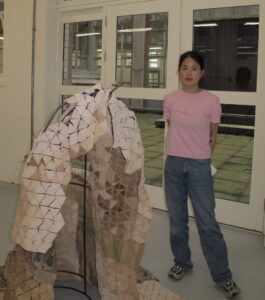
Subin Gang
(She/her )
Biography
Subin Gang is a South Korea-based installation artist engaging in the physical material. She is studying for an MLitt in Contemporary Art at The Glasgow School of Art.
She ran the community art collective called 23/3 from 2017 to 2021 in Korea, and also she is running the educational collective called CAEC(Contemporary art educational collective), which is planning the flexible education structure for children with cancer. With this experience, she is more interested in co-living well with others who are in a different environment, using the physical material.
Recent solo shows are Flowing Scenes(2024), Loosely Seen(2023). And the major group exhibitions are Site of Contemporary Art Vanishing, Emerging in the Gyeonggi Museum of Modern Art.
Artist Statement
My practice begins with the artistic question: “What is the most natural form?” Looking at stones and landscapes, I began to think that a natural form might not refer to a particular shape, but rather to a form that emerges by responding to its surrounding environment and conditions.
This idea extends into the way I work with materials. Rather than deciding on a finished form in advance and working towards a fixed goal, I observe and accept the properties and changes of materials, as well as the environmental conditions around them. The form and state of a material can shift depending on humidity, temperature, gravity, drying time, the supporting surface, and the other materials placed alongside it. What may appear to be an accidental scene is, in fact, an inevitable result produced by the meeting of these different conditions.
My use of everyday and fragile materials such as eggshells, flour glue, and thin plastic is also connected to this interest. Small pieces made from eggshells are joined together to form a flexible structure that changes according to where and how it is placed. Flour glue contracts as it dries, pulling on thin plastic and producing unexpected force and terrain-like forms.
For me, qualities such as flexibility, adaptability, observation, fragility, and transparency are not only characteristics of materials, but also attitudes that guide the way I continue my practice. By repeatedly encountering materials and environments that I cannot fully control, I try to see the conditions already given to me not as limitations or forms of lack, but as places from which new possibilities can emerge and sculpture can take shape. Through this process, I explore how we might form and exist more naturally by relating to the real conditions of the world we are already part of.
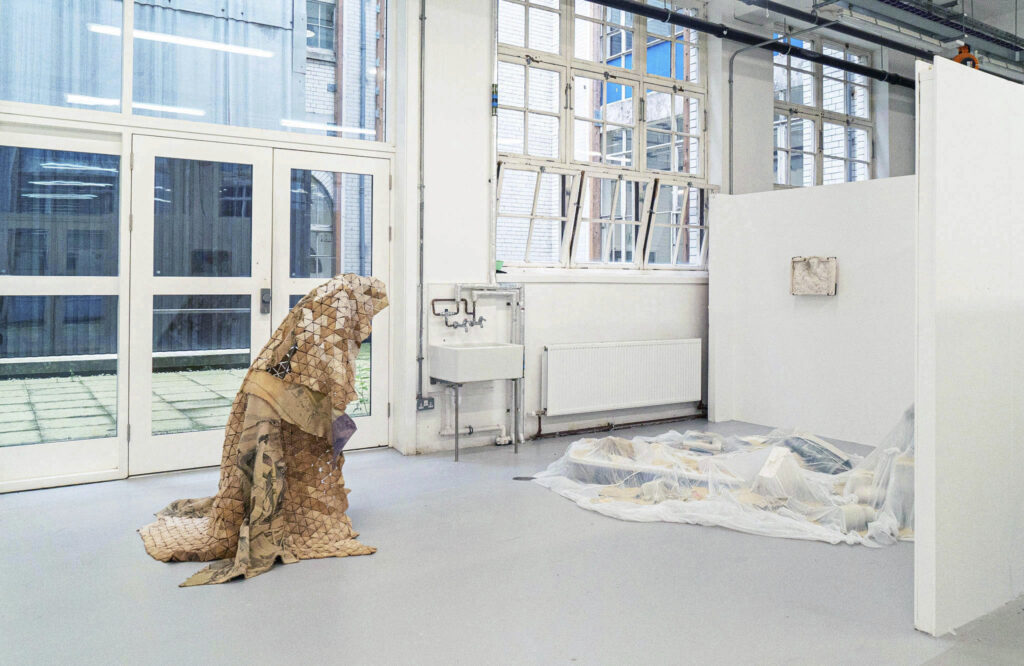
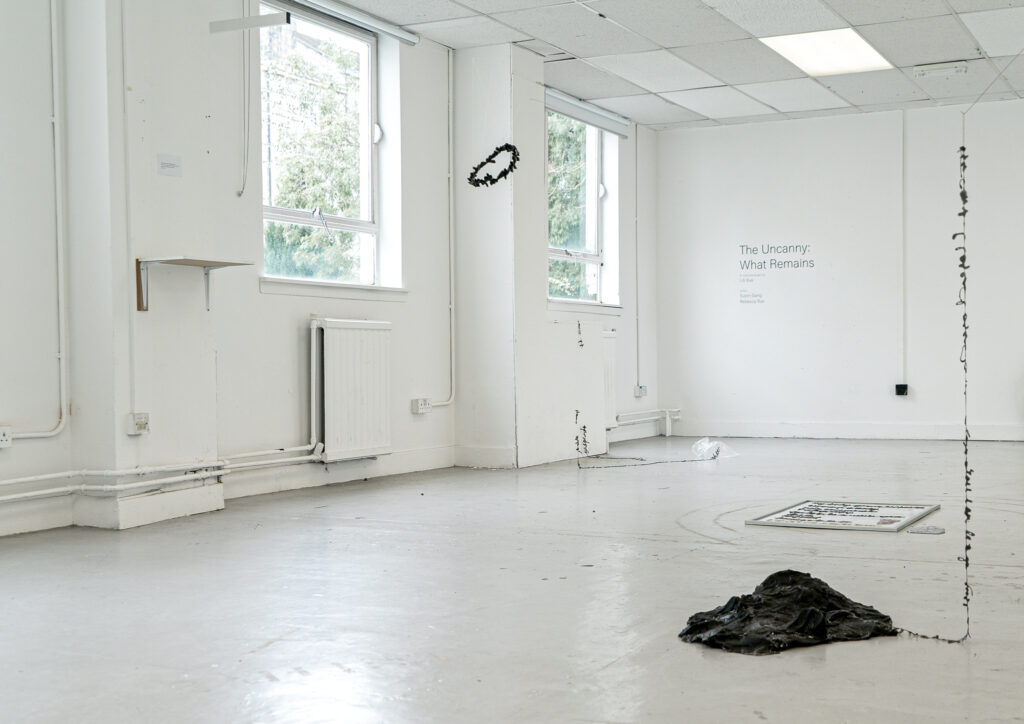
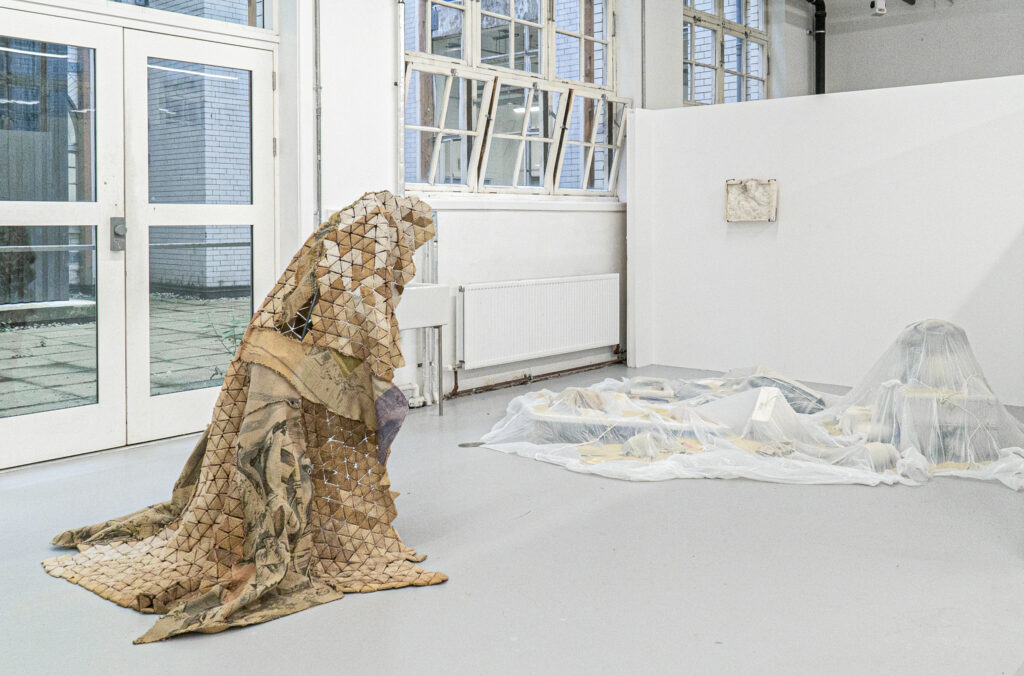
A Human Observing, Draped in Flowing Stones, 2026
eggshells, flour glue, fishing wire, thread, carpet, metal wire, 94x60x145 cm
Flowing Stones, 2026
Flowing Stones imagines the stone as an ideal object that continually changes in response to its environment and attempts to imitate its life cycle.
The work is made from eggshells, which, like limestone, are composed primarily of calcium carbonate. The shells are washed, dried, ground into powder, and combined with flour paste to form small triangular units. These are connected with thread to create a flexible surface that grows as more discarded eggshells are collected.
Although each unit is hard like stone, the overall structure can fold and bend in response to surrounding terrain and architecture. Here, fragmentation is not treated as damage, but as a condition that allows the material to be reprocessed, connected, and adapted into a new form.
About the Observing Posture
I pursue a value that I call Practical Purity, which means paying attention to and making use of what I already have or what already exists around me. This value is reflected in Flowing Stones both through its process and its form.
This includes imitating the life cycle of stone as an ideal object; collecting materials through relationships; using low-tech methods such as hand sewing to connect small fragments; and making a blanket-like sculpture that can fold and bend without being assigned a fixed function.
Rather than constantly feeling a sense of lack by idealising what I do not have or what lies beyond my limitations, this reflects an attitude towards life based on looking at what is already available to me and finding other ways to make use of it: living practically with less.
For this, the act of observing is essential. Observation allows me to discover what I had not previously noticed and expands the possibilities of how something can be used. By looking closely at what I already have, I can combine things in different ways and discover something new.
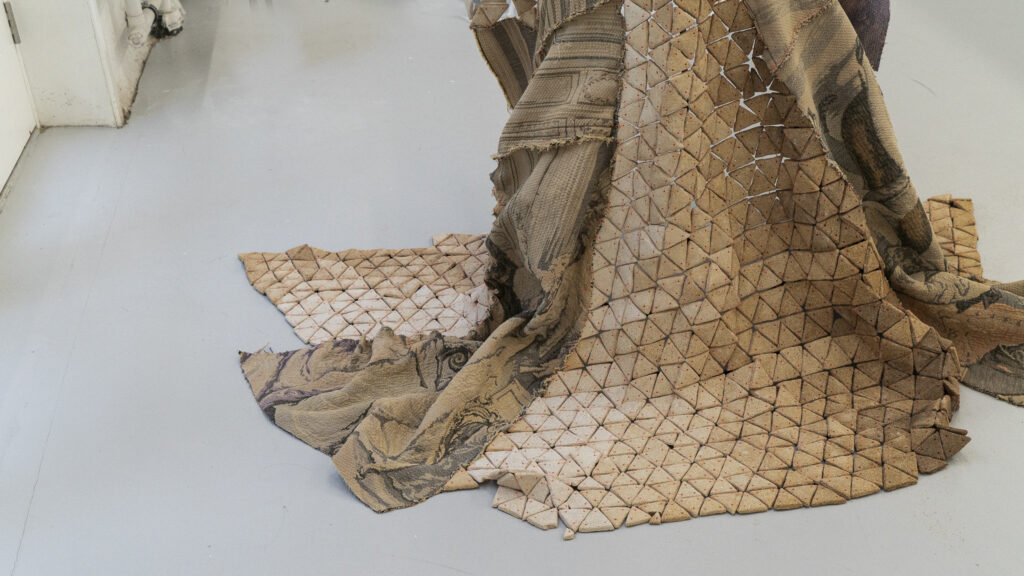
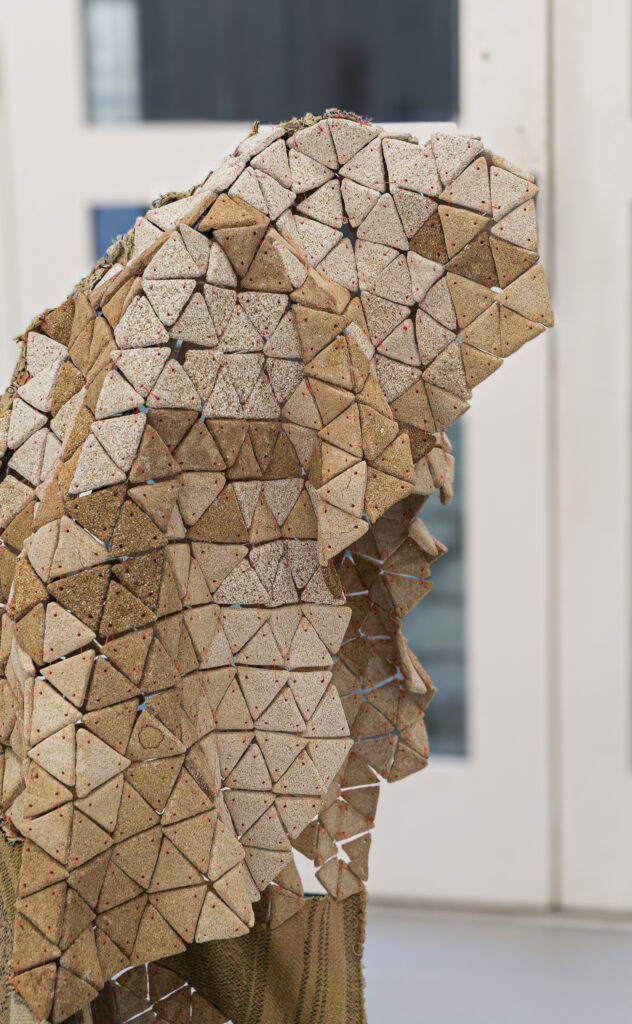
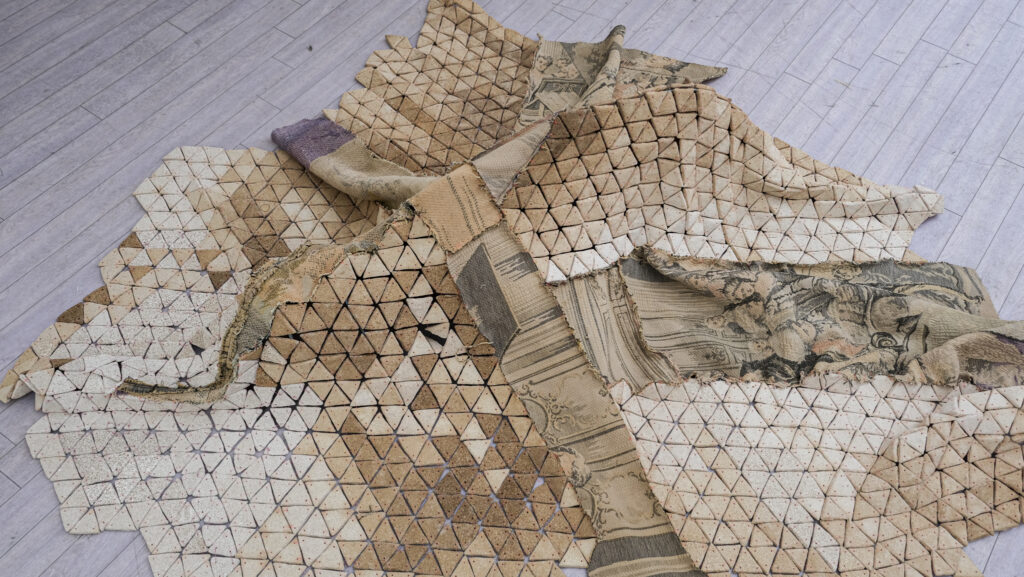
photographed by Jaia (Tzu-Chieh) Kuo
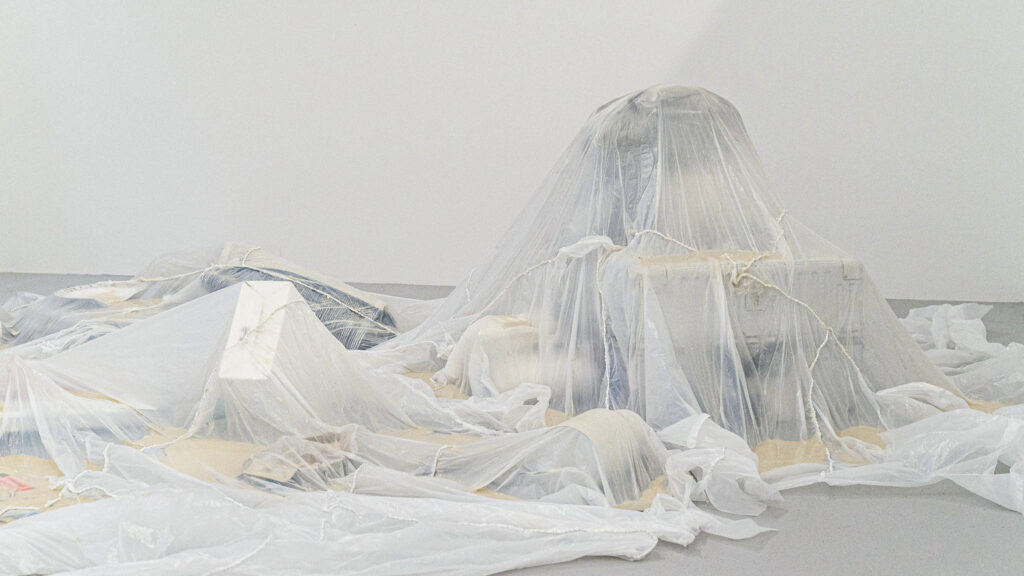
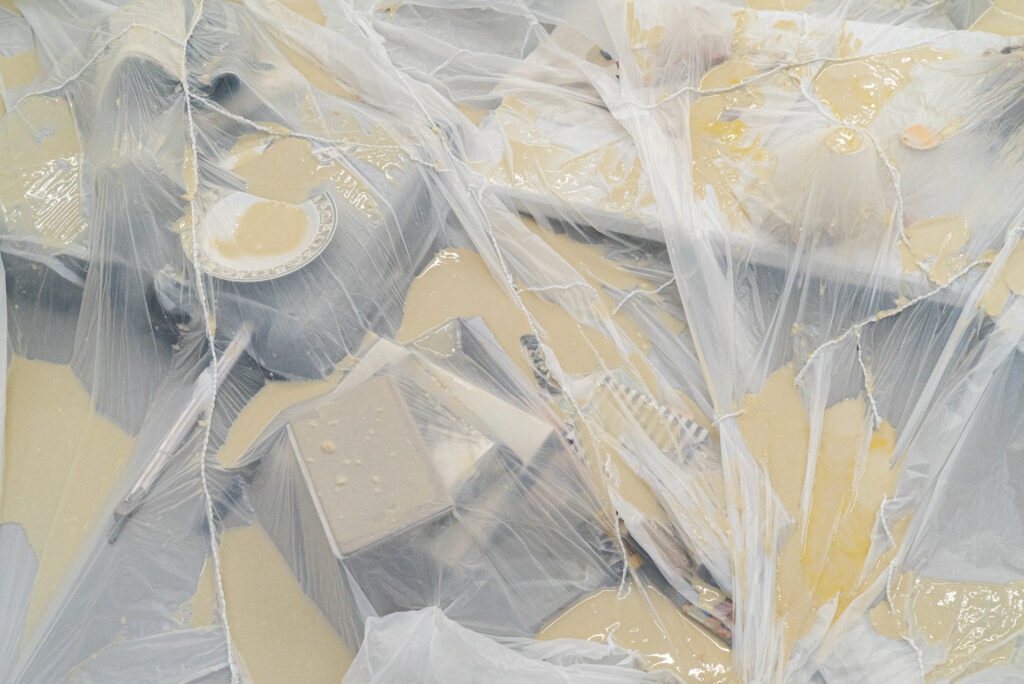
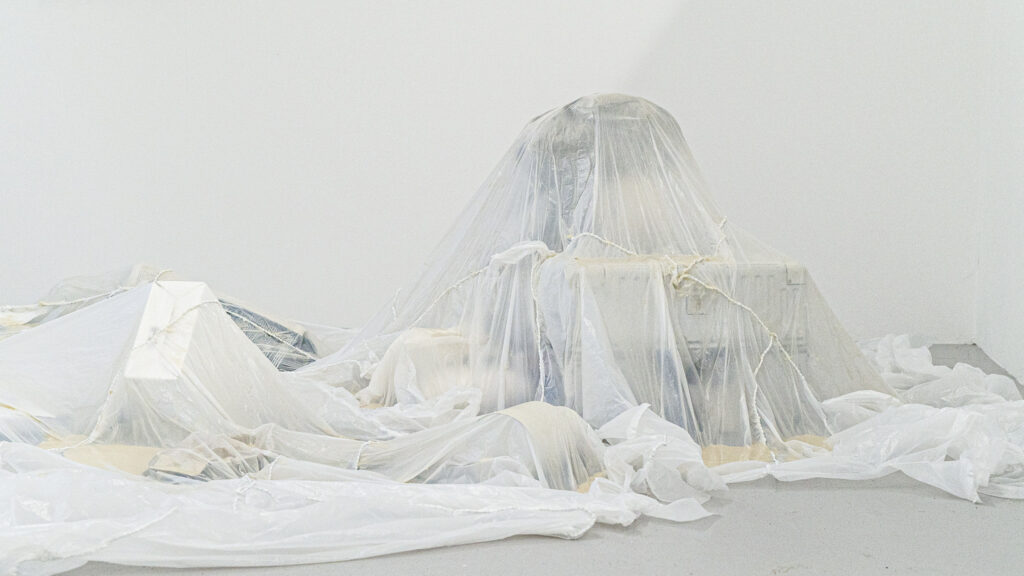
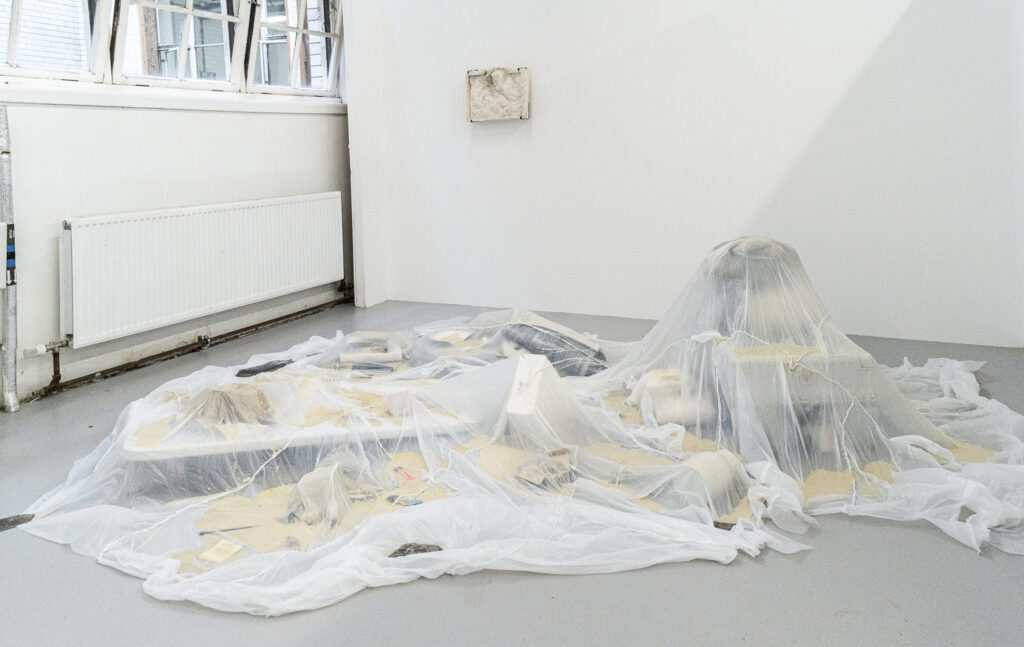
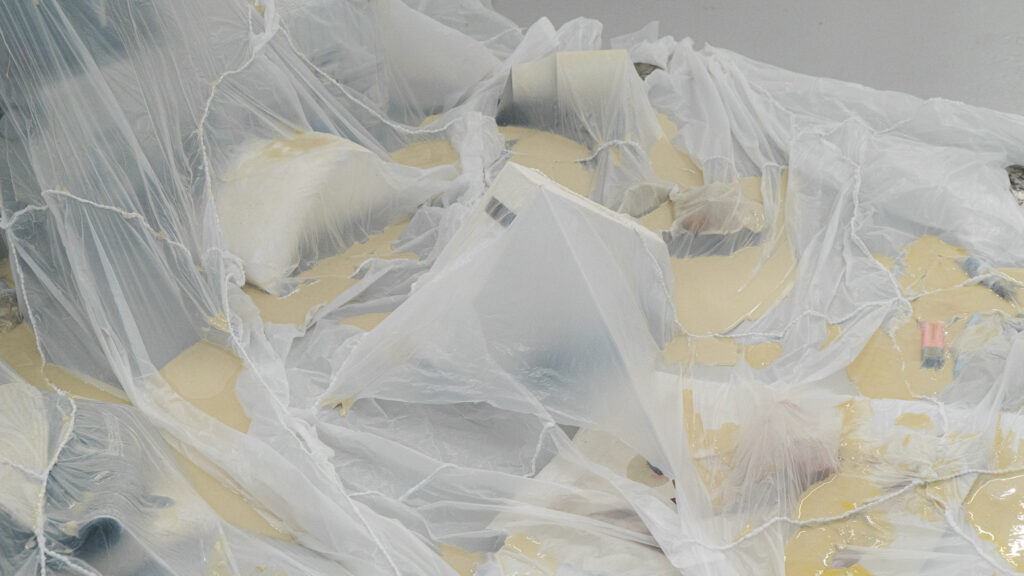
perfect so yeah it might to be that this is not to be fought and actually you go with it and you just have to…, 2026
flour, plastic bag, objects in my room and studio, variable installation
Flour glue is a material I encountered by chance while making stone-like forms from eggshells. At first, I used it simply as an adhesive to bind the particles together, but as I observed it bending, cracking, and pulling on the surfaces around it while drying, I began to see it as a sculptural material in its own right.
When flour glue is applied to thin plastic, the evaporation of moisture causes it to shrink, and this contraction pulls and reshapes the plastic surface. Rather than constructing a new supporting structure, I use objects that I already have as supports for this process. By draping thin plastic over these objects and applying flour glue, the forms of the objects, the flexibility of the plastic, and the contraction of the flour glue interact with one another, producing terrain-like forms with folds, rises, and depressions.
Once dry, flour glue is fragile and can break easily, yet when it comes into contact with certain materials, it can also reveal a surprising degree of force. I am interested in this contradictory state. Rather than trying to eliminate or overcome fragility, I observe how it can shift into different qualities and possibilities under specific conditions.
The form of the work is not predetermined. The size and shape of the objects I already have, the way the plastic is positioned, the amount and thickness of the flour glue, moisture, temperature, humidity, and drying time all affect the direction of contraction and the final form. Rather than fully controlling these conditions, I treat them as part of the work and observe the temporary terrains and sculptural forms that emerge through the interaction between what is already present and the forces of the material.
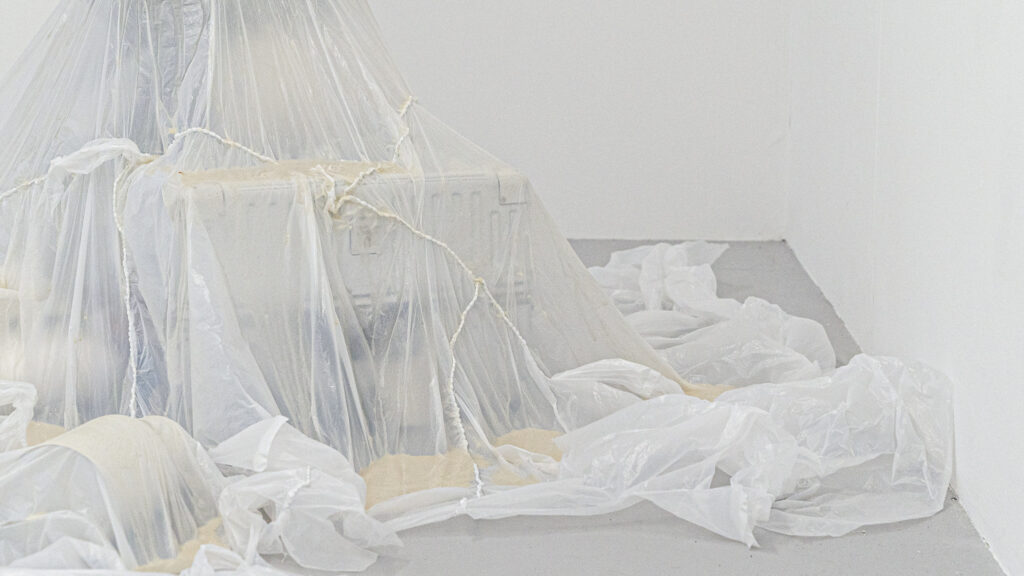
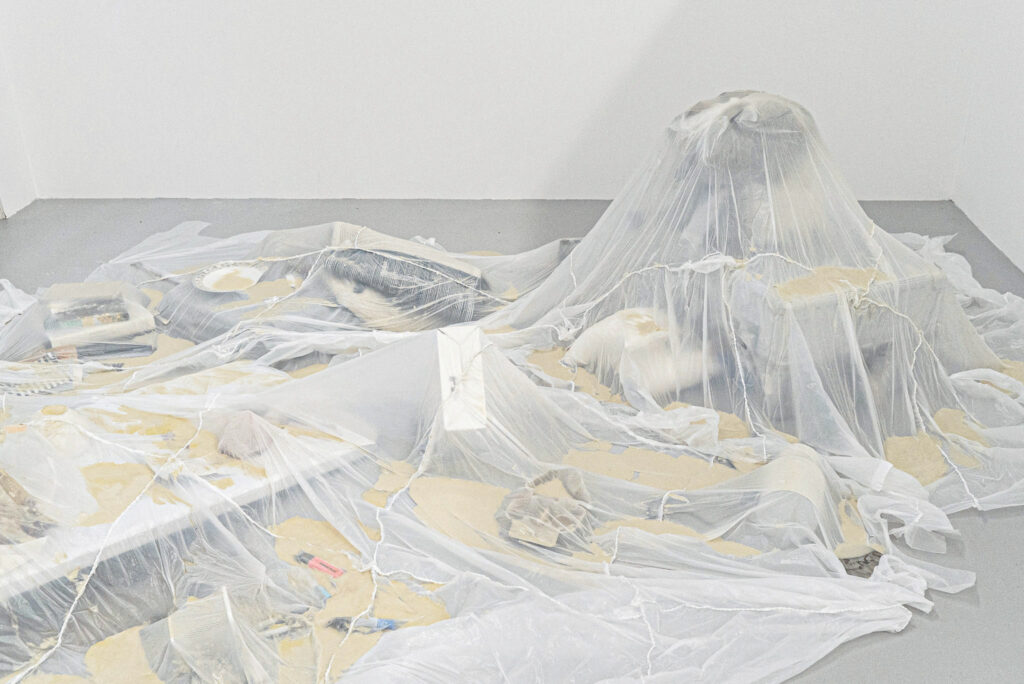
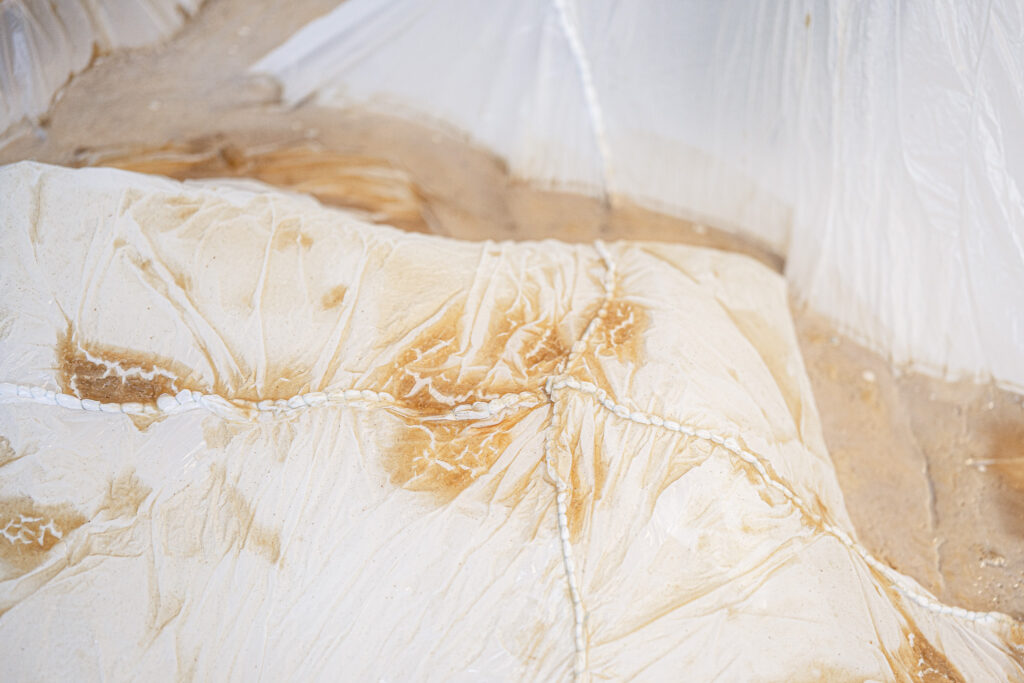
The scene a week later(23.05.26)
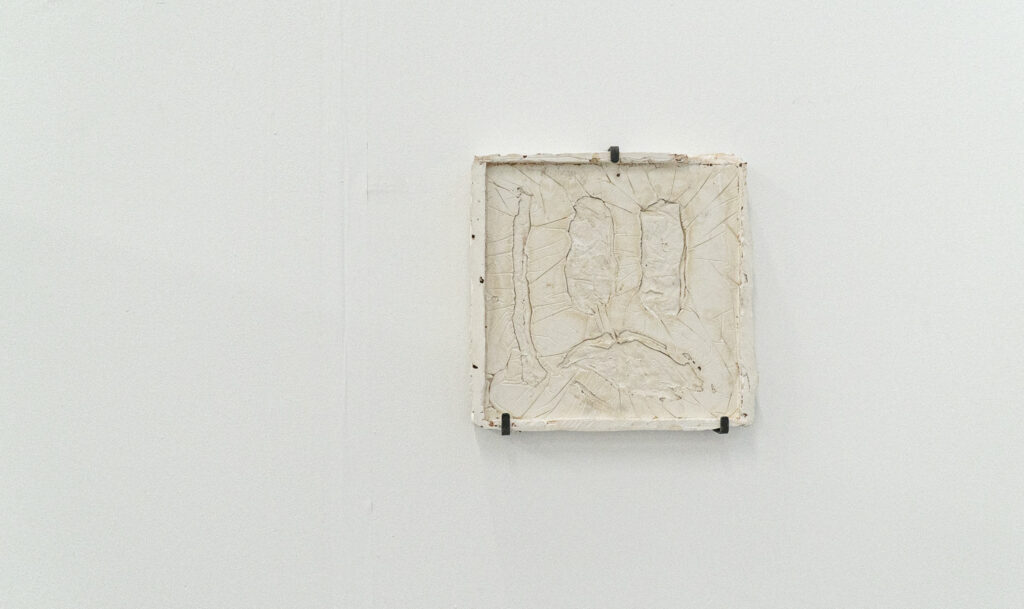
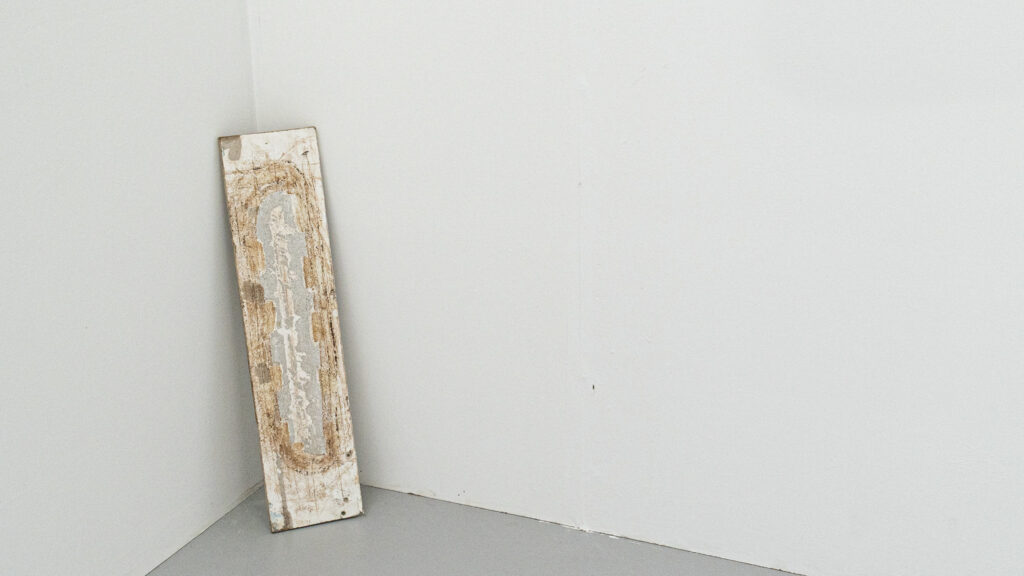
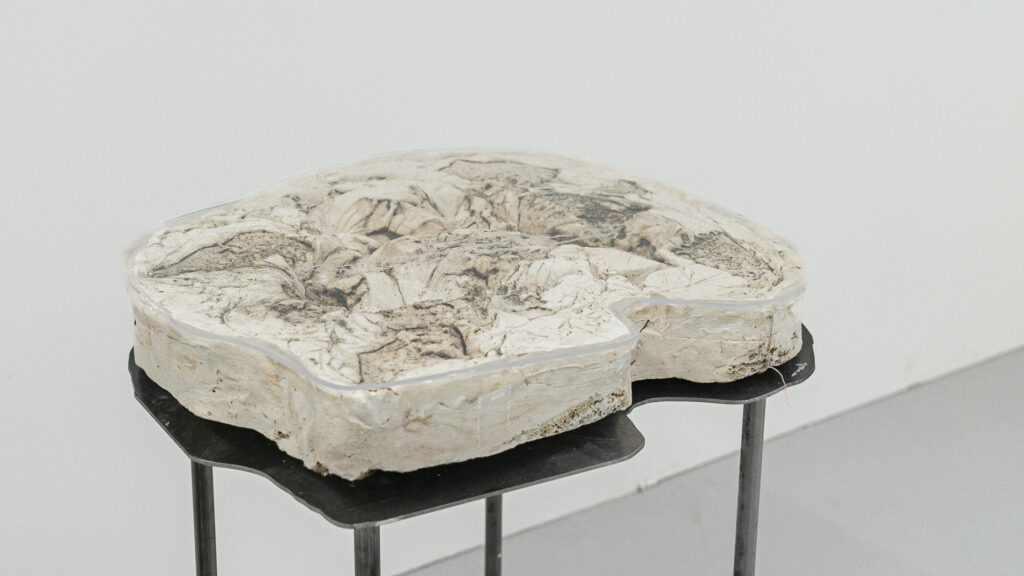
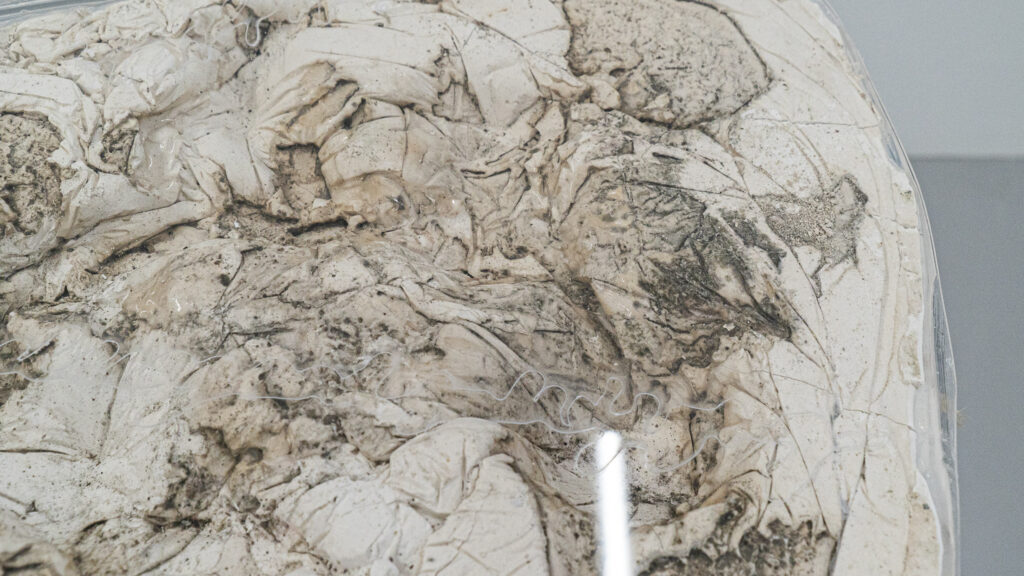
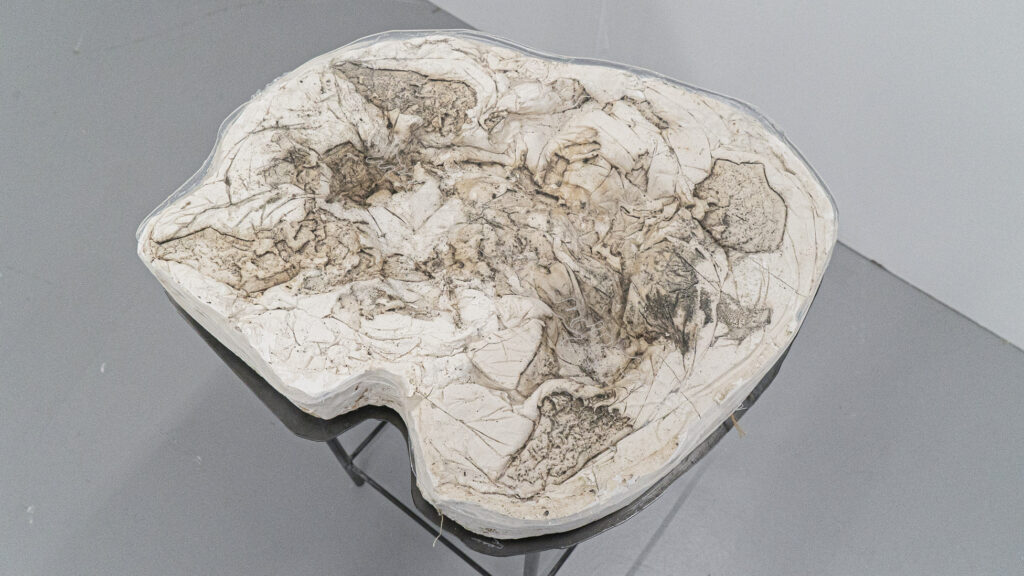
The World Before Saying series 1-3, 2026
plaster, steel, acrylic, gelatine, variable installation
The scene recorded on this plaster surface focuses on the force of contraction produced as wheat starch paste dries on plastic. During drying, the material pulls against the surface, sometimes deforming its support and generating a temporary sculptural force. Having repeatedly experienced the fragility and breakage of flour-paste sculptures, I understood this discovery as a moment in which a vulnerable material transformed into one capable of exerting force, changing both its properties and its meaning.
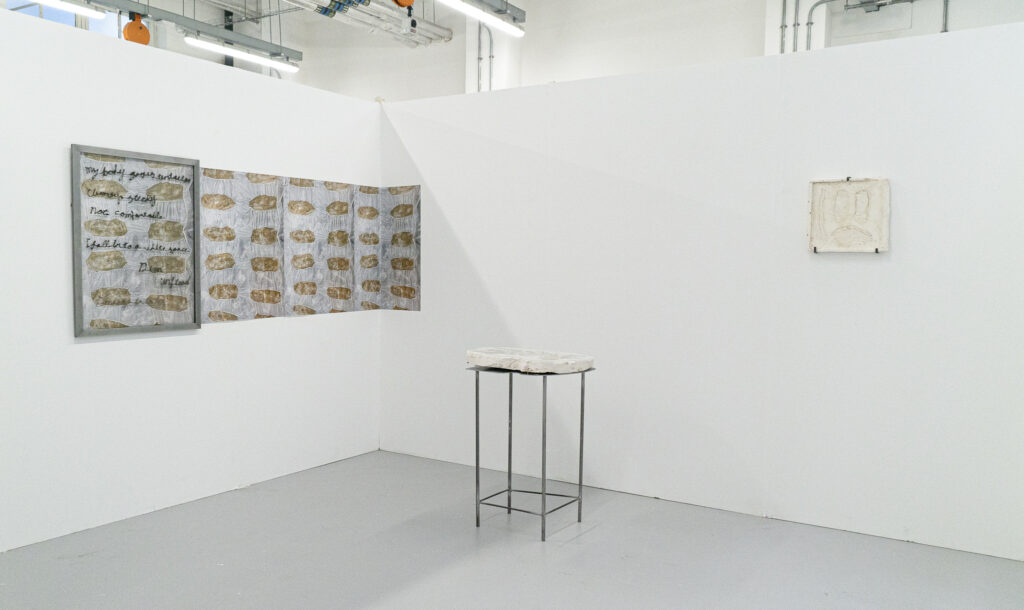
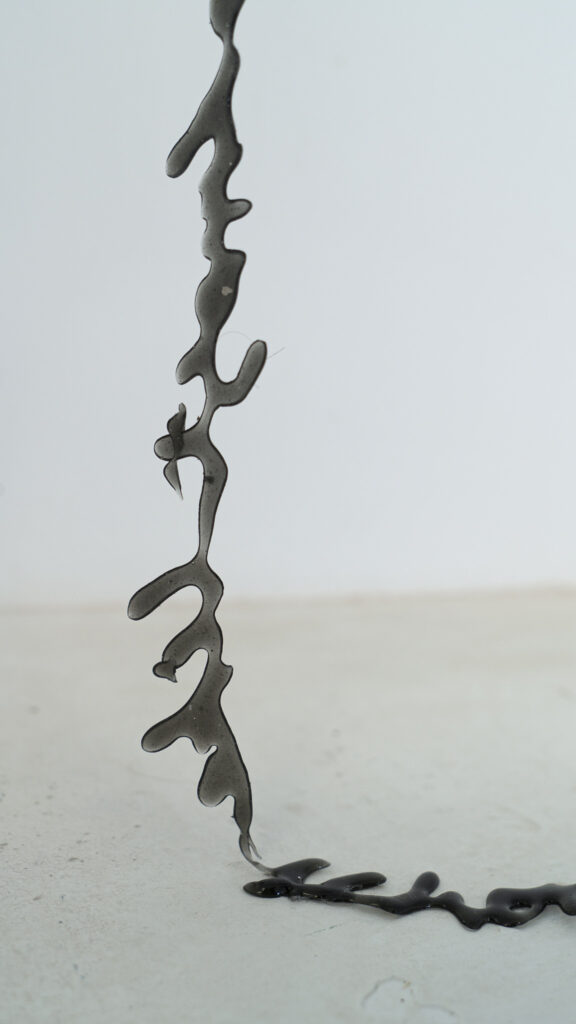
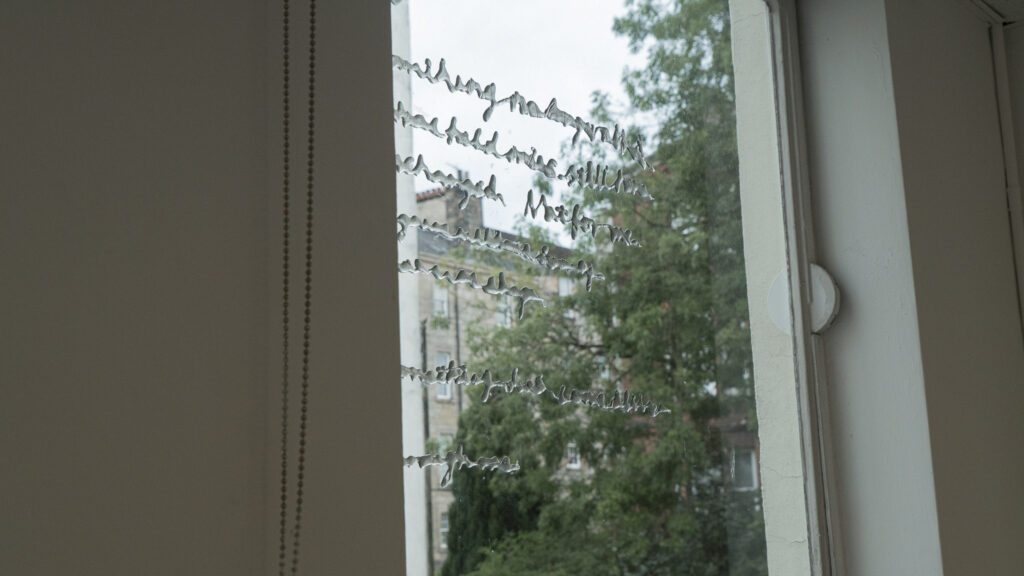
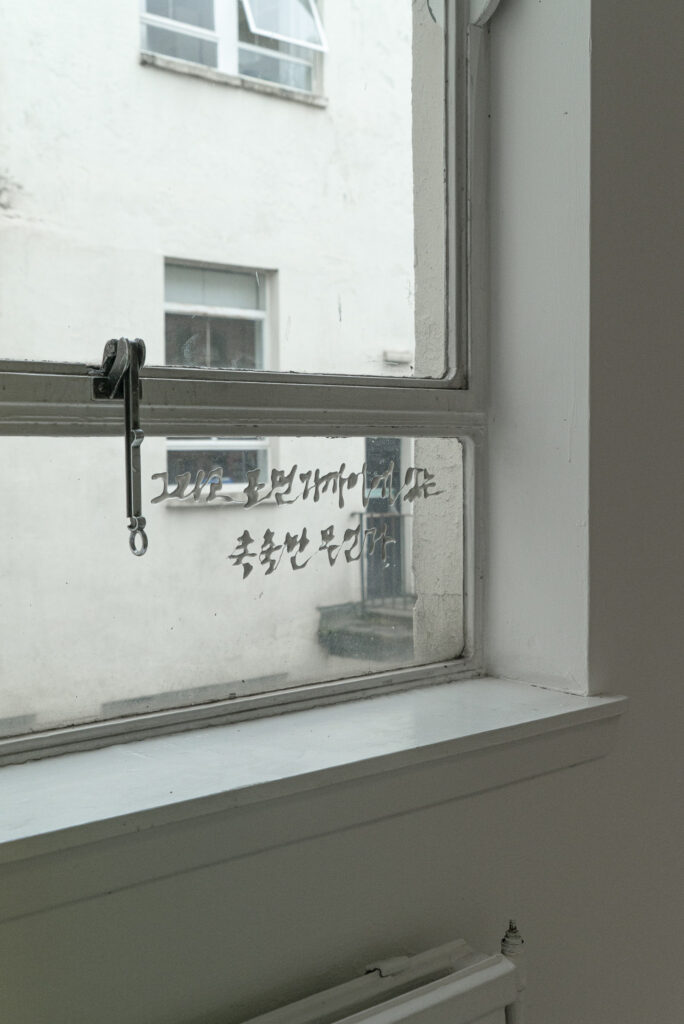
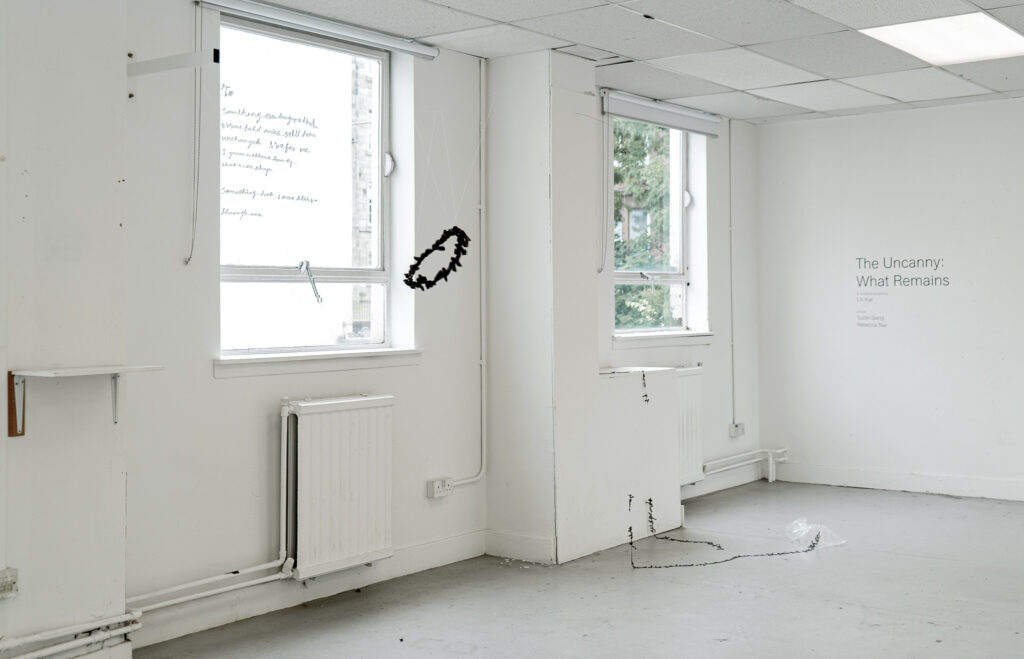
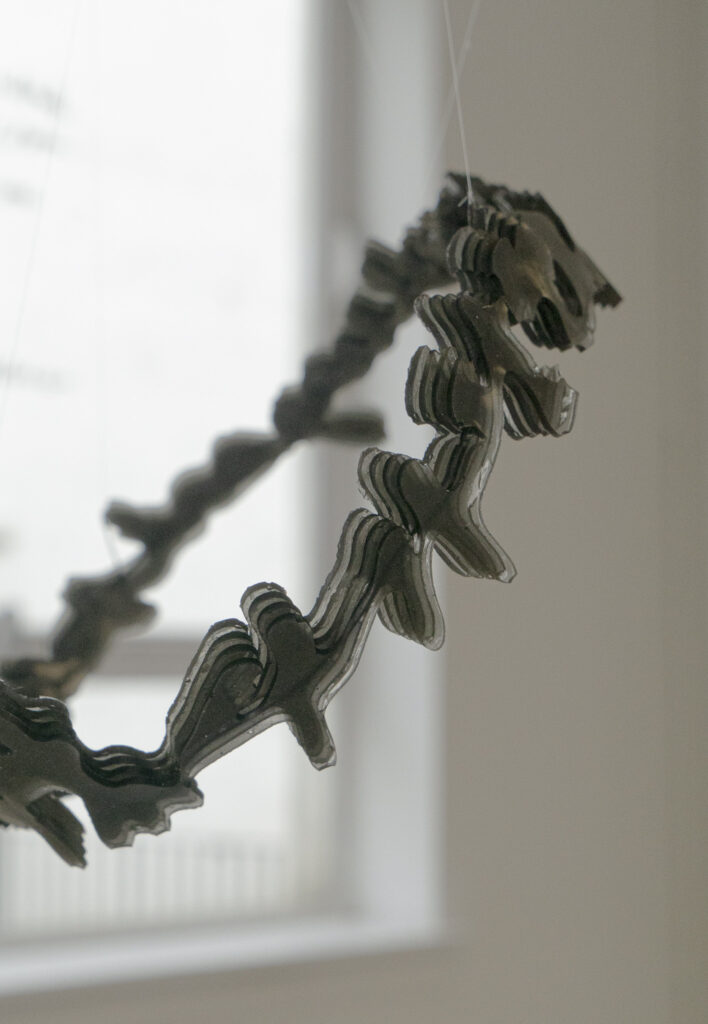
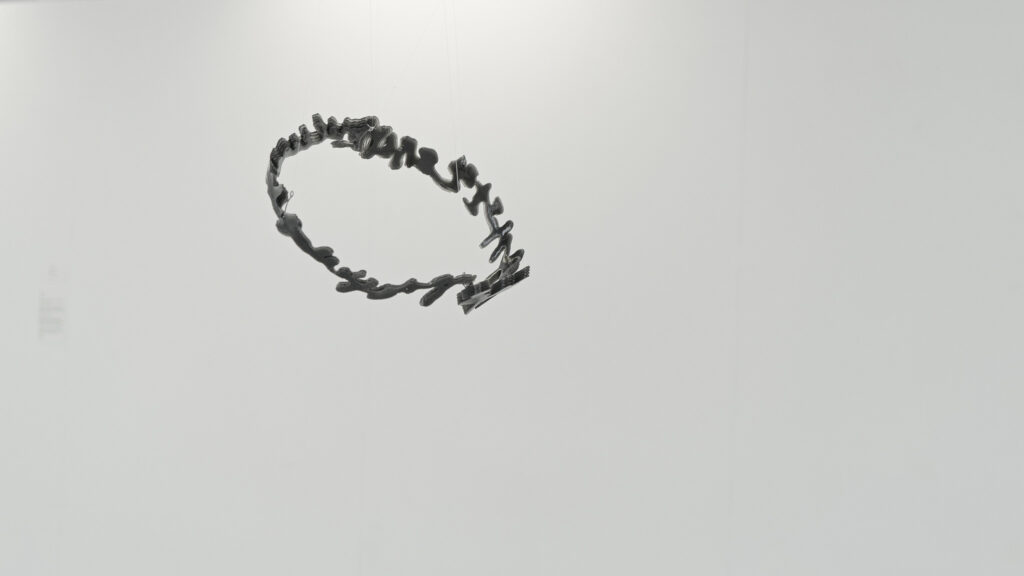
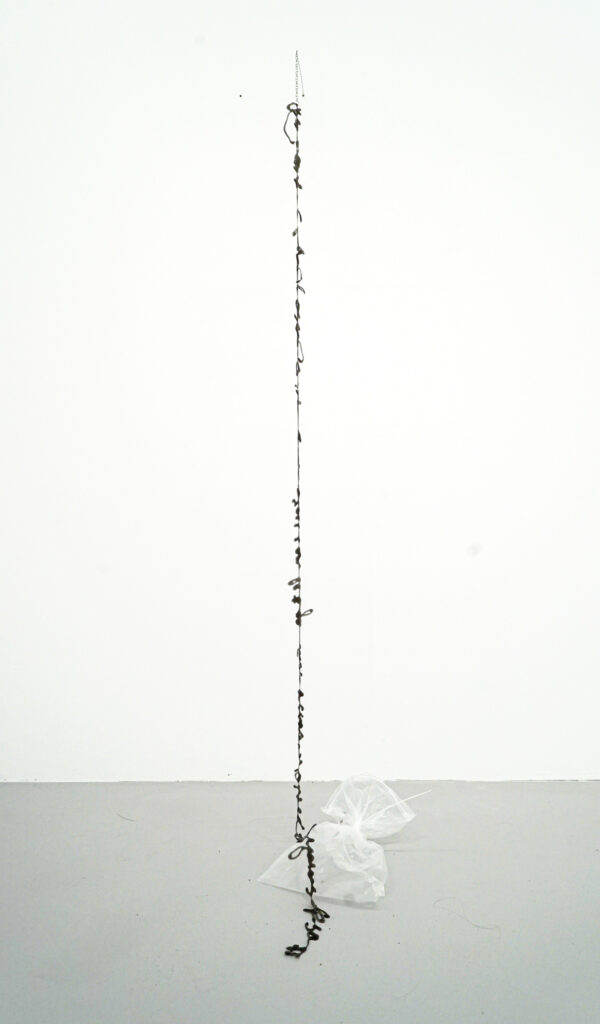
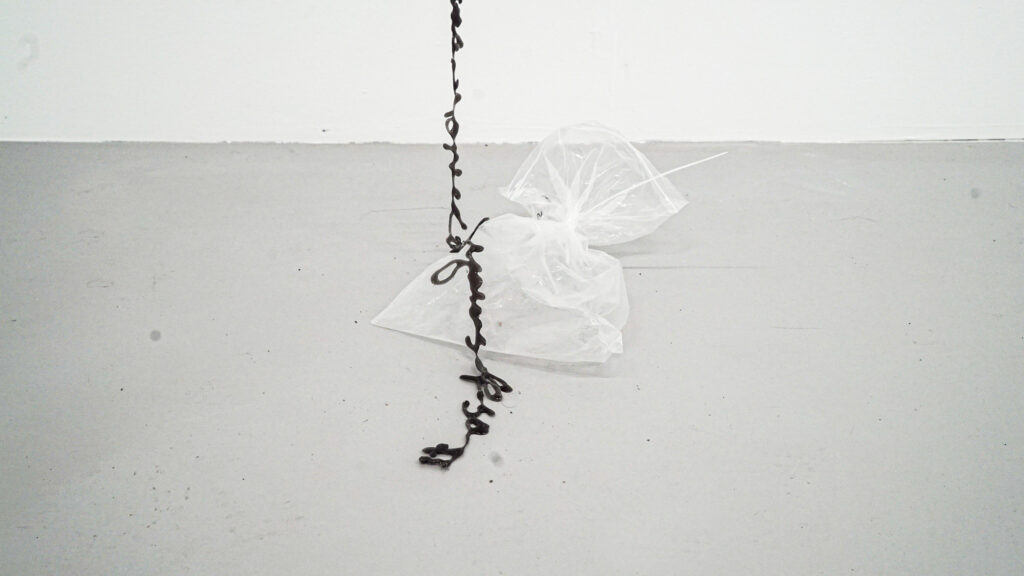
Swaying Poem series, 2026
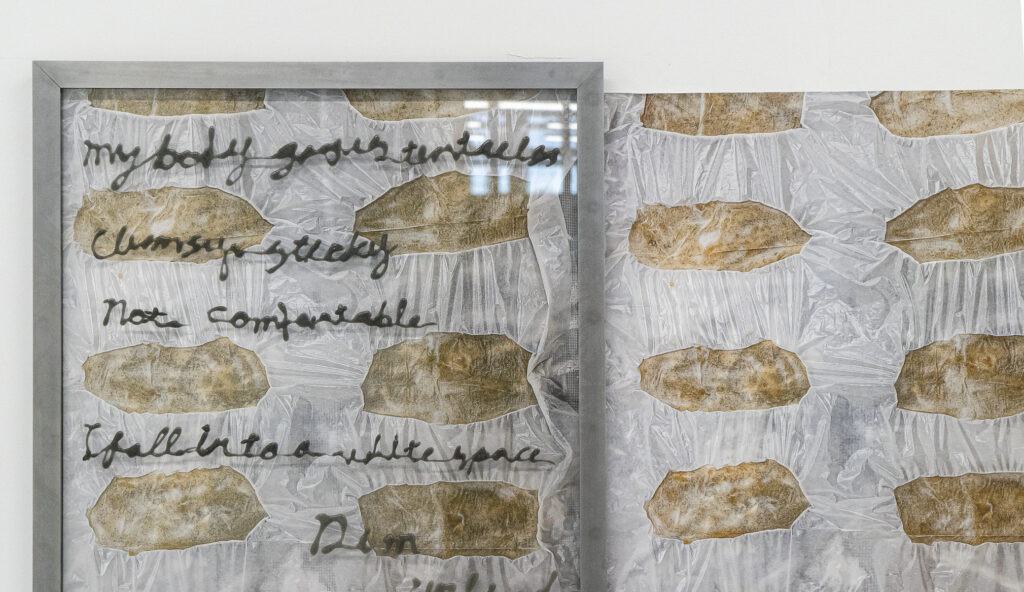
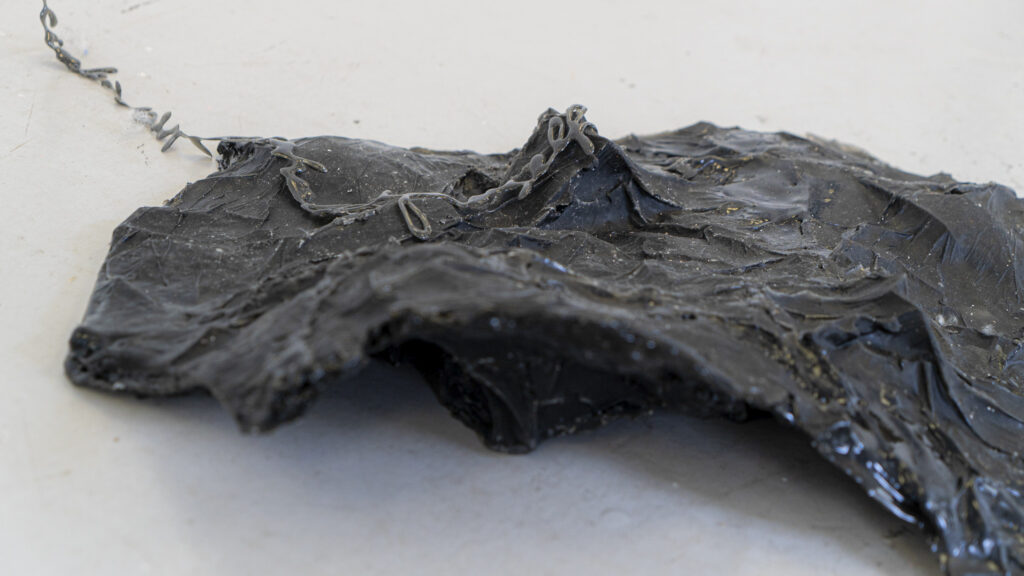
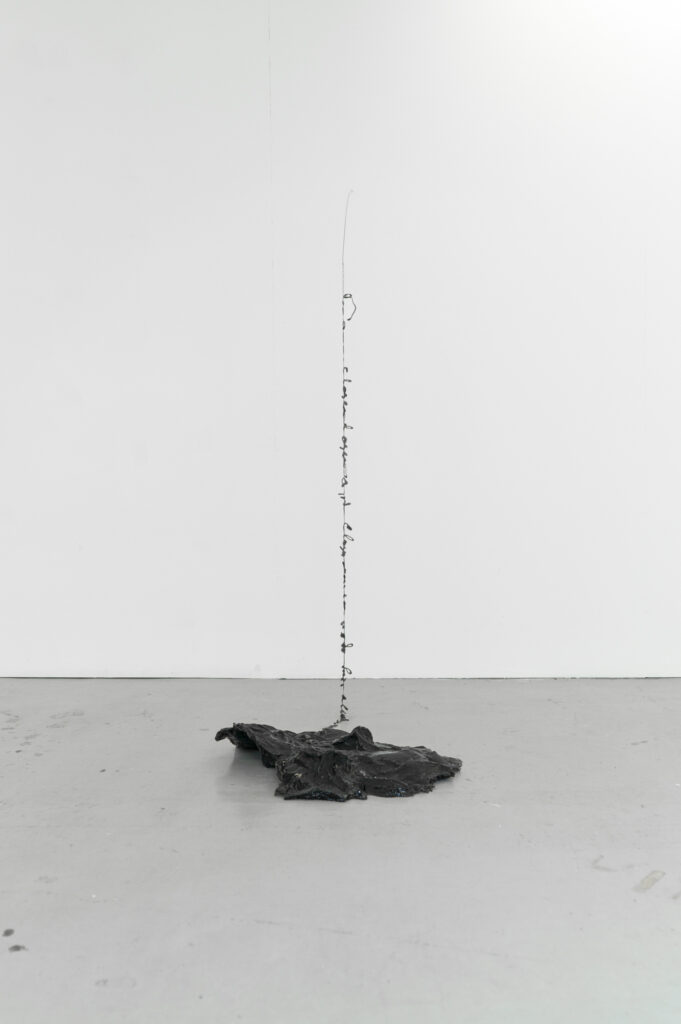
gelatine, stainless steel wire, plastic vinyl, variable installation
Swaying Poem series treats language not simply as a tool for conveying meaning, but as a material surface that sways and transforms in response to its surroundings. The poems are rendered in gelatine, a transparent and flexible material that responds to gravity, light, temperature, and humidity. Suspended in space, the letters remain partially legible while also blurring, folding, stretching, and changing shape. As a result, they may first be encountered as physical forms or material presences before they are read as language.
The work also emerges from a delay in the process of understanding the poem. As English is not Subin’s first language, its meaning is not immediately accessible. A second delay occurs through the ambiguity and indirect language of poetry itself. Produced through the conditions of collaboration, this double delay allows language to be encountered as something unfamiliar, temporarily detached from habitual meanings and assumptions.
In Swaying Poem, language occupies a shifting state between text, image, and sculpture. Rather than settling into a single, stable interpretation, the poem remains suspended: something that can be read, but also physically and spatially encountered.
All poems and texts © Lili Xue, unless otherwise stated.
The Uncanny: What Remains 📍 CPCA Studio, Level 2 Barnes Building The Glasgow School of Art 29 July – 1 August 28026 Open daily, 11:00–18:00 CURATED by Lily ARTISTS Subin Gang, Rebecca Rae Published on the occasion of the MLitt Curatorial Practice Degree Show The Glasgow School of Art WITH SUPPORT FROM MLitt Curatorial Practice (Contemporary Art) The Glasgow School of Art All poems and texts © Lili Xue unless otherwise stated. Artwork copyright remains with the respective artists.